Korea Association of Professional Engineers for Transportation: "Urban Rail is the Optimal Transportation Mode"
Need to Include "Seohaeanseon" in the 5th National Rail Network Construction Plan
Proposal to Form a "Council" for Triangular Cooperation among Gwangju, Jeonnam, and Jeonbuk
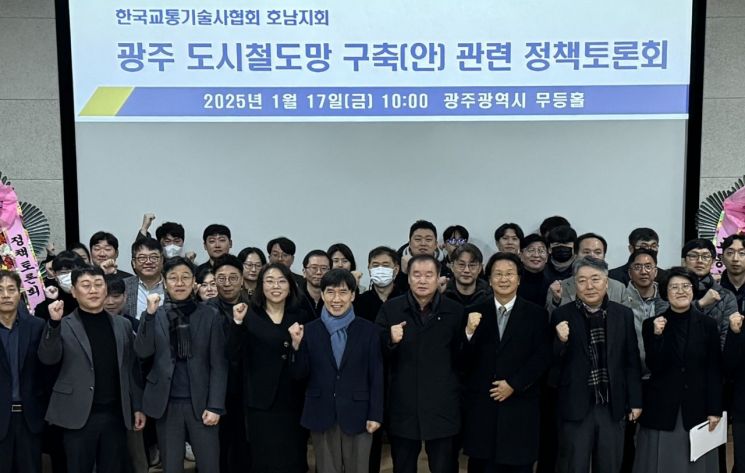 The Korea Transportation Engineers Association held a policy forum on the "Gwangju Urban Railway Network Construction Plan" on the 17th at Mudeung Hall, Gwangju City Hall, with about 70 participants including transportation experts and citizens. Provided by the Korea Transportation Engineers Association
The Korea Association of Professional Engineers for Transportation (President Lee Buwon) announced on the 18th that it held a policy forum on the Gwangju Urban Rail Network Construction Plan and the 5th National Rail Network Construction Plan at Mudeung Hall, Gwangju City Hall, on the 17th, with over 70 transportation experts and citizens in attendance.
At the policy forum, transportation engineers Lim Hyeyoung and Kim Hyeseon each gave presentations. The discussion was moderated by Professor Choi Dongho (Gwangju University) and featured active debate with participation from Lee Buwon, President of the Korea Association of Professional Engineers for Transportation, former Honam University Professor Lim Younggil, and engineers Kim Hyojong and Oh Jaechul from the Honam Branch of the Transportation Engineers Society.
Experts at the forum diagnosed that expanding the urban rail network, which is the backbone of public transportation, is essential for the creation of a Daejabo (eco-friendly transportation system centered on public transportation, bicycles, and pedestrian paths) city that Gwangju is pursuing. Most discussants agreed with Gwangju City's policy direction to solve transportation issues in areas with large transportation demand, such as the Gwangcheon district, by providing an urban rail network capable of punctuality, speed, and mass transit.
They also pointed out that, compared to other major metropolitan cities, Gwangju (with a line extension of 20.5 km) is at a very poor level when compared to Seoul Line 9 (327.1 km), Busan Line 4 (116.6 km), Daegu Line 3 (87.17 km), and Incheon Line 2 (59.4 km).
In addition, they noted that the number of lines currently under construction or planned is only one, which is far behind other cities, and assessed that reviewing new urban rail lines is very timely for the creation of a Daejabo city and for enhancing urban competitiveness.
The experts also called for local community interest in the "Seohaeanseon," a mainline railway connecting Gwangju, Jeonnam, and Jeonbuk, which is being pursued as part of the 5th National Rail Network Construction Plan by the Ministry of Land, Infrastructure and Transport. Although there are some differences of opinion regarding the routes for Gwangju and Jeonnam, they proposed forming a "council" to jointly respond and ensure that the optimal route, determined through triangular cooperation among Gwangju, Jeonnam, and Jeonbuk, is reflected in the 5th National Rail Network Construction Plan.
Lee Buwon, President of the Korea Association of Professional Engineers for Transportation, said, "This forum provided an opportunity to communicate with the region about the rail network construction plan, which is a major issue for Gwangju and the Honam area," and added, "We will continue to actively cooperate at the association level to improve the regional transportation environment and transportation welfare."
Meanwhile, the Korea Association of Professional Engineers for Transportation is an association formed mainly by experts who have obtained the highest national technical qualification, the Professional Engineer, and has been conducting various activities since its establishment in 1992 to foster transportation engineering personnel and advance the domestic transportation sector.
© The Asia Business Daily(www.asiae.co.kr). All rights reserved.
![Clutching a Stolen Dior Bag, Saying "I Hate Being Poor but Real"... The Grotesque Con of a "Human Knockoff" [Slate]](https://cwcontent.asiae.co.kr/asiaresize/183/2026021902243444107_1771435474.jpg)















