Local Court Issues Arrest and Search Warrants
Difficult to Secure Morales Due to Resistance from Supporters
A local court has issued an arrest warrant for Evo Morales (65), former president of Bolivia, who is accused of trafficking a 15-year-old girl for sexual purposes.
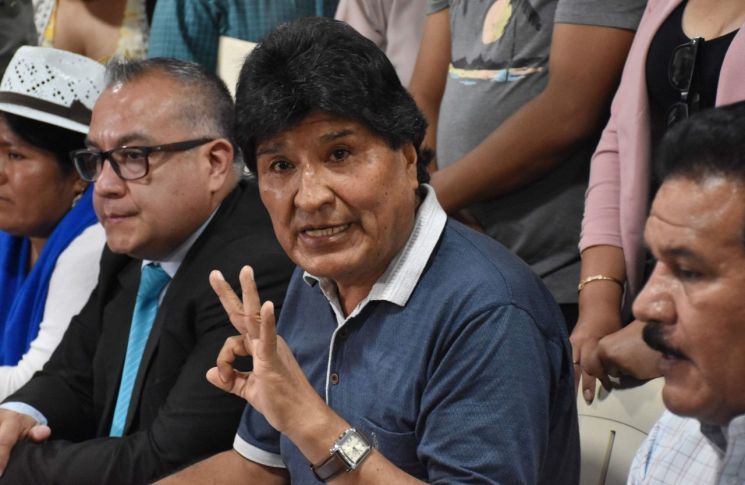 A Bolivian judge has issued an arrest warrant for Evo Morales (65), former president of Bolivia, on charges of human trafficking involving a 15-year-old girl for sexual purposes. Photo by AFP and Yonhap News.
Nelson Locavado, a judge at the Tarija District Court in Bolivia, issued an arrest and search warrant ex officio against former President Morales on the 17th (local time), who has continuously refused to appear for the prosecution's preventive detention order hearing, according to local daily El Deber and AP News. In addition, measures such as freezing the suspect's financial accounts and tracking asset flows were also taken. Although Morales' lawyer submitted a medical certificate, the court did not recognize it as a valid reason for absence.
Morales is under investigation for allegedly forcibly having sexual relations with a female adolescent who was 15 years old during his presidency (2006?2019), against her will.
The prosecution believes that the victim's parents sent their 15-year-old daughter in 2015 to a "youth organization" run by Morales, who was then president, to gain political advantage. The victim gave birth to a child the following year in 2016 and claimed that Morales was the biological father. However, Morales strongly denies these allegations, claiming they are political attacks by the current government to prevent his presidential candidacy. On his X (formerly Twitter), he stated, "Current President Luis Arce has engaged in a legal battle to hand me over to the United States as 'spoils,'" and added, "Like many leftist presidents in Latin America, crimes against me are being fabricated."
Earlier, the prosecution initiated procedures for the swift execution of the warrant, but securing Morales' custody has been difficult because the Cochabamba area where he resides is protected by coca (cocaine raw material) growers. Supporters frequently resist strongly through marches on foot and road blockades.
Morales, a coca farmer and the first indigenous president, became president in 2005. He won the presidential elections in 2009 and 2014 but failed to secure a fourth term in 2019 amid allegations of election fraud and went into exile abroad. He is currently showing strong intentions to run in the next presidential election and continues to rally supporters by organizing anti-government marches.
© The Asia Business Daily(www.asiae.co.kr). All rights reserved.

![User Who Sold Erroneously Deposited Bitcoins to Repay Debt and Fund Entertainment... What Did the Supreme Court Decide in 2021? [Legal Issue Check]](https://cwcontent.asiae.co.kr/asiaresize/183/2026020910431234020_1770601391.png)