43.1% of Office Workers Spent 9,000 to 10,000 KRW on Lunch Last Year
Share of Those Spending 12,000 to 13,000 KRW Also Increased
65.5% of Office Workers Say "Cafeterias Are an Essential Welfare Benefit"
Due to recent price increases, the burden of meal expenses has grown, with the average lunch cost for office workers rising to around 9,000 to 10,000 KRW last year. The importance of welfare benefits related to meal expenses is also increasing amid rising prices.
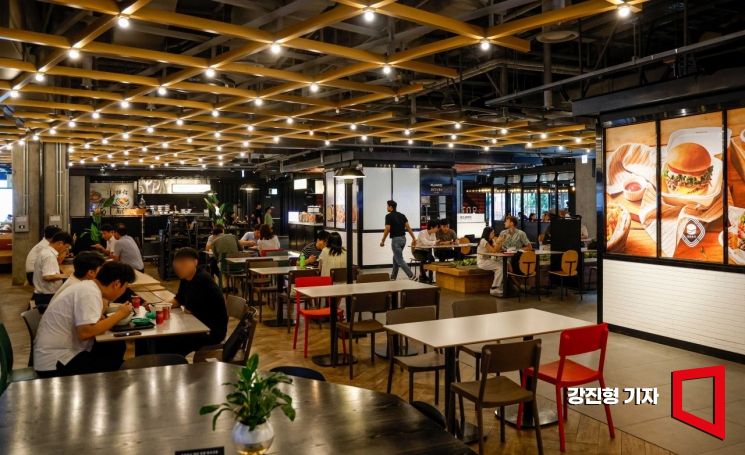
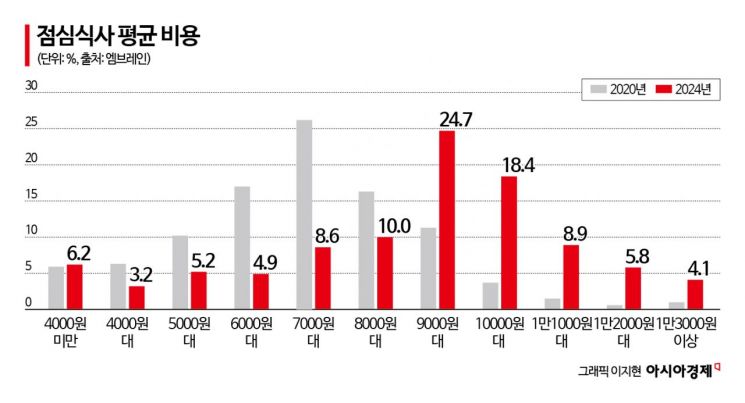
According to the '2024 Office Workers' Lunch and Cafeteria Awareness Survey' conducted on the 19th by market research firm Embrain, targeting 1,000 male and female office workers aged 19 to 59 nationwide, the average lunch cost for office workers last year was around 9,000 to 10,000 KRW.
The highest proportion of respondents, 24.7%, reported spending an average of 9,000 KRW per lunch last year. This figure more than doubled compared to the 11.3% who reported spending 9,000 KRW in the 2020 survey. Responses indicating spending in the 10,000 KRW range followed at 18.4%, showing that nearly half of respondents spent between 9,000 and 10,000 KRW on lunch.
Conversely, the proportion spending 7,000 KRW, which was the highest at 26.2% in 2020, dropped significantly to 8.6% last year, and the 6,000 KRW spending group also decreased from 17.0% to 4.9%. Meanwhile, those spending 12,000 KRW, which was only 0.6%, increased to 5.8%, and those spending over 13,000 KRW rose from 1.0% to 4.1%, confirming that the burden of lunch expenses on office workers is steadily increasing.
As the burden of lunch costs grows, more office workers are considering cafeterias as an essential welfare benefit. A significant majority of respondents evaluated cafeterias as an important system for employee welfare (76.7% agreement) and one of the essential welfare benefits (65.5%), indicating that cafeterias are regarded as a core element of the work environment. The perception that cafeteria quality directly affects employee happiness (76.4%) is also high, showing that cafeterias play a role in enhancing job satisfaction.
However, even if a company has a cafeteria, if the quality does not meet expectations, its effectiveness is likely to be greatly limited. The perception that a cafeteria without guaranteed quality is worse than none was high at 65.3%, and 62.4% responded that if the taste and quality of food are poor, there is no need to use the cafeteria. In other words, the quality of meals provided is a crucial factor determining office workers' satisfaction and welfare effects, more so than the mere presence of a cafeteria. Particularly, among respondents with a cafeteria at their workplace, satisfaction with taste (49.5%), menu variety (49.0%), and quality (45.5%) was relatively lower compared to quantity (61.6%), indicating that improving overall meal quality is essential to maximize the benefits of welfare programs.
Among those with a workplace cafeteria, the majority reported using it three or more times a week (29.9% three to four times a week, 41.2% almost daily). The main reasons for using the cafeteria were saving meal expenses (49.5%, multiple responses allowed), not having to go outside (45.0%), and saving lunch time (42.6%), highlighting the advantages of cafeterias in saving both money and time.
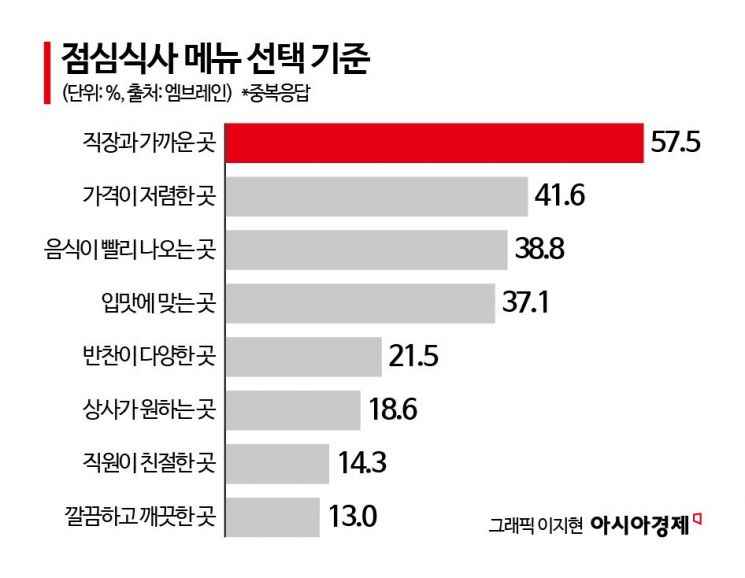
In fact, the top criteria for office workers when choosing lunch menus were proximity to the workplace at 57.5% (multiple responses allowed), followed by low price at 41.6%. Other popular preferences included places where food is served quickly (38.8%), places that suit their taste (37.1%), places with a variety of side dishes (21.5%), and places preferred by their supervisors (18.6%).
© The Asia Business Daily(www.asiae.co.kr). All rights reserved.
![Clutching a Stolen Dior Bag, Saying "I Hate Being Poor but Real"... The Grotesque Con of a "Human Knockoff" [Slate]](https://cwcontent.asiae.co.kr/asiaresize/183/2026021902243444107_1771435474.jpg)

















