All 164 Cases Last Year Met Permissible Standards
Safety of Locally Produced and Distributed Specialty and Seafood Products Confirmed
Busan Gijang-gun (Governor Jeong Jong-bok) announced on the 16th that the results of radioactivity analysis of environmental samples measured last year in living environments and food all met the permissible standards, reaffirming safety from radioactivity.
To actively respond to the Japanese government's discharge of contaminated water from Fukushima into the ocean, since June 2023, the county has been promoting a project to establish a continuous environmental radioactivity monitoring system by freely lending and installing radioactivity measuring devices at local schools and the Gijang Fisheries Cooperative auction site, utilizing its own radioisotope analyzer for radiation disaster preparedness.
Additionally, environmental radioactivity samples measured by individual institutions are cross-verified at least twice a month through the Radiation Science and Technology Research Institute at the National Pukyong National University to ensure expertise and objectivity in the measurement results.
Last year, the county focused on measuring tritium, radioactive cesium, and radioactive iodine isotopes in a total of 164 samples, including 71 cases of school meal ingredients from 7 schools, 9 cases of seafood from the Gijang Fisheries Cooperative auction, 24 cases of local specialties (such as miyeok, dashima, anchovies), and seawater collected from 3 coastal points totaling 60 samples.
The measurement results showed that tritium, radioactive cesium (Cs-134), and radioactive iodine (I-131) isotopes were all below the detection limit and thus not detected. In seawater samples, radioactive cesium (Cs-137) was detected in trace amounts (0.000104~0.00207 Bq/L), but this level is comparable to concentrations measured in global seawater (0.000794~0.00193 Bq/L) and is considered residual from nuclear weapons tests conducted by major powers in the past (1950s-60s).
Thus, it has been scientifically confirmed that there is no radioactivity impact on the local environment due to the discharge of contaminated water from the Fukushima nuclear accident in Japan.
Accordingly, the county plans to continuously accumulate objective data through ongoing radioactivity inspections of local environmental samples while actively promoting the safety of local agricultural and marine products both domestically and internationally, and responding proactively to fears, social issues, and consumption declines caused by radioactivity concerns.
In particular, starting this year, the county will strengthen radioactivity safety inspections by adding analysis of radioactive strontium (Sr-90), an anti-bone isotope, in seawater samples, increasing the number of schools participating in radioactivity inspections of school meal ingredients, and expanding the number of analyses to establish a more meticulous radioactivity safety system.
Jeong Jong-bok, Governor of Gijang-gun, emphasized, “Radioactivity inspections of specialty products and seafood produced and distributed in our region are the best way for producers, sellers, and consumers alike to completely eliminate vague anxieties about radioactivity.” He also said, “Since the safety of local specialties has been scientifically proven, I hope many citizens actively use seafood from the clean sea of Gijang.”
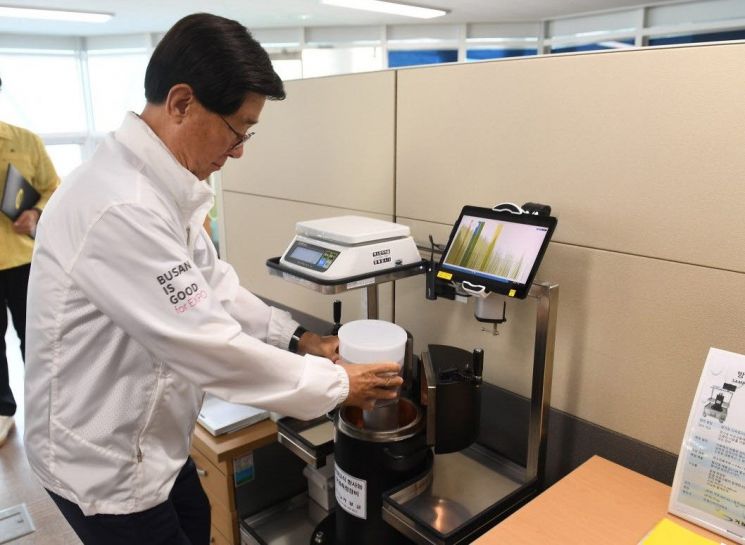 Jung Jong-bok, the mayor of Gijang County, is demonstrating radiation measurement equipment at the Gijang Fisheries Cooperative in July last year.
© The Asia Business Daily(www.asiae.co.kr). All rights reserved.
![Clutching a Stolen Dior Bag, Saying "I Hate Being Poor but Real"... The Grotesque Con of a "Human Knockoff" [Slate]](https://cwcontent.asiae.co.kr/asiaresize/183/2026021902243444107_1771435474.jpg)















