Burden of Three Consecutive Rate Cuts Amid High Exchange Rate
Possibility of Base Rate Cut Next Month Due to Economic Slowdown
Lee Chang-yong: "Supplementary Budget Should Be Prepared as Soon as Possible"
The Bank of Korea has kept the base interest rate steady at 3.00% per annum. Although concerns over economic slowdown had grown enough to warrant two consecutive rate cuts earlier, the rate was maintained this month. This decision reflects worries that further rate cuts could push the already high won-dollar exchange rate even higher. There is a prevailing expectation that the Bank of Korea may lower the base rate again next month to revive the sluggish domestic economy.
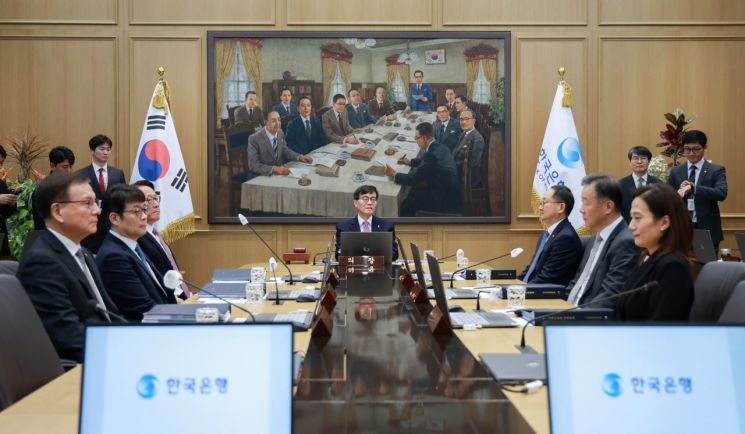
The Monetary Policy Board (MPB) of the Bank of Korea announced on the morning of the 16th at the Bank’s headquarters in Jung-gu, Seoul, during the first monetary policy meeting of the year, that it would keep the base interest rate at the current level of 3.00%. Among the six board members excluding Governor Lee Chang-yong, five voted to maintain the rate, while board member Shin Sung-hwan submitted a minority opinion advocating a 0.25 percentage point cut. Regarding the forward guidance on interest rates beyond three months, all six board members agreed that the possibility of a rate cut should remain open.
The MPB had lowered the base rate by 0.25 percentage points at its previous meeting held on November 28 last year. Including the consideration of a cut in October, the rate was reduced twice consecutively before returning to a hold this time.
The consensus among the board members appears to be that the rate cuts could further elevate the exchange rate, which had surged due to the martial law incident. Having cut rates twice in a row, the board decided to hold the rate for now, monitor the domestic economic situation, and discuss additional cuts at the next meeting.
Governor Lee said at a press briefing held that morning, "Although only one member submitted a minority opinion for a rate cut, there were more diverse opinions than the 5-to-1 vote ratio suggests. From an economic standpoint, lowering the rate now would be natural, but interest rates affect not only the economy but also various other factors, so those impacts must be considered together."
He continued, "Political changes are having a significant impact on the exchange rate, and the current level of the exchange rate is much higher than what can be explained by Korea’s economic fundamentals or the interest rate gap with the United States. We judged that it would be more prudent and desirable to pause after seeing the effects of the two rate cuts and assess the situation before making further decisions," explaining the rationale behind holding the rate.
Regarding the recent rise in the exchange rate to a high level, he explained, "Before the martial law, the rate rose from 1,400 won to the 1,470 won range. Of this increase, about 50 won was due to the global trend of a strong dollar, and about 20 won was due to political reasons. However, considering the dollar hedging volume of the National Pension Service and the market stabilization effects of the foreign exchange authorities, the increase attributable to the martial law incident is estimated to be about 30 won."
He added, "If the exchange rate rises to the 1,470 won level, the consumer price inflation rate, previously forecasted at 1.9%, would increase by about 0.15 percentage points to 2.05%."
On why all board members kept the possibility of a rate cut open beyond three months, he said, "Because the domestic economy is performing worse than expected, it was considered appropriate to respond to the economy with a rate cut after confirming short-term domestic political uncertainties and changes in external economic conditions."
Bank of Korea Likely to Cut Rates Next Month... Lee Chang-yong: "Supplementary Budget Should Be Prepared as Soon as Possible"
The Bank of Korea is expected to lower the base interest rate again next month to revive the sluggish domestic economy. Major domestic and international research institutions forecast that Korea’s economic growth rate this year will fall significantly below the potential growth rate of 2.0%. The average forecast from eight major global investment banks (IBs), including Goldman Sachs and JP Morgan, is only 1.7%. The Bank of Korea’s own forecast is 1.9%, and it may lower this figure further in next month’s economic outlook. Forecasting institutions commonly warn that Korea’s low growth could become entrenched due to export slowdown and weak domestic demand.
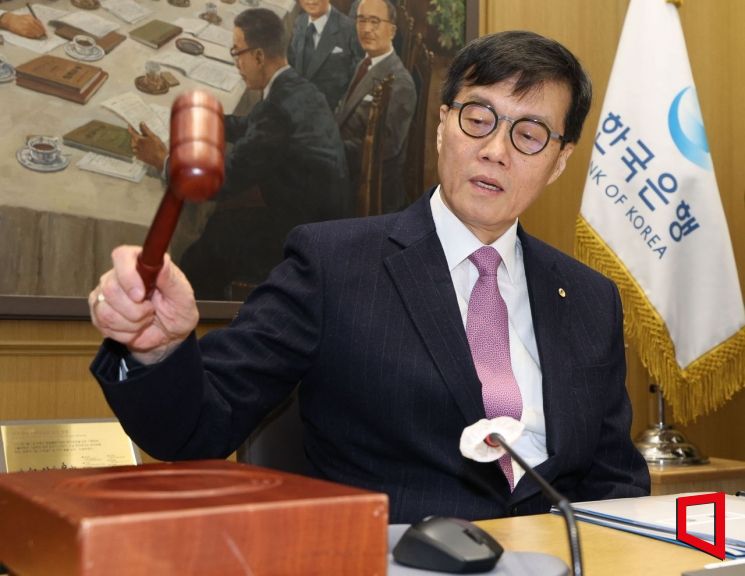 Lee Chang-yong, Governor of the Bank of Korea, is striking the gavel at the Monetary Policy Committee plenary meeting held at the Bank of Korea in Jung-gu, Seoul, on the morning of the 16th. 2025.01.16 Photo by Joint Press Corps
Governor Lee said, "The fourth quarter of last year was affected by the martial law incident, causing consumption and domestic demand indicators to fall more than expected. Recently, there has been internal discussion within the Bank of Korea that the economic growth rate for the fourth quarter of last year could be 0.2% lower than previously estimated."
He urged the government to prepare a supplementary budget (chugyeong) as soon as possible. Governor Lee said, "Unlike before, monetary policy variables now affect other variables such as the exchange rate, so it is not desirable to stimulate the economy solely through monetary policy. Since the growth rate is below the potential growth rate, supplementary measures are necessary to compensate, and an amount of about 15 to 20 trillion won would be appropriate."
He added, "(The supplementary budget) is a temporary measure to respond to the economy, so it is necessary to support targeted groups such as self-employed individuals rather than providing indiscriminate aid."
Meanwhile, Governor Lee claimed that his recent supportive remarks about Choi Sang-mok, the acting Deputy Prime Minister and Minister of Strategy and Finance, were economic rather than political messages. He said, "To stabilize the economy, the most important message was not about how much to lower interest rates but something more fundamental. As someone responsible for the economy, I could not avoid making that statement."
Regarding the execution of an arrest warrant for President Yoon Seok-youl, who is accused of being the ringleader of the martial law incident, Governor Lee positively evaluated the situation, saying, "Following yesterday’s incident, our economic processes will normalize again, and problems will be resolved in the usual order as in the past."
Governor Lee emphasized the need to demonstrate externally that the Korean economy is functioning normally through a tripartite consultative body involving the ruling party, opposition parties, and the government. He said, "Even if political issues are difficult to resolve, efforts must continue to expedite consultations among the ruling party, opposition parties, and the government so that economic issues can proceed quickly. It is necessary to separate politics and the economy into two tracks and show that economic policies are progressing swiftly."
© The Asia Business Daily(www.asiae.co.kr). All rights reserved.
![Clutching a Stolen Dior Bag, Saying "I Hate Being Poor but Real"... The Grotesque Con of a "Human Knockoff" [Slate]](https://cwcontent.asiae.co.kr/asiaresize/183/2026021902243444107_1771435474.jpg)
















