The fields of bio, artificial intelligence (AI), and advanced robotics will be newly included in the priority examination targets for patents. When priority examination is applied, the examination processing period will be drastically reduced, enabling rapid acquisition of patent rights. It is expected that the priority processing of domestic patent applications will also accelerate the acquisition of global patent rights.
On the 16th, the Korean Intellectual Property Office (KIPO) announced the "2025 Patent Examination Processing Plan" containing these details. The core of the patent examination plan is to include the bio, AI, and advanced robotics fields in the priority examination targets starting from the 19th of next month. Through this, the patent examination processing period, which previously took an average of more than 18 months, is expected to be shortened to within 2 months at most.
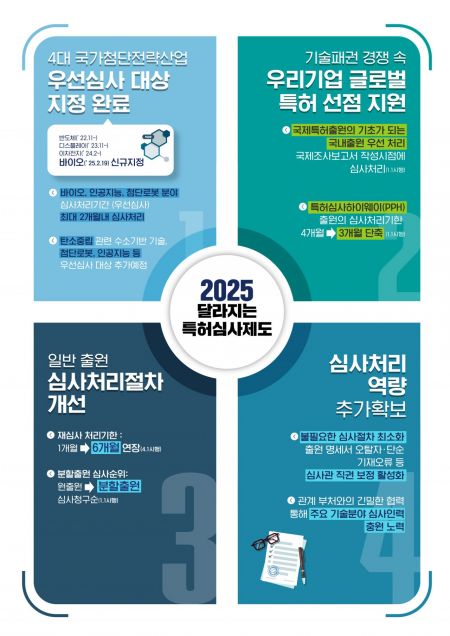
Previously, KIPO sequentially included semiconductors (November 2022), displays (November 2023), and secondary batteries (February 2024) in the priority examination targets.
Once bio is included in the priority examination targets next month, all four major national advanced strategic industries (semiconductors, displays, secondary batteries, and bio) will receive priority examination. Additionally, KIPO plans to add hydrogen-based technologies directly related to carbon neutrality to the priority examination targets.
The purpose of expanding the priority examination targets is to support early rights acquisition of advanced technologies by domestic companies and rapid patent acquisition in major foreign countries. The intention is to help patents quickly secured domestically lead to overseas market entry and enhanced competitiveness for companies.
For example, the average processing period for priority examination in the semiconductor and display fields was 1.6 months (as of the end of December last year), which is 12.1 months shorter than the average examination processing period of 13.7 months without priority examination. This verifies the effectiveness of priority examination.
To this end, KIPO has increased examination personnel in advanced industry fields in cooperation with related ministries: 67 for semiconductors (2023?2024), 38 for secondary batteries (2024). This year, an additional 60 private experts will be hired as patent examiners, including 35 for bio, 9 for AI, and 16 for advanced robotics.
The examination processing procedures to support international patent acquisition will also be improved. For example, the processing period for Patent Prosecution Highway (PPH) applications will be shortened from 4 months to 3 months. This strategy is linked with the PPH improvement policies currently being promoted by the United States and Japan, aiming to reduce the patent acquisition period for domestic companies entering these countries.
The processing period for reexamination, which can be requested instead of an appeal after a patent rejection decision, has been extended from 1 month to 6 months (effective April this year) to expand general examination processing. Changing the examination order of divisional applications is another notable change.
The change in the examination order of divisional applications means improving the existing method, which prioritized divisional applications based on the order of examination requests for the original application (the first application before division). Going forward, divisional applications will be examined according to the order of their own examination requests, aligning with major countries such as the United States and Japan.
Ultimately, KIPO's strategy is to ensure that domestic companies do not face difficulties in securing global technological leadership through multifaceted support such as expanding priority examination targets, increasing examination personnel, and supporting international patent acquisition.
Jung Yeon-woo, Director of the Patent Examination Planning Bureau at KIPO, said, "Rapid acquisition of patent rights is directly linked not only to the survival of companies but also to the national economy. KIPO will continue efforts to ensure that high-quality examinations are conducted based on rapid examinations to support the dynamism of the national economy and industrial development."
© The Asia Business Daily(www.asiae.co.kr). All rights reserved.
![Clutching a Stolen Dior Bag, Saying "I Hate Being Poor but Real"... The Grotesque Con of a "Human Knockoff" [Slate]](https://cwcontent.asiae.co.kr/asiaresize/183/2026021902243444107_1771435474.jpg)















