As the election to choose the new head (首長) of the lawyers' association approaches on the 20th, attention is focused on what percentage of voter turnout will be recorded in this election, where the term of the Bar Association president has been extended from 2 years to 3 years, expanding their role and authority. Some predict that the voter turnout could be a variable that determines the outcome.
Lowest turnout in history after abolishing electronic voting
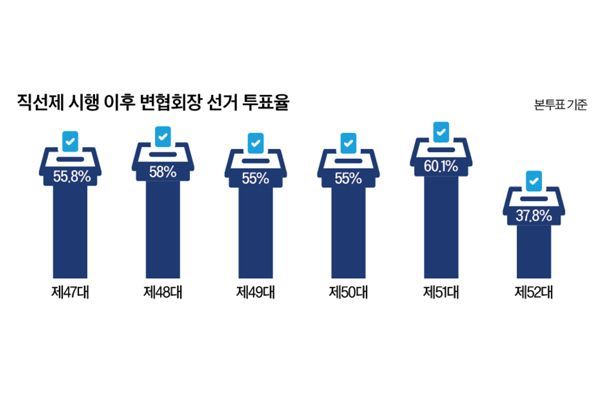
In the 52nd Korean Bar Association (KBA) presidential election held in January 2023, the voter turnout was 37.8%, the lowest in history. At that time, the legal community cited the cause of the record low turnout as a decline in interest in association affairs due to the downturn in the legal industry and the difficulty of going to polling stations during weekday working hours.
Since the introduction of the direct election system in the 47th election in 2013, most elections have shown a turnout rate of 55-58%.
In the 51st election held in 2021, when electronic voting was implemented, the turnout reached as high as 60.1%. That election introduced the Central Election Management Committee’s ‘k-voting’ system, enabling the first-ever paperless online voting. Voters who had previously expressed their intention to participate in electronic voting via mobile or PC received a notification text and a connection link (URL) from the Central Election Management Committee at the start of the election to cast their votes. Despite being held amid ongoing social distancing measures due to the COVID-19 pandemic, the election recorded the highest turnout ever through electronic voting.
However, from the 52nd election in 2023, electronic voting was not used, and the election reverted to the previous method, resulting in the lowest turnout since the introduction of direct elections at 37.8%. Out of 27,289 eligible voters nationwide, 10,324 participated (including 181 invalid votes and 6 abstentions).
Vote margin was not large in the last election
In this election, there are voices urging many lawyers to vote to elect a leader who can overcome the difficulties facing the legal industry. However, concerns coexist that the turnout may be similarly low as in the last election, which was held after the abolition of electronic voting. This election, the first since the elimination of the runoff vote, is expected by some to see voter turnout play a significant role in the final result.
A lawyer in Seocho-dong said, “The legal industry has become even more difficult than two years ago, so the future of the legal profession could change depending on the capabilities of the elected association president,” adding, “I plan to vote with a desperate heart.”
On the other hand, another lawyer said, “Although the Bar Association president’s authority has increased, the industry is becoming more difficult, so it’s uncertain how many lawyers will take an interest in the association’s affairs,” and added, “Expectations for the association head are gradually decreasing, so the turnout might even be lower.”
One lawyer said, “Although the last election recorded a low turnout, the vote margin between candidates was not large,” and concluded, “Ultimately, I think voter turnout is related to the outcome.” He added, “The lower the turnout, the stronger the cohesion around a particular candidate might be, which could be reflected in the results, whereas a higher turnout could produce the opposite outcome.”
Han Suhyun, Legal Times Reporter
※This article is based on content supplied by Law Times.
© The Asia Business Daily(www.asiae.co.kr). All rights reserved.
![Clutching a Stolen Dior Bag, Saying "I Hate Being Poor but Real"... The Grotesque Con of a "Human Knockoff" [Slate]](https://cwcontent.asiae.co.kr/asiaresize/183/2026021902243444107_1771435474.jpg)















