Effectively Bans Chinese Cars from Entering the U.S. Market
Automakers Must Remove Chinese Autonomous Driving Code
Regulations Could Be Reversed Under Trump Administration
The U.S. government finalized regulations on connected cars using Chinese and Russian technology immediately after CES 2025, the world's largest consumer electronics and IT exhibition where autonomous vehicles have rapidly emerged. Chinese automakers will also be banned from testing autonomous vehicles in the U.S. With this move, Chinese cars and trucks are expected to be pushed out of the U.S. market, and automakers such as Hyundai are likely to have to remove major Chinese-made software from vehicles sold in the U.S.
On the 14th (local time), the U.S. Department of Commerce unveiled the final rule to gradually ban the sale of connected cars that use Chinese or Russian software or components for autonomous driving or communication functions. The software ban will apply starting with 2027 model year vehicles, and the hardware ban will apply from 2030 model year vehicles. The Department of Commerce also prohibited Chinese automakers from testing autonomous vehicles on U.S. roads. U.S. media pointed out that this is expected to affect Chinese companies with autonomous driving test permits in California, such as Apollo Autonomous Driving, WeRid, and Pony AI.
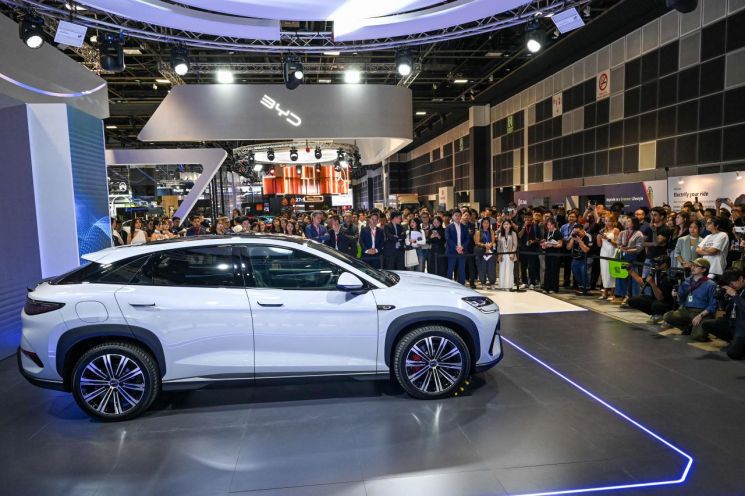 On the 9th (local time), a vehicle from Chinese electric car manufacturer BYD is exhibited at the Singapore Motor Show. Photo by AFP Yonhap News
Connected vehicles exchange information wirelessly with their surroundings and provide functions such as navigation, autonomous driving, and driver assistance systems. In fact, it is safe to say that there are virtually no new cars without at least some of these features.
U.S. Secretary of Commerce Gina Raimondo emphasized the urgency of this measure, stating, "It is too late to regulate after more than 2 million Chinese cars have been operating in the U.S." The White House also stressed the necessity of this action, saying, "Connected cars are designed to provide convenience to consumers and enhance the safety of drivers, passengers, and pedestrians, but foreign hostile actors can intervene, posing a significant threat to most cars on the road." The White House also expressed hope that this will help the U.S. defend against Chinese cyber espionage and intrusion operations.
The Department of Commerce clearly specified that the autonomous driving system (Automated Driving System, ADS) regulations apply only to software, not hardware. Hardware regulations for sensors such as LiDAR, which had been raised by some, were not included. Components such as cameras, satellite navigation systems (GNSS), and radio-related parts are also considered hardware.
The Department of Commerce explained that excluding hardware regulations was a decision to limit the impact on supply chains and the economy. This can be linked to the fact that U.S. autonomous driving company Waymo is developing autonomous driving based on LiDAR sensors. Automakers such as GM, Toyota, and Hyundai also requested the Department of Commerce to delay hardware regulations by at least one year immediately after the draft announcement in early September. The Consumer Technology Association (CTA), the organizer of CES, also advocated for a two-year delay in implementation.
However, the Department of Commerce clarified that ADS software using even some Chinese or Russian source code will be subject to regulation. Software supplied before the enforcement of this measure is exempt from regulation.
This measure is expected to make it difficult for Chinese-made vehicles to enter the U.S. market. Although Russian-made vehicles are also subject to regulation, it is clear that the measure targets China, which is expanding globally with electric vehicles.
The regulation applies to vehicles weighing 10,000 lb (approximately 4.5 tons) or less, but commercial vehicles exceeding 10,000 lb will also be regulated in the future. BYD, which is currently assembling electric buses in the U.S., will be able to continue operations for the time being. However, variables remain. Major foreign media have predicted that the next administration under Donald Trump, which emphasizes domestic automobile production, might make different decisions.
© The Asia Business Daily(www.asiae.co.kr). All rights reserved.
![Clutching a Stolen Dior Bag, Saying "I Hate Being Poor but Real"... The Grotesque Con of a "Human Knockoff" [Slate]](https://cwcontent.asiae.co.kr/asiaresize/183/2026021902243444107_1771435474.jpg)















