Large-Scale Deployment of Drones on New Amphibious Assault Ship
Concerns Over Setbacks in U.S.-Taiwan 'Hellscape' Strategy
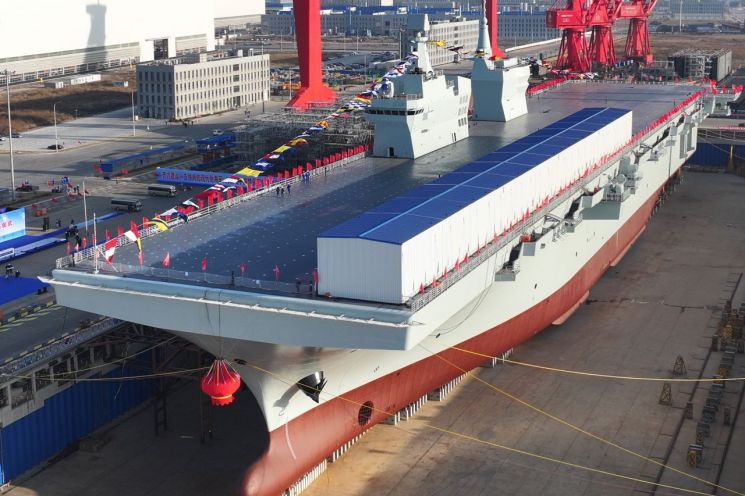 The Type 076 amphibious assault ship Sichuan, launched on the 27th of last month in Shanghai, China. It is called a 'drone aircraft carrier' due to the large deployment of attack unmanned aerial vehicles (drones). Photo by Xinhua and Yonhap News.
China has officially launched a so-called 'drone aircraft carrier' capable of carrying a large number of attack unmanned aerial vehicles (drones), escalating military tensions around the Taiwan Strait. Through the drone carrier, China is expected to fully implement the 'Anaconda strategy' by deploying large-scale drone squadrons in the event of an emergency to dominate air superiority and isolate the Taiwanese mainland.
The United States and Taiwan are planning a 'hellscape' strategy to counter this by using advanced drones to prevent the Chinese military's invasion of the Taiwan Strait. Although the drone technology itself is superior in the U.S., which holds a technical edge, it is anticipated that it will be difficult to counter the overwhelming quantity of Chinese drones.
New amphibious assault ship equipped with drones... Official recognition of 'drone aircraft carrier'
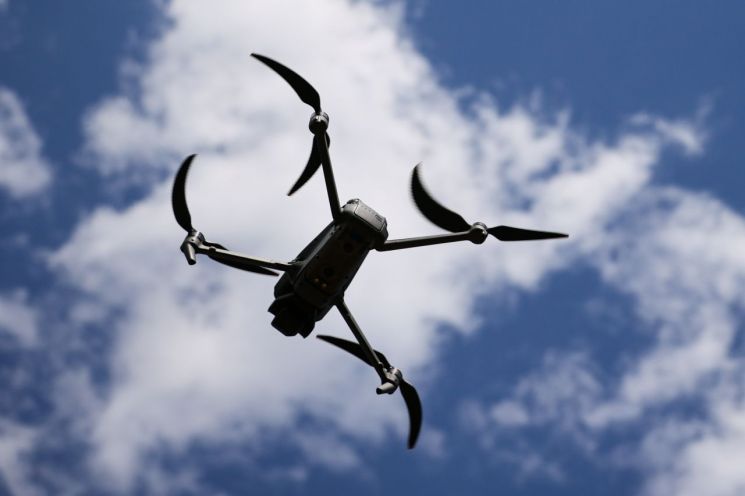 A Chinese-made unmanned aerial vehicle (drone) modified and used by Russian forces on the eastern Luhansk front in Ukraine. Photo by TASS and Yonhap News.
Commander Ci Genjun of the Nanchang, a Type 055 destroyer of the Chinese People's Liberation Army Navy, stated in an interview with China Central Television (CCTV) that "the role of drones and attack robots on the battlefield is increasing," and that "the newly built Type 076 and existing Type 075 amphibious assault ships are all involved and will continue to be so." This is an official acknowledgment that the Type 076 amphibious assault ship, launched last month, will serve as a drone aircraft carrier.
Generally, amphibious assault ships are smaller than the main aircraft carriers of various countries and have flight decks capable of helicopter, reconnaissance aircraft, and small aircraft takeoffs and landings, often referred to as light aircraft carriers. The Chinese military is loading these amphibious assault ships with various drones, stealth unmanned combat aircraft, and combat robots capable of reconnaissance missions in large numbers.
In particular, the main reason for deploying a large number of drones on these vessels is interpreted as a strategy to prepare for conflicts in the Taiwan Strait. The Hong Kong South China Morning Post (SCMP) analyzed that "the Type 076 amphibious assault ship will play a key role in all conflicts occurring in the Taiwan Strait," and that "it will enhance operational range, attack intensity, and landing speed."
China's Anaconda Strategy VS U.S. Hellscape Strategy... Comparing Drone Numbers
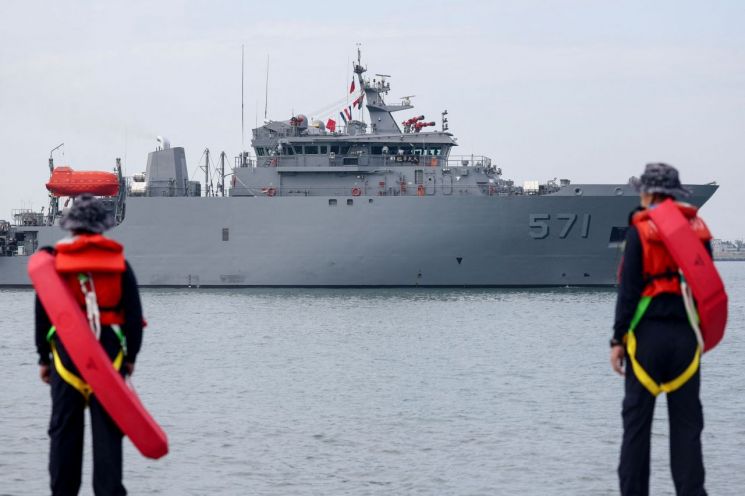 On the 9th (local time), the Taiwan Navy conducting training around the Kaohsiung Naval Base in Taiwan. Photo by AFP and Yonhap News.
China is planning the Anaconda strategy in the event of an emergency in the Taiwan Strait by simultaneously moving a large number of drones to the frontline area to dominate air superiority and completely encircle and strangle the Taiwanese mainland.
The Anaconda strategy is a term first officially coined during the American Civil War, referring to the tactic of blockading the entire land and sea border areas of enemy territory without direct engagement, paralyzing logistics movement and causing strangulation. It is named after the hunting method of the giant anaconda snake, which coils around its prey to suffocate it.
The United States and Taiwan are planning the hellscape strategy to overwhelm Chinese warships attempting to cross the Taiwan Strait with large-scale drones. The core idea is to establish a first line of defense that harshly responds with thousands of aerial drones and unmanned surface and underwater vessels, creating a hellish scene.
Accordingly, since October last year, the U.S. government has pledged to deliver over 1,000 military drones to Taiwan over two years. However, some assessments suggest that at least several thousand drones are needed to counter Chinese drones, making 1,000 units grossly insufficient. China dominates over 75% of the global drone production market, and the sheer volume of drones it possesses is enormous, making it difficult for the U.S. and Taiwan to respond effectively in an emergency.
As of last year, the number of civilian drones registered with China's Civil Aviation Administration was 1,875,000 units, more than twice the 790,000 registered with the U.S. Federal Aviation Administration (FAA). CNN estimated that the number of military drones China possesses could be in the millions.
© The Asia Business Daily(www.asiae.co.kr). All rights reserved.
![Clutching a Stolen Dior Bag, Saying "I Hate Being Poor but Real"... The Grotesque Con of a "Human Knockoff" [Slate]](https://cwcontent.asiae.co.kr/asiaresize/183/2026021902243444107_1771435474.jpg)


















