KCCI and Office for Government Policy Coordination Improve Eight On-site Regulations
Countermeasures Prepared in Just Two Months of Review
"Factory Expansion Burden Charge Eased"
Investment Obstacles for Sohari Future Vehicle Projects Resolved
Firefighter Access Window Standards for High-rise Buildings Relaxed
Automotive Over-the-Air (OTA) Updates Also Legalized
The issue of the 'expansion and reconstruction burden charge,' which has been an obstacle to investment at Kia Autoland Gwangmyeong (formerly Sohari) plant for the past 54 years, will be resolved. Additionally, the installation standards for firefighter access windows in high-rise buildings will be rationally improved, and automotive over-the-air (OTA) update services will be legalized through regulatory revisions.
The Korea Chamber of Commerce and Industry (KCCI) announced on the 15th the achievements in resolving on-site regulatory difficulties, which it has been promoting together with the Office for Government Policy Coordination. KCCI explained that out of the 'Top 10 On-site Regulations Selected by the Public' proposed last October, eight tasks were accepted, and the Office for Government Policy Coordination officially responded with follow-up action schedules for each task.
The 'Top 10 On-site Regulations Selected by the Public' refers to ten improvement tasks selected from those identified through KCCI’s Regulation and Difficulty Reporting Center, which received strong consensus on the need for improvement from the public and business stakeholders. The Regulation and Investment Difficulty Reporting Center, operated by KCCI, is a joint public-private channel for reporting on-site regulatory and investment difficulties. It continuously receives reports on regulatory and investment difficulties through seven regional centers nationwide (Seoul, Busan, Daegu, Incheon, Gwangju, Daejeon, Ulsan) and supports resolving on-site difficulties in cooperation with the Office for Government Policy Coordination and the Ministry of Trade, Industry and Energy.
The corporate activity-hindering regulations to be improved this time include easing the preservation burden charge when expanding or reconstructing factories designated as greenbelt areas after completion, and rationalizing the installation standards for firefighter access windows in high-rise buildings.
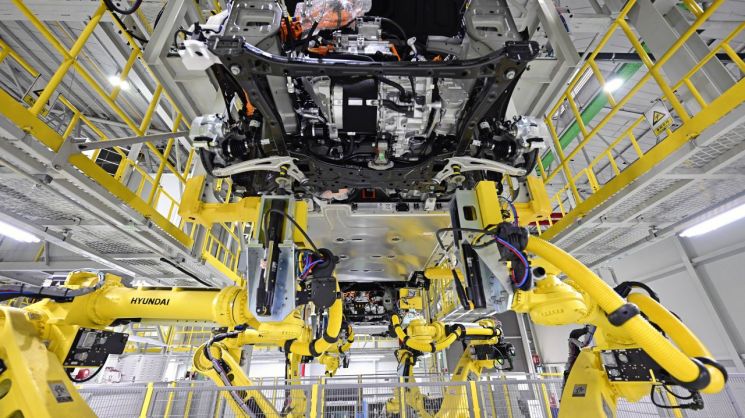
In particular, the burden charge issue for expansion and reconstruction at Kia Autoland Gwangmyeong (formerly Sohari) plant will be resolved. Regarding this, requests for burden charge reductions have been made several times to improve factory aging and promote the transition to electric vehicle processes. As a result, the Office for Government Policy Coordination has prepared an alternative to change the land category of the factory from "site" to "factory site," resolving the burden charge issue that has been an obstacle to investment for the past 54 years. When the land category is changed, the burden charge is reduced to about one-sixth, which is expected to contribute to securing future industrial competitiveness and revitalizing the local economy.
The installation standards for firefighter access windows in high-rise buildings will also be improved. Previously, although firefighters could access up to about 40 meters via fire ladders, the installation of firefighter access windows was mandatory on every floor up to the 11th floor regardless of building height. In the case of semiconductor factories, where one floor height is about 8 meters?much higher than general buildings (2.8 to 3 meters)?there were criticisms that the mandatory installation of firefighter access windows was ineffective. Accordingly, a dual standard of '11 floors or less, or 44 meters or less' will be introduced.
Automotive over-the-air (OTA) update services will also be legalized through regulatory revisions. OTA is a service that updates automotive electronic control unit software wirelessly, which was previously only possible at repair shops. Since receiving temporary approval through KCCI’s Sandbox Support Center in June 2020, OTA has become widespread alongside the spread of electric vehicles, but the legal basis has been unclear due to the lack of regulatory revisions for over four years. The government plans to complete the revision of the Enforcement Rules of the Automobile Management Act within the first half of this year.
In addition, regulatory improvements that hinder corporate activities will be promoted, such as allowing parking lot installation in production management areas, deleting 'domestic hiring performance' from the evaluation criteria for foreign worker employment permits, and permitting food consumption in low-risk laboratories. The cost of installing gas ranges in specific gas-use facilities such as senior centers and daycare centers, which was up to five times more expensive than in general households, will be reduced to the level of general households, and regulatory improvements such as allowing dual labeling of legal and non-legal units on electronic scales will also be made.
Meanwhile, KCCI announced that through the Regulation and Investment Difficulty Reporting Center, it received 362 on-site difficulty reports over the past year (January to December 2024) and supported the resolution of 104 difficulties.
According to the center, the most frequently reported area for on-site difficulty improvement last year was management difficulties (43.6%), followed by new industries (14.9%), environment (13.5%), location (11.0%), labor (7.2%), taxation (5.0%), and investment (4.7%). The resolved on-site difficulties were in the order of management difficulties (39.4%), new industries (18.3%), environment (16.3%), and location (10.6%).
Kang Seok-gu, head of the KCCI Research Headquarters, said, "Regulatory improvement is an important task not only for the convenience of companies but also to promote the revitalization of the national economy and job creation. Since continuous and uninterrupted regulatory improvement is crucial, we will strengthen the linked operation of the KCCI Regulation Difficulty Reporting Center and the Office for Government Policy Coordination’s Regulatory Reform Petition Office to resolve regulatory and investment difficulties at corporate sites."
© The Asia Business Daily(www.asiae.co.kr). All rights reserved.

















