Meeting with Reporters at the Steel Industry New Year's Gathering on the 14th
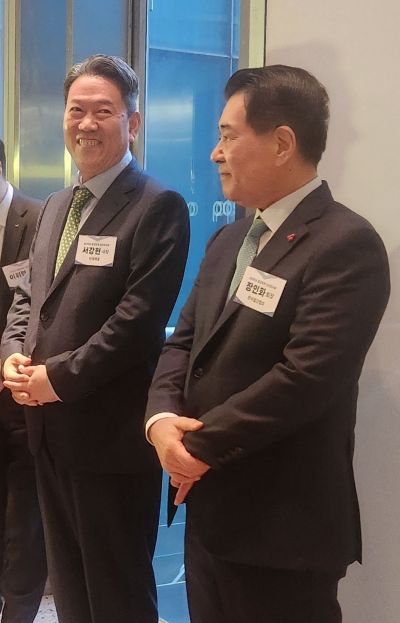 Jang In-hwa, Chairman of POSCO Group (right), and Seo Kang-hyun, President of Hyundai Steel, are exchanging greetings at the New Year's meeting held on the 14th at the POSCO Center in Gangnam-gu, Seoul. Photo by Jung Dong-hoon
Jang In-hwa, chairman of POSCO Group, emphasized that the steel industry must unite to respond to the oversupply of Chinese products.
On the 14th, Chairman Jang met with reporters at the 'Steel Industry New Year's Meeting' held at POSCO Center in Gangnam-gu, Seoul, and said, "Korean steel is one of the major exporters, but (this year) export barriers worldwide will become very high," adding, "Since domestic demand in China is not recovering, China will push out products, and (our steel industry) will face various difficulties."
Recently, steelmakers such as POSCO and Hyundai Steel have argued that anti-dumping tariffs should be imposed to protect the domestic steel industry. On the other hand, steelmakers who import and process Chinese steel believe that imposing tariffs only strengthens the monopoly of steelmakers owning blast furnaces and is unrelated to industrial competitiveness. Chairman Jang's remarks appear to take these conflicting interests into account.
He also viewed this year as a year to prepare for eco-friendly regulations such as the 'carbon border tax.' The carbon border tax is a tariff imposed on products produced or imported from countries with higher carbon dioxide emissions than the home country, and it is a tariff form actively promoted by the U.S. Biden administration and the European Union (EU).
Chairman Jang said, "Starting next year, the carbon border tax system will be implemented, making this year a year when (such eco-friendly regulations) become a reality," emphasizing, "For this, above all else, the domestic steel industry must unite to solve the problem." He added, "In the short term, interests may differ, but in the long term, the steel industry must move together to survive."
Regarding major powers' 'steel anti-dumping' regulations, he said, "We need to sit down and discuss the specifics," adding, "Concrete plans probably won't come out until the end of this year."
In his New Year's address at the meeting, Chairman Jang said, "This year, difficult conditions such as shrinking steel demand, increased uncertainty in the trade environment, and the transition to a low-carbon economy are expected to continue," adding, "The steel industry must actively respond to the rapidly changing trade environment through cooperation between the government and industry and focus on securing technological competitiveness to achieve carbon neutrality."
At the event, Seo Kang-hyun, president of Hyundai Steel, responded to a reporter's question about plans to build a factory in the U.S. by saying, "Under review," and regarding the location or scale of the factory, he said, "Nothing has been decided." When asked how to cope with the difficult market environment, he said, "We will first adjust production according to order volume."
The steel industry New Year's meeting was held for the first time in five years since 2020. About 200 key figures from the steel industry attended, including Ahn Deok-geun, Minister of Trade, Industry and Energy; Jang In-hwa, chairman of the Korea Iron & Steel Association; Seo Kang-hyun, president of Hyundai Steel; and Lee Hwi-ryeong, vice chairman of SeAH Steel.
© The Asia Business Daily(www.asiae.co.kr). All rights reserved.

















