Difficult to Respond to Invisible Danger
Road Heating Cables Discussed, but Cost Remains an Issue
On the morning of the 14th, a chain collision involving 44 vehicles, including trucks, buses, and passenger cars, occurred near Gusan IC on Jayuro in Ilsanseo-gu, Goyang-si, Gyeonggi-do, heading towards Paju. As a result of the accident, drivers sustained minor abrasions, and one driver of a 16-ton cargo truck was slightly injured and transported to the hospital.
On the same day, multi-vehicle collisions also occurred near Goyang Junction on the Seoul-Munsan Expressway in Goyang-si and near Heungdo IC behind Goyang Rest Area, involving 43 and 18 vehicles respectively. In total, about 130 vehicles were involved in collisions across Gyeonggi-do that day, with 19 people reported injured. Police and fire authorities suspect that 'black ice' formed due to overnight snowfall and freezing temperatures was the cause of the accidents.
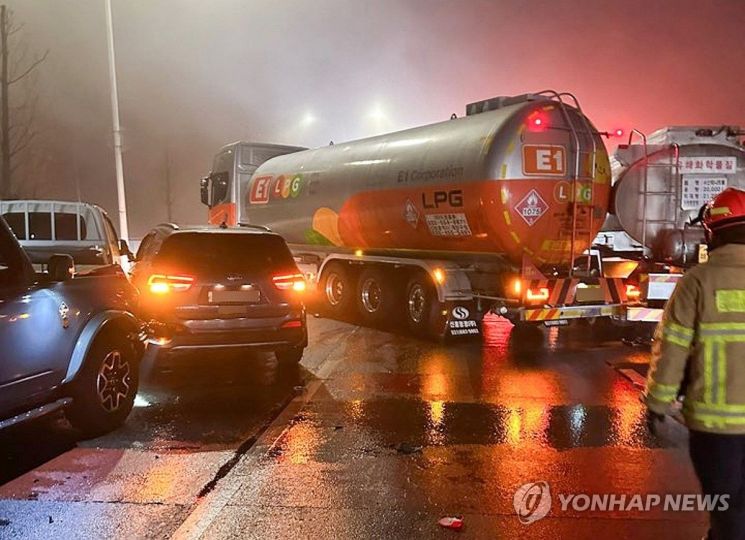 At around 5:15 a.m. on the 14th, a chain collision involving 44 vehicles occurred near Gusan IC on Jayuro in Ilsanseo-gu, Goyang-si, Gyeonggi Province, heading towards Paju. Trucks, buses, and passenger cars were entangled. Photo by Yonhap News
Black ice, often called the 'assassin on the road' because it is difficult to detect visually, continues to cause accidents. Despite various government-level proposals to improve road surface conditions, progress has been slow due to budget constraints and other issues.
According to the Korea Road Traffic Authority's Traffic Accident Analysis System, over the past five years (2019?2023), there have been a total of 3,466 traffic accidents caused by frost and ice formation, averaging 693 incidents annually. The number of fatalities and injuries resulting from these accidents reached 427 and 33,251 respectively.
Black ice refers to ice formed when snow or calcium chloride melts and seeps into small cracks on the asphalt surface. Unlike ice that appears white and is visible to drivers, black ice is transparent and therefore invisible. Unlike other accidents, defensive driving measures such as driving at low speeds and keeping eyes on the road are less effective in preventing black ice accidents. Professor Choi Jaewon of the Korea Road Traffic Authority explained, "Maintaining a safe distance and driving slowly at entrances or curves can help prevent accidents to some extent, but black ice is fundamentally hard to see, which is problematic. If a driver panics after suddenly slipping on black ice and slams on the brakes, causing the vehicle to spin sharply, it can worsen the accident."
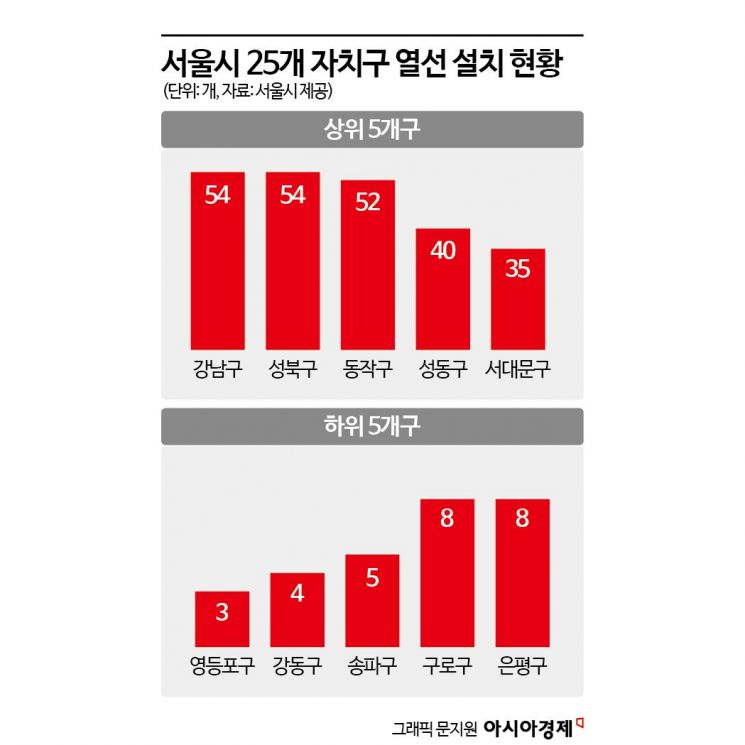
The government has issued various measures to warn drivers and improve road surface conditions, but progress remains slow due to budget issues. The most effective solution is considered to be installing heating cables 7 to 10 cm beneath the road surface to melt snow and maintain the road temperature above freezing. However, installation and maintenance costs are substantial, causing local governments to hesitate in implementing them, and there is significant disparity in installation status. According to the 'Heating Cable Installation Status in 25 Districts' provided by Seoul City, a total of 549 roads in Seoul have heating cables installed, but these are concentrated in Gangnam-gu and Seongbuk-gu (54 roads each), Dongjak-gu (52 roads), and Seongdong-gu (40 roads).
The cost of installing road heating cables is about 100 million KRW per 100 meters, with maintenance costs around 3 million KRW per 100 meters. Considering that the maintenance cost of commonly used brine spraying devices is about 300,000 KRW per 100 meters, heating cables are roughly ten times more expensive. A Seoul city official stated, "Installation costs for heating cables are high, and since they operate using electricity, maintenance costs are also significant. Maintenance expenses must be covered by district finances, so districts with relatively low financial independence may have lower installation rates." A representative from Gangbuk-gu, Seoul, said, "Even if heating cable installation is covered by special grants, the electricity costs required for operation must be fully funded by the national government, so some districts lack the capacity to install them."
Experts predict that black ice accidents will become more frequent in the future and emphasize the importance of related countermeasures. Professor Kim Pilsoo of Daelim University's Department of Automotive Engineering advised, "As black ice accidents are expected to increase due to climate change, government-level attention is necessary. It is important to expand road heating cables in critical sections and, using big data, identify areas where black ice frequently occurs to install warning signs that alert drivers before entering these zones."
© The Asia Business Daily(www.asiae.co.kr). All rights reserved.


















