Named as the Emergency Martial Law Special Prosecutor Act
"Internal Rebellion and Foreign Exchange Special Prosecutor Act Presumes Guilt"
Urges the Corruption Investigation Office for High-ranking Officials to Suspend Investigation as Special Prosecutor Intention Has Been Expressed
On the 14th, the People Power Party announced that it would propose its own 'Emergency Martial Law Special Prosecutor Act' to replace the internal rebellion and foreign exchange special prosecutor law passed under the leadership of the Democratic Party in the National Assembly's Legislation and Judiciary Committee.
Kwon Seong-dong, the floor leader of the People Power Party, held a press briefing related to current issues at the National Assembly at 2:30 p.m. on the same day and announced the results of discussions on their own emergency martial law special prosecutor law. The People Power Party held a party meeting the previous afternoon and discussed the draft special prosecutor law for over three hours but did not decide on whether to propose it, leaving the decision to the leadership.
Kwon explained the purpose of proposing their own special prosecutor law by stating that the Democratic Party-led internal rebellion and foreign exchange special prosecutor law is "a bad law with too many unconstitutional and toxic provisions" and emphasized that "the passage of an all-powerful special prosecutor law must be prevented at all costs."
Main contents of the special prosecutor law to be proposed by the People Power Party
First, the People Power Party's own special prosecutor bill includes investigation targets such as suspicions of dispatching the National Assembly or the Central Election Commission, attempts to arrest or detain politicians and public officials, material and human damages occurring in the process, participation, command, service, and instigation in the internal rebellion until the lifting of emergency martial law, involvement in riots, and suspicions of prior conspiracy regarding emergency martial law.
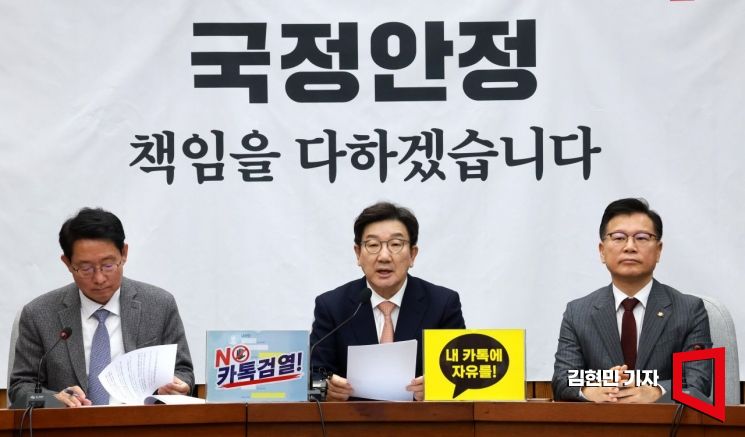 Kwon Seong-dong, floor leader of the People Power Party, is speaking at the party's policy meeting held at the National Assembly on the 14th. Photo by Kim Hyun-min
On the other hand, charges of internal rebellion propaganda and incitement, and foreign exchange inducement were all excluded from the investigation. They explained that if the special prosecutor investigates charges of internal rebellion propaganda and incitement, the entire nation could become subjects of investigation, and foreign exchange crimes are directly related to North Korea and security policies, so they were excluded.
They also excluded about 70 cases filed as complaints or accusations by the Democratic Party from the investigation targets, and softened the name of the special prosecutor law from the opposition party's "internal rebellion and foreign exchange special prosecutor law," which presumes guilt excessively, to the "Emergency Martial Law Special Prosecutor Law."
Regarding the recommendation of the special prosecutor, along with the option of the Chief Justice of the Supreme Court taking charge, they also proposed options where the head of the Court Administration, the president of the Law Professors Association, and the chairman of the Law School Council recommend candidates. Ju Jin-woo, the chairman of the People Power Party's legal advisory committee, explained, "The Supreme Court Chief Justice recommendation method stipulates that if the special prosecutor exceeds the scope or targets of investigation, the Seoul High Court's judgment is sought, but there is an indirect possibility of conflict of interest."
They argued that the Democratic Party's special prosecutor law's search and seizure methods should also be excluded. Ju said, "The law emphasizes convenience for investigation but could infringe on military secrets or official secrets. It is reasonable to exclude this as it imposes disadvantages by applying different evidence collection methods only to those on trial in this case, violating due process."
They also stated that the clause on the disclosure of suspect facts should be deleted. Ju said, "We decided to delete parts that could recklessly disclose suspect facts under the pretext of reporting to the public."
The investigation period and personnel were reviewed based on the permanent special prosecutor system. According to the permanent special prosecutor regulations, the preparation period is 20 days, the investigation period is 60 days, and an extension of 30 days is allowed. The number of investigators was set at 68, significantly reduced from the opposition party's proposal of 150 days and 155 personnel. Ju said, "If it is the early stage of investigation and the scope is wide, the period is set accordingly, but in this case, the police leadership and military command are all detained and on trial," adding, "Even during discussions in the Legislation and Judiciary Committee, the Democratic Party could not clearly answer what more to investigate."
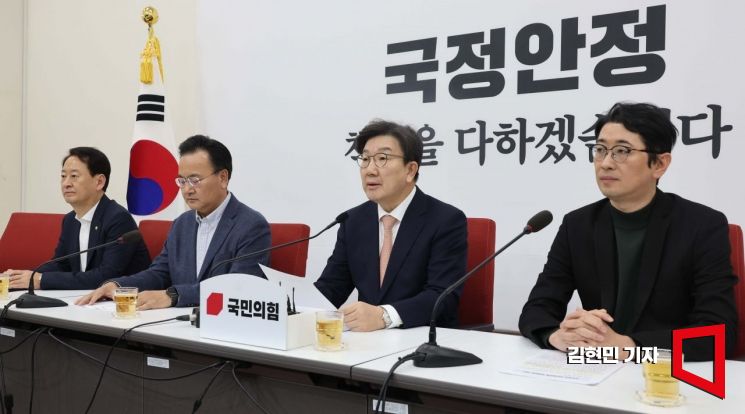 On the 14th, Kwon Seong-dong, floor leader of the People Power Party, Joo Jin-woo, chairman of the legal advisory committee, and Yoo Sang-beom, secretary of the Legislation and Judiciary Committee, held a press briefing at the National Assembly regarding the proposed "Emergency Martial Law Special Prosecutor Act" (tentative name). Photo by Kim Hyun-min
Negotiation table is key for ruling and opposition parties
Kwon urged, "The Democratic Party should immediately stop the unconstitutional internal rebellion and foreign exchange special prosecutor law's plenary session processing plan and the illegal incitement to arrest the president, and come to negotiate the special prosecutor law with our party," adding, "If the Democratic Party refuses to negotiate with us and forcibly passes the law, we will immediately demand Acting President and Deputy Prime Minister Choi Sang-mok to exercise the veto power."
He also urged the High-ranking Officials' Crime Investigation Agency (Gongu-cheo) to "stop the investigation or arrest attempts against the president immediately, as they have expressed their intention to investigate the president through the special prosecutor, and to suspend any attempts to execute arrest warrants until this special prosecutor law passes the National Assembly."
Regarding the possibility that the opposition party may not accept the People Power Party's own special prosecutor law, Kwon argued that "they cannot refuse." He said, "The internal rebellion special prosecutor law submitted by the Democratic Party contains too many unconstitutional elements and toxic provisions. If the Democratic Party cannot accept the removal of toxic provisions, it proves that their purpose is not to uncover the truth through the special prosecutor but politically to pressure and attack the People Power Party and to destroy conservatism."
Ju also said, "I think the gap between the Democratic Party and the People Power Party is not large," adding, "Even after the special prosecutor period ends, the police and prosecution can continue investigating the remaining cases." He further explained, "What makes the public uncomfortable is that the prosecution, police, and Gongu-cheo competitively investigate without coordination, and this will be neatly resolved. The core is that the special prosecutor investigates, and the remaining cases and suspicions can be sufficiently investigated, so the gap is not wide."
When asked whether the Emergency Martial Law Special Prosecutor Law was proposed because they thought it was necessary or to prevent dissenting votes, Kwon replied, "Everyone knows that the prosecution, police, and Gongu-cheo are conducting investigations very quickly and persistently. From that perspective, a special prosecutor is not necessary," adding, "We are proposing our own special prosecutor law due to practical issues."
He continued, "Politically and realistically, during the last internal rebellion special prosecutor law vote, 6 out of 108 members defected, and we do not know when another 2 might defect," adding, "If the Democratic Party's special prosecutor law passes with 2 defections, a greater disaster will come, so the floor leadership decided to propose this bill as a last resort to choose the lesser evil."
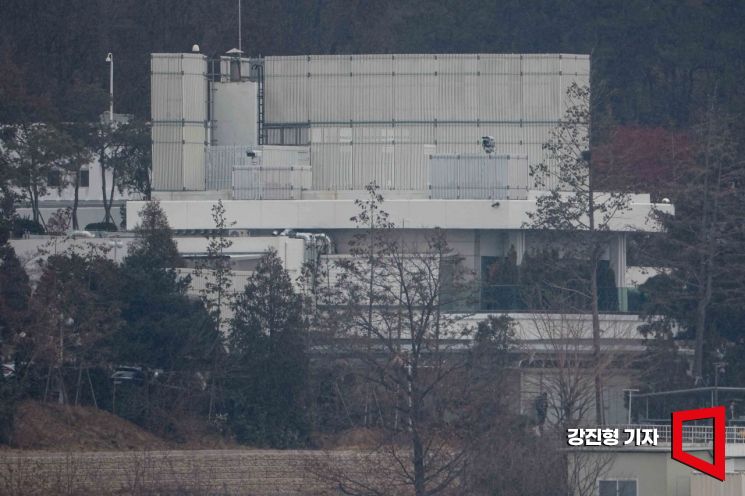 On the 13th, as the High-ranking Officials' Crime Investigation Agency's second arrest warrant execution attempt for President Yoon Seok-yeol approaches, a sense of silence envelops the presidential residence in Yongsan-gu, Seoul. Photo by Kang Jin-hyung
© The Asia Business Daily(www.asiae.co.kr). All rights reserved.



















