Mechanism of Catalysts Converting Carbon Dioxide to Formic Acid Elucidated
National Mokpo University (President Song Hacheol) announced on the 14th that the research results of graduate student Choi Seungyeon and researcher Na Chaeyoung from the Department of Chemistry, titled "Real-Time Reaction Mechanism of Catalysts Converting Carbon Dioxide to Formic Acid," have been published in the online edition of Energy & Fuels (IF: 5.2, 2023 JCR), a journal of the American Chemical Society (ACS), the world's largest academic institution.
In addition, the paper was selected as an "ACS Editor's Choice," a distinction given to a single paper recognized for excellence by the editors among all journal articles published by the American Chemical Society (ACS), and was introduced separately.
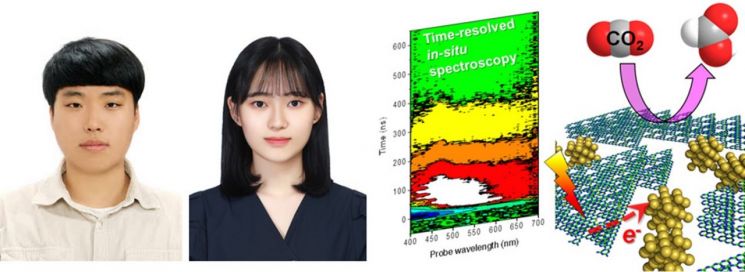 Graduate student Seungyeon Choi (left) and teaching assistant Chaeyoung Na conducted a study on the real-time reaction mechanism of a catalyst converting carbon dioxide into formic acid, which was published in the online edition of the American Chemical Society. Provided by Mokpo National University
Formic acid is a type of organic acid and a high value-added compound used in various industries such as biodegradable resins and fuel cells. Recently, there has been active development of eco-friendly catalysts that convert carbon dioxide into formic acid.
Through this research, the team independently developed an organic-inorganic hybrid catalyst that mimics the photosynthesis process of plants to produce formic acid using light energy and carbon dioxide as reactants. Furthermore, the entire process in which light energy is converted into chemical energy within formic acid was elucidated at the molecular level by comprehensively utilizing time-resolved reaction spectroscopy and X-ray spectroscopy.
Choi Seungyeon stated, "Based on the results obtained from designing the time-resolved reaction spectrometer to conducting catalyst experiments, I want to devote myself even further to various studies in reaction kinetics."
This research was supported by the Young Researcher Program, First Innovative Laboratory Project, and Basic Research Laboratory Program of the National Research Foundation of Korea. Choi Seungyeon participated as the first author, having led the research since the undergraduate program, while teaching assistant Na Chaeyoung (Department of Chemistry and Department of Energy Chemical Engineering) participated as a co-author, and Professor Kim Taewoo (Department of Chemistry and Department of Energy Chemical Engineering) participated as the corresponding author.
© The Asia Business Daily(www.asiae.co.kr). All rights reserved.
![Clutching a Stolen Dior Bag, Saying "I Hate Being Poor but Real"... The Grotesque Con of a "Human Knockoff" [Slate]](https://cwcontent.asiae.co.kr/asiaresize/183/2026021902243444107_1771435474.jpg)















