'Education Material Downgrade' Bill Passes Ahead of This Year's Implementation
Developers Protest Damages... Plan Legal Action
Confusion at Schools... Subscription Fees Undecided, Status Unclear
With about 50 days left until the new semester begins, controversies surrounding AI digital textbooks are intensifying. Although the bill to downgrade them to 'educational materials' passed the National Assembly plenary session, the government is likely to exercise its veto power. Due to this confusion, textbook developers are complaining of damages, and education offices are issuing inconsistent policies depending on the superintendent's stance and region.
AI Textbooks Face Roadblocks in the National Assembly Ahead of First Application This Year
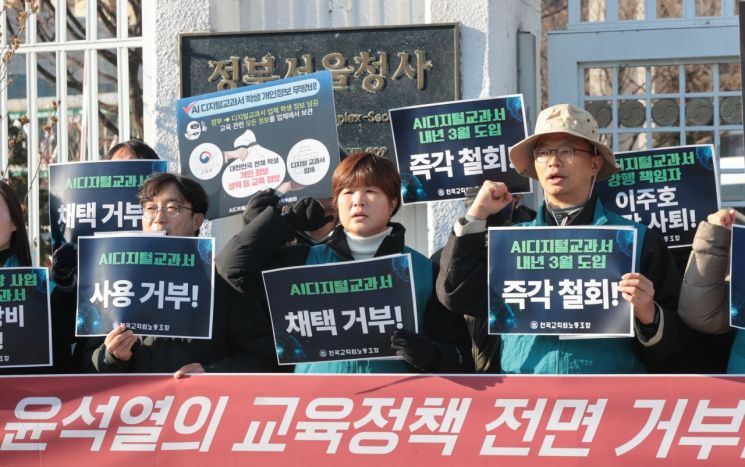
On the 14th, the Korean Teachers and Education Workers Union (Jeon-gyo-jo) held a press conference in front of the Government Seoul Office, urging the Ministry of Education to immediately promulgate the Elementary and Secondary Education Act that defines AI digital textbooks as educational materials. Jeon-gyo-jo stated, "Even though problems with AI digital textbooks are emerging, if the bill is pushed through without careful consideration, it is highly likely to result in uniform and compulsory learning rather than the customized education the Ministry of Education claims."
AI digital textbooks were promoted with the purpose of providing customized lessons tailored to students' levels. AI offers personalized content according to the student's level, to be used separately from the printed textbooks, like a workbook. However, concerns have been raised continuously among educators and parents throughout the policy's promotion. These include worries about students' overdependence on digital devices and the policy being implemented too rapidly, leaving insufficient preparation such as teacher training and consensus building. From the announcement of the promotion plan in June 2023 to implementation, the entire process was completed within a year and a half.
Meanwhile, a bill led by the opposition party to lower the legal status of AI digital textbooks from 'textbooks' to 'educational materials' under the Elementary and Secondary Education Act passed the National Assembly at the end of last month, casting uncertainty over future schedules. Unlike textbooks, which must be used in schools, educational materials can be voluntarily selected by each school. The Ministry of Education announced plans to request reconsideration and, even if the textbook status is maintained for one year this year, to allow schools to autonomously select AI digital textbooks.
After Two Years of Struggle... AI Textbook Publishers 'Protest'
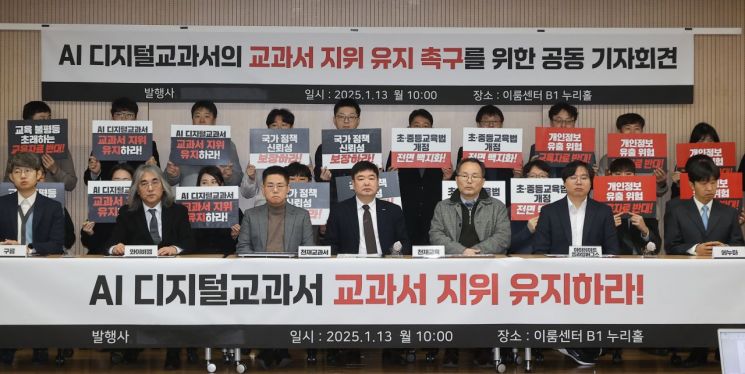
Following the bill's passage, publishers who developed AI digital textbooks over two years and received certification protested. At a press conference held the previous day, AI digital textbook publishers demanded the bill be scrapped, stating, "If the status as textbooks is lost and downgraded to educational materials, publishers and edutech companies will face serious difficulties not only in recovering development costs but also in maintaining personnel, leading to severe employment issues."
They also expressed willingness to take legal action. A publisher representative said, "If the bill, which the Ministry of Education requested reconsideration for, is re-approved by the National Assembly, we plan to actively file a constitutional complaint," adding, "If the Ministry of Education proceeds with a one-year grace period or one-year voluntary application, we may consider administrative litigation, and in case of losses to publishers, civil litigation."
The publishers also questioned the Ministry of Education's step back to 'one-year voluntary selection.' They expressed concern, saying, "Although they say they will implement mandatory introduction after one year of voluntary selection, nothing is guaranteed regarding that mandatory introduction, so the same confusion is likely to occur again."
Subscription Fees, School Selection... Practical Processes Also 'Difficult'
The situation is equally difficult for schools on the ground. As the legal status of AI digital textbooks becomes unclear, education offices are issuing different policies depending on the superintendent's stance. Seoul Metropolitan Office of Education Superintendent Jeong Geun-sik said, "It is better to use them actively only after educational effectiveness is clearly verified; using them before sufficient educational effects are proven is premature," but added, "If schools choose to use them, the education office can support within the school budget." On the other hand, Daegu Metropolitan Office of Education Superintendent Kang Eun-hee said, "Even if AI digital textbooks remain as educational materials, we will proceed from a policy standpoint."
The price fluctuation may also increase depending on the legal status of AI digital textbooks. Shin Dong-hee, deputy manager at the publisher YBM, explained, "When the textbook status is lost, the copyright fees that developers must pay increase tremendously, naturally leading to subscription fee hikes," adding, "For reference books, copyright fees can be 20 to 30 times higher than for textbooks."
The key issue is whether AI digital textbooks can regain their status as textbooks. It is expected that a reconsideration request will be submitted to the Cabinet meeting around the 21st. If the bill returns to the National Assembly, it is likely to be rejected due to failing to meet the quorum for reconsideration (majority of total members present and two-thirds of those present in favor). However, the opposition party is known to be preparing responses such as reintroducing the bill.
© The Asia Business Daily(www.asiae.co.kr). All rights reserved.
![Clutching a Stolen Dior Bag, Saying "I Hate Being Poor but Real"... The Grotesque Con of a "Human Knockoff" [Slate]](https://cwcontent.asiae.co.kr/asiaresize/183/2026021902243444107_1771435474.jpg)
















