Negative Impact on Southeast Asia and India, Where NVIDIA Focused Efforts
Green Light for Securing GPUs for National AI Computing Center and Supercomputer
Uncertainty Remains Over Continuation of Regulations Under Trump Administration
U.S. President Joe Biden's export restrictions on artificial intelligence (AI) chips are drawing attention as a potential relief for South Korea, which has been struggling to secure graphics processing units (GPUs). Since NVIDIA, a major GPU supplier, may face difficulties supplying GPUs to Southeast Asia and India?regions it has recently focused on?these supplies could be redirected to South Korea.
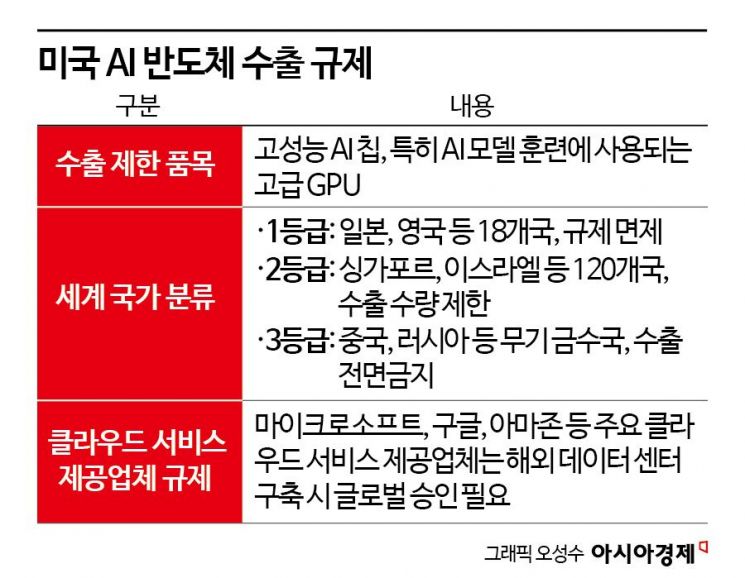
On the 13th (local time), the U.S. government announced AI semiconductor export regulations that classify countries worldwide into three groups. Among them, allied countries including South Korea are allowed unlimited exports. Southeast Asia, the Middle East, and other regions excluding China, Russia, and North Korea will face an annual purchase limit of approximately 50,000 units. Diplomats view this move as an effort to prevent GPUs secured by Southeast Asian countries, where China's influence is strong, from being used for China or smuggled there. GPUs could be smuggled into China through Southeast Asia. Major cloud providers such as AWS and Microsoft will also face restrictions on importing GPUs into countries subject to export limits.
Jensen Huang, CEO of NVIDIA, visited Southeast Asian countries such as Vietnam, Singapore, and Thailand, as well as India and the Middle East, last year, receiving GPU purchase requests from their governments and promising support, but disruptions are expected. Singapore has already purchased GPUs on a large scale and is pursuing a national AI strategy.
This measure is expected to have a positive effect on South Korea, which has faced difficulties building AI infrastructure amid a global GPU supply shortage. South Korea has struggled to procure NVIDIA's high-performance AI semiconductors, limiting national research and development and corporate AI service development. A representative example of the damage is the multi-year halt in acquiring the National Supercomputer 6 due to budget shortages caused by soaring GPU prices. Yousang Lim, Minister of Science and ICT, recently stated that South Korea currently holds about 2,000 NVIDIA ‘H100’ GPUs and emphasized the need to increase purchases promptly.
In particular, this measure is seen as a green light for the ongoing establishment of the National AI Supercomputing Center and the acquisition of the Supercomputer 6. On the 13th, the Ministry of Science and ICT announced in a joint report with five ministries that it plans to issue a project announcement for building the National AI Computing Center within the first quarter. Approximately 4 trillion won in government funding will be invested in the National AI Computing Center by 2040. The Supercomputer 6 project, led by the Korea Institute of Science and Technology Information (KISTI), can also gain momentum.
However, the supply of NVIDIA’s new GPU, Blackwell, remains a variable. The U.S. IT media outlet The Information reported that major cloud providers such as Microsoft and AWS are looking to expand purchases of the current flagship product, the H100, due to heat dissipation issues with racks composing the Blackwell system. This could disrupt the South Korean government's strategy to increase H100 purchases by anticipating a shift in demand to Blackwell among major companies.
There are also criticisms that the U.S. government's regulations are limited. Some argue that even countries subject to restrictions can purchase 50,000 H100 units annually, which is not a small quantity. This amount is sufficient to implement AI services with considerable performance. The GPUs allocated to South Korea’s National Supercomputer 6 are only about 8,800 units.
It is also uncertain whether this U.S. government policy will be maintained as the inauguration of the Donald Trump administration approaches. NVIDIA has already criticized the Biden administration's policy and requested a response from the Trump transition team. The New York Post reported that it sought comments from a spokesperson for the Trump transition team and David Sacks, who was nominated as the 'AI czar,' but received no response.
© The Asia Business Daily(www.asiae.co.kr). All rights reserved.
![Clutching a Stolen Dior Bag, Saying "I Hate Being Poor but Real"... The Grotesque Con of a "Human Knockoff" [Slate]](https://cwcontent.asiae.co.kr/asiaresize/183/2026021902243444107_1771435474.jpg)
















