Support Linking “Daily Living Assistance + Medical Treatment and Recovery”
First in the Nation to Introduce “Medical Care Managers”
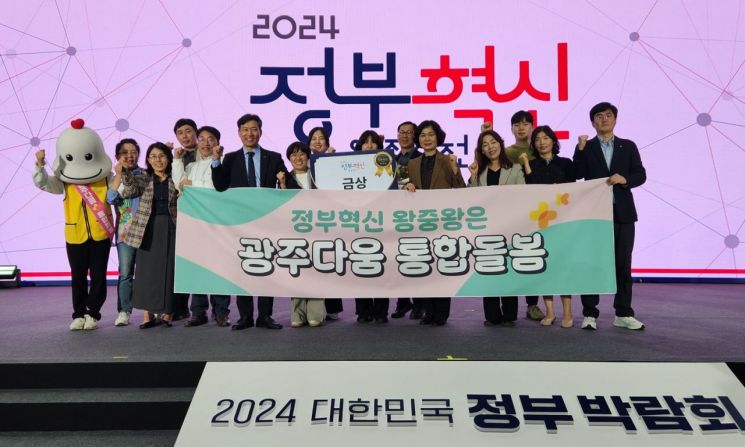 Photo of last year's 'Gwangju Daum Integrated Care' winning the Government Innovation Championship. Provided by Gwangju City
Gwangju City is taking its signature “Gwangju-style Integrated Care,” which proved the value of care in the wake of the December 29 Jeju Air passenger plane disaster, to the next level this year by expanding it into medical care and introducing new changes.
According to the city on the 13th, “Gwangju-style Integrated Care,” which was the first in the nation to implement “Universal Care,” is now in its third year. This year, it will combine medical services to introduce the “third-generation Gwangju-style Integrated Care,” connecting “daily living support” and “treatment and recovery” into a single system. This is an expansion of the achievements of “Gwangju-style Integrated Care” into the medical care sector, ahead of the nationwide implementation of the “Integrated Support Act for Local Care including Medical and Nursing” in March 2026.
The key feature of the “third-generation Gwangju-style Integrated Care” is the expansion of the medical care delivery system through personalized medical care managers and joint management by public health center integrated health centers. The city will expand its Gwangju-style home medical services through newly established services such as home nursing, oral health education, and customized exercise programs.
First, the city will introduce home nursing into “Gwangju-style Integrated Care.” It also plans to operate the “Gwangju-style Home Medical Support Center,” which will be responsible for home nursing and home medical services.
Home nursing is a service where nurses, under a doctor’s instructions, provide nursing care, medical assistance, counseling, and health education during home visits. Until now, “home nursing” where nurses visit regular households was the only option, but in Gwangju, only two hospitals have been providing home nursing, making it difficult to meet the demand for such services.
The city will also launch a new “home oral health education service.” Dental hygienists and other professionals will assess the oral health of recipients and provide education and information on dental care. Considering the impact of oral health on overall health, the city plans to conduct oral hygiene education and promote oral health through mouth exercises and other activities.
“Home customized exercise,” which has been operated mainly by physical therapists, will expand participation by occupational therapists and broaden its scope to include fall prevention education and daily living training.
For the first time in the nation, the city will introduce medical care managers to connect citizens with necessary medical services, even if they do not seek them out themselves. Designated public officials will serve as medical care managers, assessing the health status and care needs of citizens and providing integrated guidance and connections to various home medical services offered by public health centers, hospitals, and medical organizations.
Since April 2023, the city has been operating “Gwangju-style Integrated Care” and was the first in the nation to establish a “Universal Care” system. By overcoming the limitations of the application-based and selective traditional welfare systems, the city now provides universal care to any citizen whenever care is needed.
So far, about 17,000 citizens have benefited from “Gwangju-style Integrated Care.” The number of cases linking “Gwangju+Care” to fill the gaps in existing care services has reached approximately 31,000.
Since its launch in 2023, the most frequently provided service has been “meal support,” accounting for 31% (9,893 cases) of the total. Next were “well-being check and safety support services” using advanced technologies such as artificial intelligence (AI) and information and communication technology (ICT), at 22% (7,095 cases), and “household support services” assisting with chores, at 9% (2,898 cases).
The performance data shows that there is a high demand for daily living support such as household chores and meals, and that the demand for technology-based care is steadily increasing due to the rapid rise in single-person households.
Jung Younghwa, Director of Welfare and Health, said, “Gwangju City is supporting a healthy and stable life for citizens within the public care system through ‘Gwangju-style Integrated Care,’ which has spread the social responsibility of care with ‘Universal Care.’ We will go beyond expanding relationship-based care, where neighbors care for neighbors, to guarantee citizens’ right to health and pursue a stronger democracy in everyday life.”
© The Asia Business Daily(www.asiae.co.kr). All rights reserved.
![Clutching a Stolen Dior Bag, Saying "I Hate Being Poor but Real"... The Grotesque Con of a "Human Knockoff" [Slate]](https://cwcontent.asiae.co.kr/asiaresize/183/2026021902243444107_1771435474.jpg)















