Ministry of Oceans and Fisheries to Allocate 80% of Seafood Discount Budget in First Half
Eco-Friendly Vessels to Reach 10% of National Fleet by Year-End
Climate Change Resilient Marine Areas to Be Designated to Minimize Damage from High Water Temperatures
The Ministry of Oceans and Fisheries will allocate 80% of the seafood discount event budget in the first half of the year to manage prices. The proportion of eco-friendly vessels in national shipping companies will also be expanded up to 10% within this year. To minimize damage caused by high water temperatures due to climate change, the ministry will designate climate change resilient marine areas.
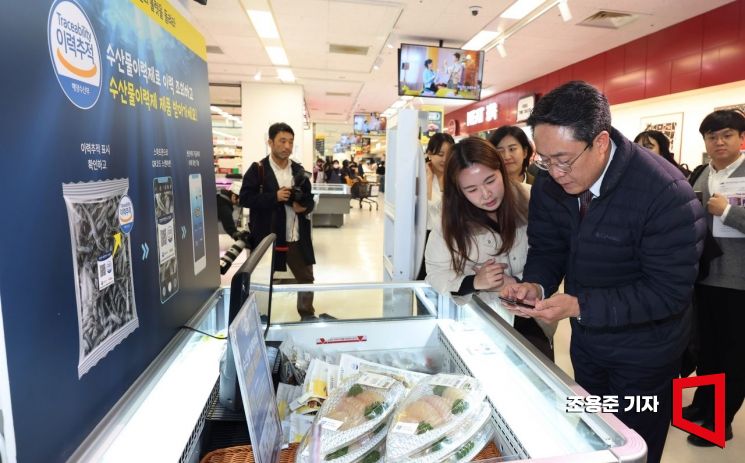 Kang Do-hyung, Minister of Oceans and Fisheries, is checking the seafood traceability information using a smartphone at the seafood traceability promotion booth set up at the Emart Yongsan branch in Yongsan-gu, Seoul, on the 19th. The Ministry of Oceans and Fisheries is conducting the "Korea Seafood Expo - Korea Seafood Festa" event together with online and offline distributors to promote seafood consumption during the kimchi-making season and to ease the burden on the national grocery basket. Photo by Jo Yong-jun
On the 13th, the Ministry of Oceans and Fisheries announced the "2025 Ministry of Oceans and Fisheries Work Plan" containing these details. The ministry plans to invest up to 80% of the total discount event budget (100 billion KRW) in the first half of this year and operate direct transaction markets in up to 56 basic local governments previously excluded from discount events to ease the burden of grocery prices. Additionally, it will strengthen supply and demand monitoring by item, expand the supply base by allowing seaweed offshore test farming (1000ha) and conversion of existing farms to seaweed aquaculture.
The share of eco-friendly vessels will also be significantly increased. To expand the proportion of eco-friendly vessels in national foreign-going ships from the current 7.8% to 10% by 2025, policy financial support for national shipping companies will be strengthened. Furthermore, a Korea-US green shipping route roadmap will be announced to leverage global carbon regulations as an opportunity for the logistics industry’s advancement. To secure domestic technology for smart ports, construction of the Gwangyang Port smart port testbed will begin in July, and a preliminary feasibility study for the development of fully autonomous ship technology will be promoted starting this year.
Efforts will also focus on minimizing damage caused by high water temperatures due to climate change. Habitually affected marine areas will be designated as climate change resilient areas, and a system allowing relocation of aquaculture farms will be introduced. The aquaculture industry will expand infrastructure such as smart aquaculture clusters, and from August, the aquaculture license review and evaluation system will be fully implemented. Additionally, a public institution participation system will be introduced to allow youth and private companies to use idle village fishing grounds, and support for new entrants such as youth into the fisheries industry will continue through the provision of fishing vessels (25 ships) and aquaculture farm leases (20 sites).
Expansion of seafood exports will also be pursued. To surpass the record-high seafood food export amount of 3.15 billion USD in 2022, a customized export strategy will be established, and export voucher support projects and diversification of overseas trade support centers will be promoted targeting 100 seafood food export companies.
The ministry will also foster new marine industries to drive coastal economic growth. Southeast Asian marine plant facilities such as those in Indonesia number about 1,700, and a recycling and dismantling market approaching 10 trillion KRW is expected to form within the next 10 years. Accordingly, technology development to preoccupy the new marine plant market will commence. Moreover, by expanding the application range of high manganese steel developed by domestic companies, Korea will reduce the royalty costs (about 3.2 trillion KRW) paid overseas for eco-friendly ship new materials. Additionally, to revitalize marine leisure tourism, two sites for complex marine leisure tourism city projects will be selected in the first half of the year.
© The Asia Business Daily(www.asiae.co.kr). All rights reserved.

















