Passenger Numbers on China Routes Up 7.6% Month-on-Month
International Passenger Growth Rate Still Higher
Preference for Southeast Asia in Winter...
Increase Expected After Spring This Year
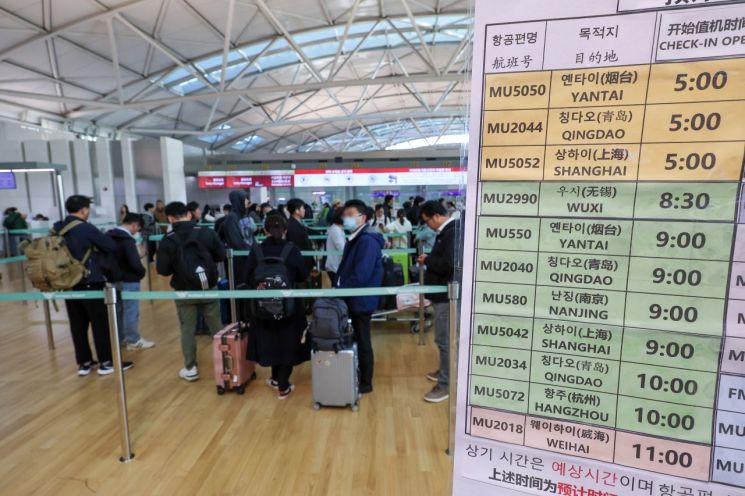
The number of passengers on international flights to and from China increased by 7.6% compared to the previous month. Despite domestic airlines significantly increasing flights on China routes since the end of last year, the overall growth in international passengers fell short due to seasonal factors. It is expected that the visa-free effect will fully manifest starting from the spring season when the weather warms up.
According to the Ministry of Land, Infrastructure and Transport's Aviation Information Portal System on the 15th, the number of passengers traveling to and from China in December last year was recorded at 1,146,224. This represents a 7.6% increase after China implemented visa-free entry for South Korea at the beginning of the previous month. However, this increase was lower than the overall international passenger growth rate of 9.0% and the Southeast Asia region's growth rate of 13.7%. It also lagged behind other Greater China region countries such as Taiwan (10.1%) and Hong Kong (12.4%). The proportion of passengers on China routes among all international passengers slightly decreased from 14.3% in the previous month to 14.1%.
Although the number of passengers increased by 40.1% compared to the same month last year, this is seen as a base effect due to previously low demand and flights to China. The figure is still at 75% of the 1,523,924 passengers recorded in December 2019 before the COVID-19 pandemic. Last month, the total number of international passengers increased by 6.6% compared to December 2019, indicating a full recovery from the impact of COVID-19, which contrasts with the China route trend.
It is analyzed that the preference for warmer Southeast Asian destinations is strong during the winter season. Indeed, regions such as Thailand (19.1%), Vietnam (13.2%), the Philippines (14.9%), and Singapore (14.9%) showed double-digit passenger growth rates compared to the previous month.
There is also an analysis that foreign tourists still do not prefer traveling to China. Despite the Chinese government expanding visa-free entry countries, including South Korea, to increase tourism revenue amid an economic crisis, the effect has fallen short of expectations. According to Bloomberg, the number of foreign tourists visiting China from the first to third quarters was about 23 million. Although this doubled compared to the same period last year, it was only 63% of the level in the first to third quarters of 2019 before COVID-19. Last year, China implemented visa-free policies for nationals from 38 countries, including South Korea, France, Germany, Italy, Australia, and New Zealand, and expected to attract 190 million foreign tourists.
Since domestic airlines have increased the number of flights on China routes from the fourth quarter of last year, it is expected that the visa-free effect will become more apparent starting this spring. Korean Air and Asiana Airlines resumed the Busan-Qingdao route in December last year for the first time in four years since COVID-19. In October of the same year, they also began operating the Incheon-Wu Dan Jiang route five times a week. Asiana Airlines increased the Incheon-Beijing and Incheon-Shanghai routes to 20 times per week and 4 times per day, respectively. Eastar Jet was the only low-cost carrier (LCC) to resume the Incheon-Zhengzhou route since September.
An aviation industry official said, "Travel agencies are planning China travel packages, and airlines are increasing China routes, so demand is growing, but due to seasonal factors, there is no explosive increase yet. Once the weather warms up and the government finalizes visa-free entry for Chinese nationals, it will be a great opportunity for the aviation industry."
© The Asia Business Daily(www.asiae.co.kr). All rights reserved.
![Clutching a Stolen Dior Bag, Saying "I Hate Being Poor but Real"... The Grotesque Con of a "Human Knockoff" [Slate]](https://cwcontent.asiae.co.kr/asiaresize/183/2026021902243444107_1771435474.jpg)















