Establishing a New Qualification for Architectural Structural Engineers to Prevent Apartment Collapses
Strengthening Construction Safety Management
Introducing a Battery Certification System
Aiming to Eliminate Electric Vehicle Fires
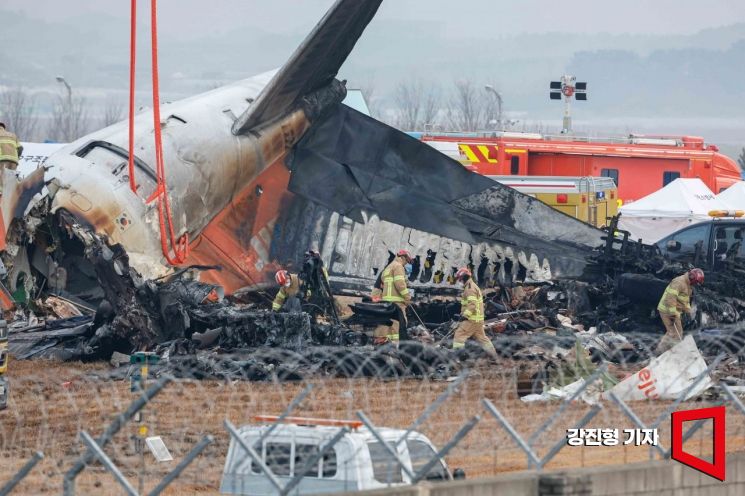 Firefighters are searching for belongings at the site of the Jeju Air passenger plane collision and explosion accident that occurred 30 days ago at Muan International Airport in Jeonnam. Photo by Kang Jin-hyung
On the 14th, the Ministry of Land, Infrastructure and Transport announced that it will create a special law to support bereaved families related to the Jeju Air passenger plane accident that occurred at Muan International Airport in Jeollanam-do on the 29th of last month, and will promote innovation in the overall aviation safety management system.
On the 13th, through the announcement of the '2025 Major Work Plan of the Ministry of Land, Infrastructure and Transport,' the ministry stated, "We will promote the enactment of a special law to support bereaved families who lost their loved ones in the accident by providing living and medical support, psychological counseling, childcare support, and memorial projects." It also said, "In January, a joint dedicated support organization involving the government, local governments, and public institutions will be established to provide systematic support to bereaved families."
It added, "We will objectively identify the cause of the accident to prevent recurrence." During the accident investigation process, the investigation results at each stage will be transparently disclosed to the bereaved families, and the accident investigation committee will be reorganized to strengthen the independence of the investigation. A white paper will also be published to document the accident response process, including support for bereaved families and accident investigation.
Establishment of Aviation Safety Innovation Plan by April
To innovate overall aviation safety, the ministry stated, "After conducting urgent safety inspections in each sector such as airlines, airports, air traffic control, and regulations, we will prepare an aviation safety innovation plan together with private experts by April." Subsequently, detailed measures will be taken in policy, operation/control, and facilities sectors.
Comprehensive safety inspections of airlines including low-cost carriers (LCCs) and special safety inspections of 18 air traffic control facilities nationwide will be conducted by the 31st. Special safety inspections of airports nationwide and facility improvement plans will be established by the 24th.
Construction safety management will also be strengthened. First, safety management at each stage of construction work such as design, construction, and supervision will be reinforced. To prevent repeated safety accidents caused by inadequate structural design like the Incheon Geomdan accident, the ministry plans to establish a new qualification for architectural structural engineers within this year to expand structural experts. Currently, there are only about 1,300 architectural structural engineers responsible for structural calculations of buildings.
Customized safety measures to prevent fall accidents, which account for half of the fatal accidents at construction sites, will also be prepared. To enhance the expertise of supervisors responsible for site supervision, the government will select 400 certified supervisors through a national certification system for excellent supervisors for the first time.
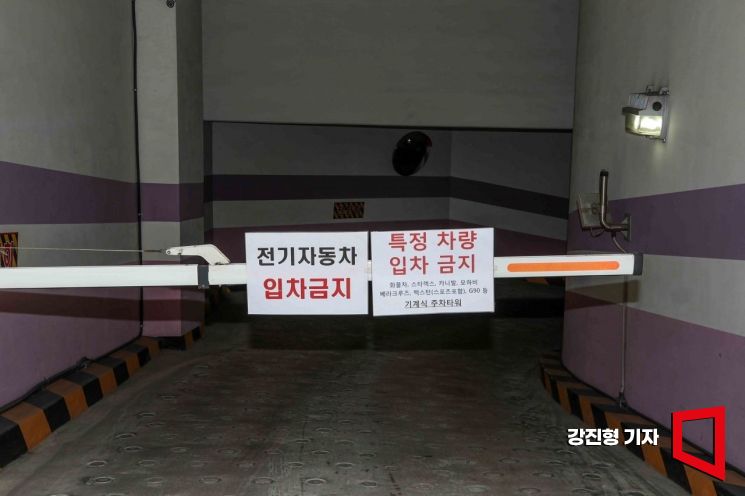 On the 8th, as electric vehicle fires continue to occur, interest in the safety of electric vehicles is growing. At the entrance of an underground parking lot in Incheon, a notice prohibiting electric vehicles from entering is posted. Photo by Jinhyung Kang aymsdream@
Electric Vehicle Battery Risk Levels Automatically Reported to Fire Authorities
Electric vehicle fires will also be prevented. Starting in April this year, a pilot service will be implemented in which the Battery Management System (BMS) diagnoses the battery and automatically notifies fire authorities if the battery is at a risk level in preparation for electric vehicle fires. From next month, the government will also implement a battery certification system that directly certifies compliance with battery safety standards and a battery history management system that registers and manages battery identification numbers.
For two-wheelers, regular inspections will be conducted not only for emissions and noise but also for structural safety verification to prevent safety accidents caused by illegal modifications and poor management.
To detect the risk of train derailment and malfunction caused by track distortion due to heatwaves in advance, advanced technology-based safety systems will be expanded. The axle temperature monitoring system will be installed on 38 KTX-Sancheon train sets within this year. Axle temperature detection devices near Dongdaegu Station (2 locations) and thermal imaging cameras (at Gwangmyeong, Daejeon, Ulsan, and Iksan stations) will also be additionally installed.
Additionally, an Internet of Things (IoT) system for slopes will be installed at 100 locations to monitor road facilities in real time and detect accident risks in advance. The integrated bridge measurement system will also be increased from 36 to 38 locations.
Meanwhile, to prevent safety accidents caused by extreme heavy rain such as the Osong underground road flooding accident, the rainfall design frequency for road facilities will be strengthened. The rainfall design frequency for drainage facilities in vulnerable underground road sections will be increased from 50 years to 100 years, and for slope drainage facilities from 20 years to 30 years.
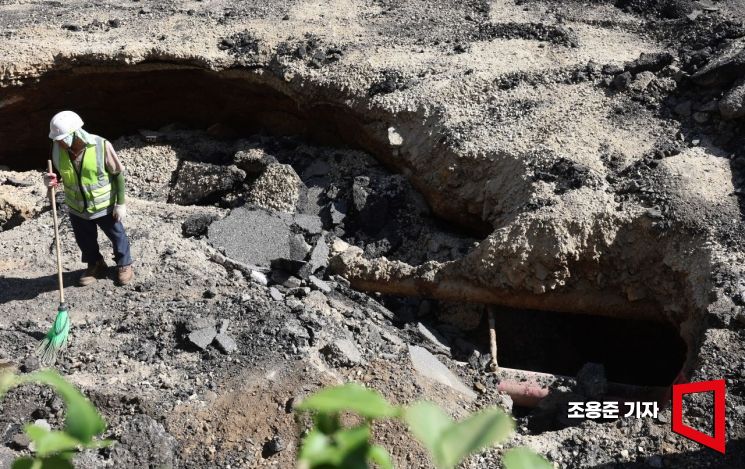 On the 29th, a sinkhole occurred on a road in Yeonhui-dong, Seodaemun-gu, Seoul, prompting emergency repair work. Due to this sinkhole accident, a passenger car fell in, and two occupants were seriously injured and transported to the hospital. Photo by Jo Yongjun jun21@
To prevent accidents caused by ground subsidence like the sinkhole accident in Yeonhui-dong, Seodaemun-gu, the inspection cycle for high-risk areas such as aging water pipelines will be shortened. The ground survey support project will be expanded from the current 2,300 km to 3,200 km to intensively manage vulnerable sections. Currently, inspections are conducted once every five years without considering risk levels, but going forward, inspections will be conducted up to twice a year depending on the risk level.
To reduce carbon emissions in the construction sector, the minimum grade for zero-energy buildings required when constructing new public buildings will be raised (from grade 5 to grade 4). For new private buildings with a total floor area of 1,000㎡ or more, the 'Energy-saving Design Standards for Buildings' will be strengthened to improve the energy performance of buildings.
In the transportation sector, to replace diesel trains, 20 billion KRW will be invested from this year until 2027 to conduct a hydrogen electric train demonstration project. By 2028, 28.9 billion KRW will be invested in the development of hydrogen electric locomotive technology to carry out a demonstration project for eco-friendly hydrogen trains. In preparation for the mandatory blending of Sustainable Aviation Fuel (SAF) by 2027, usage targets will also be established in the second half of this year.
© The Asia Business Daily(www.asiae.co.kr). All rights reserved.
![Clutching a Stolen Dior Bag, Saying "I Hate Being Poor but Real"... The Grotesque Con of a "Human Knockoff" [Slate]](https://cwcontent.asiae.co.kr/asiaresize/183/2026021902243444107_1771435474.jpg)


















