Foreign Exchange Inducement and Internal Rebellion Propaganda at the Center of Controversy
PPP: "Military Activities Could Be Defined as Illegal Acts"
DPK: "Opposition to the Internal Rebellion Special Investigation Act Means Being Ringleaders and Accomplices"
On the 13th, the People Power Party (PPP) will initiate internal procedures to prepare an alternative Emergency Martial Law Special Investigation Act (tentative name) in response to the Internal Rebellion Special Investigation Act proposed by the six opposition parties, including the Democratic Party of Korea (DPK). The PPP's plan is to exclude the crimes of foreign exchange inducement, internal rebellion propaganda and incitement, and the scope currently under police investigation to reduce public confusion. Although the DPK fundamentally harbors resistance toward the PPP, which opposes the Internal Rebellion Special Investigation Act jointly proposed by all opposition parties in the National Assembly, it has hinted at the possibility of negotiation on the condition of a "proposal that meets the public's expectations."
The PPP leadership held a party meeting at the National Assembly at 3 p.m. on the same day to disclose the draft of the Emergency Martial Law Special Investigation Act to its members and gather feedback. The draft was prepared by Representative Joo Jin-woo, the PPP's legal advisory chairman. Earlier, on the 9th, the six opposition parties, including the DPK, reintroduced the Internal Rebellion Special Investigation Act, which grants the Chief Justice of the Supreme Court the authority to recommend special investigation candidates as a third party. Additionally, to partially accommodate the ruling party's demands, the bill excluded the 'veto right' so that the National Assembly cannot reject the Supreme Court Chief Justice's recommended candidates even if deemed inappropriate. However, they indirectly pressured the government and ruling party by expanding the investigation scope to include crimes such as foreign exchange inducement and internal rebellion propaganda and incitement.
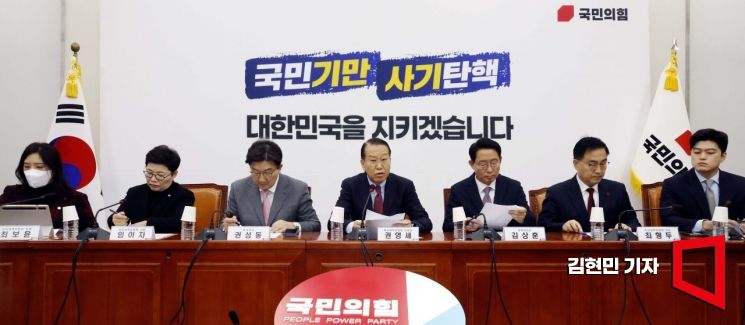 Kwon Young-se, Emergency Response Committee Chairman of the People Power Party, is speaking at the Emergency Response Committee meeting held at the National Assembly on the 13th. Photo by Kim Hyun-min
On the other hand, the draft prepared by Representative Joo excludes investigations into foreign exchange inducement crimes, complaints and accusations related to internal rebellion and foreign exchange, and internal rebellion propaganda and incitement crimes. The rationale is that if the investigation includes overseas dispatches to conflict zones, the operation of loudspeakers toward North Korea, large-scale leaflet distribution to North Korea, drone infiltrations into Pyongyang, direct strikes on North Korean waste balloons, and provocations of North Korean attacks at the Northern Limit Line (NLL), all military actions by the South Korean military to deter military provocations could be deemed illegal. Regarding investigations into internal rebellion propaganda and incitement crimes, the PPP believes they should be excluded from the investigation scope as they could lead to investigations targeting ordinary citizens and personal messenger censorship.
The PPP plans to collect opinions on the investigation scope and duration during the party meeting. There is also an opinion within the PPP that the special investigation candidate recommendation authority currently granted to the Chief Justice of the Supreme Court should be distributed among the Court Administration Office, the Council of Law Schools, and the Korean Bar Association. In a phone interview with Asia Economy, Representative Joo explained, "Even though the military and police leadership are currently under indictment and detention, investigative agencies are competitively conducting investigations, so we need to organize them properly," adding, "The core parts should be investigated by the special investigation team, and the rest by the police."
However, the DPK plans to pass the Internal Rebellion Special Investigation Act in the plenary session as early as the 14th and no later than the 16th. They seem to be pressuring for a quick vote to expect more defections from the ruling party. The Internal Rebellion Special Investigation Act was rejected in the plenary session re-vote on the 8th with 198 votes in favor, 101 against, and 1 abstention. The number of favorable votes increased from 195 last month, indicating at least three defections within a month. Park Chan-dae, the DPK floor leader, pointed out at the party's supreme council meeting at the National Assembly that day, "Those opposing the Internal Rebellion Special Investigation Act are nothing but the ringleaders and accomplices of the rebellion." However, Park also stated, "The DPK will negotiate if the PPP presents a proposal that meets the public's expectations." The negotiation deadline is set before this week's plenary session.
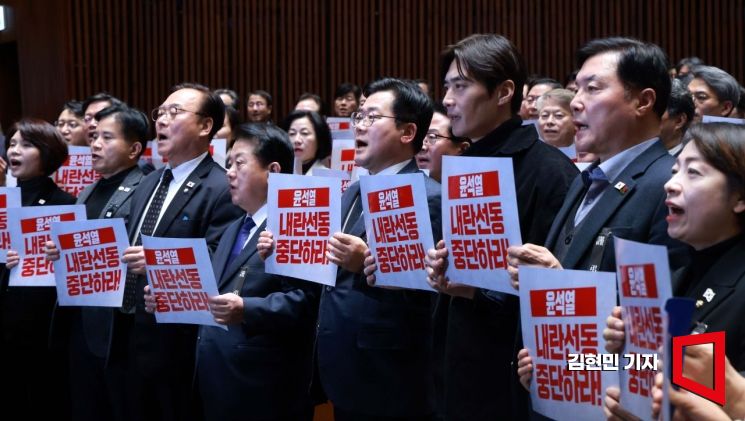 Democratic Party lawmakers, including Floor Leader Park Chan-dae, are shouting slogans urging the arrest and detention investigation of President Yoon Seok-yeol at a party meeting held at the National Assembly on the 2nd. Photo by Kim Hyun-min
© The Asia Business Daily(www.asiae.co.kr). All rights reserved.
![Clutching a Stolen Dior Bag, Saying "I Hate Being Poor but Real"... The Grotesque Con of a "Human Knockoff" [Slate]](https://cwcontent.asiae.co.kr/asiaresize/183/2026021902243444107_1771435474.jpg)
















