SOC Budget Cut from 26.4 Trillion to 25.4 Trillion Won for 2025
Difficult to Achieve Early Construction Market Recovery with Tax Cuts and Incentives
"Additional Funding Needed for Fiscal Projects to Increase Short-Term Construction Volume"
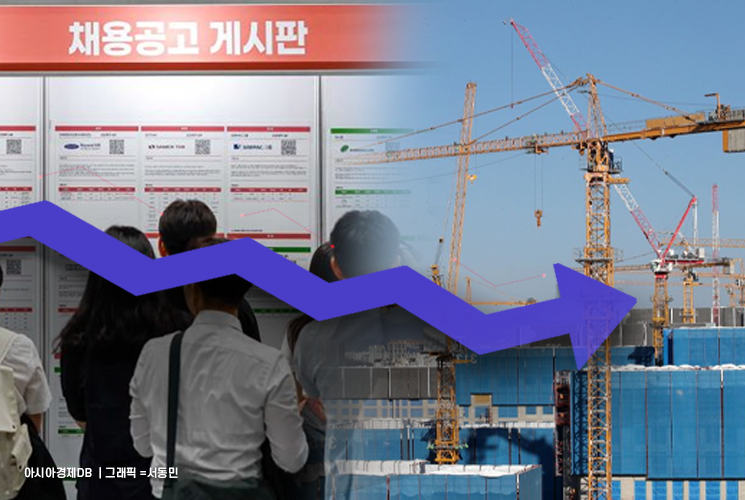
Although the 2025 government economic policy includes measures to induce an early recovery in the construction market, there are concerns that the social overhead capital (SOC) budget has decreased by about 1 trillion won compared to last year, indicating the need for supplementary budget allocation.
On the 12th, the Construction Industry Research Institute explained in its trend briefing report titled "2025 Economic Policy, Focused on Stable Management in Response to Uncertainty" that "policies related to revitalizing the construction sector have been established to restore the livelihood economy, suggesting the important role of the construction industry in economic recovery."
Among the government's announced economic policy directions, the section on early recovery of construction and regional economies includes △ expansion of housing supply, early ordering and commencement of SOC projects to strengthen the construction market △ a three-package plan to realize construction costs △ resolution of factors hindering private construction and transactions such as regulations, burdens, and taxation △ policy design emphasizing preferential treatment for local areas to boost regional economic vitality.
To expand housing supply and promote early ordering and commencement of SOC projects, the government plans to implement a pilot project in the first half of the year to reorganize permanent rental housing over 30 years old and establish a roadmap for remodeling and reorganizing old public rental housing. The comprehensive real estate tax imposed on public rental housing owned by LH and local housing and urban corporations will be excluded from aggregation regardless of value or area. Newly built purchase rentals will supply 150,000 households from 2024 to 2026, with early contracts for more than 30,000 households to be signed in the first half of the year. Additionally, public-supported private rental REITs will be executed early in the first half and expanded to 300 billion won in scale.
Approximately 30,000 new housing site candidates, mainly in the metropolitan area, will be announced in the first half of the year. The 50,000 households announced last year, including Seoul Seoripul and Uiwang Ojeon Wanggok, will complete district designation by the first half of next year. The 3rd new towns plan to commence construction of 12,000 households within the year and promote sales for 8,000 households. Furthermore, major construction projects such as roads, railways, airports, and ports will be ordered and commenced early, with 70% of the SOC budget to be executed within the first half of the year.
The "three-package plan to realize construction costs" will also address difficulties faced by the construction industry. Public construction costs will be adjusted to reflect increases, including public contract and total project cost management. Detailed standards for construction cost adjustments based on project conditions will be refined, and price fluctuations during the design period (about one year) will be reflected when signing turnkey negotiated contracts. The purchase price for some private multi-family housing built on public land by LH and others will be increased by 10% (to 110% of the standard construction cost). Additional costs required for housing construction will be reflected in the land price addition and construction addition items when calculating sale prices.
To remove factors hindering private construction and transactions, regulations and burdens restricting commencement and housing supply will be eased. The policy includes a one-year temporary extension of the exemption from heavy capital gains tax for multi-homeowners to promote housing transactions and expand supply. Project normalization will be pursued through the PF Adjustment Committee, and government investment will be made to increase HUG's capital, expanding public guarantees for housing PF, redevelopment projects, and unsold local housing by more than 30 trillion won.
To boost regional economic vitality, local real estate tax surcharges will be eased. The target for the comprehensive real estate tax exemption for one household one house in local low-priced housing will be relaxed from publicly announced prices of 300 million won or less to 400 million won or less. The criteria for exemption from acquisition tax surcharges for low-priced housing will also be relaxed from publicly announced prices of 100 million won or less to 400 million won or less. Through regional cost analysis, the construction of data centers will be encouraged in local areas with reduced electricity rates, and the scope of ancillary facilities in industrial complexes will be expanded to include a wide range of convenience facilities.
The Construction Industry Research Institute stated, "Given that the SOC budget has decreased by nearly 1 trillion won compared to 2024, there are expected limitations in reversing the construction market downturn," adding, "Since the approach mainly focuses on tax reductions and incentives rather than active fiscal projects, it will be difficult to immediately recover the sluggish construction market."
The institute emphasized that securing funding is necessary to significantly increase construction volume in the short term. It explained, "To mitigate economic uncertainty and resolve domestic demand sluggishness, it is necessary to maximize the use of the construction industry, and for this, additional SOC budget allocation is needed to generally expand public construction volume. The government's plan to revitalize housing supply is unlikely to increase construction volume immediately this year, and due to high uncertainty in sales after permits, private housing construction cannot increase rapidly in the short term by increasing sales."
© The Asia Business Daily(www.asiae.co.kr). All rights reserved.

















