Legislative Discussion on Legalizing Housing Lease Registration Held
"Move-in Date and Deposit Must Be Disclosed in the Official Registry"
Tenants Can Easily Verify Rights Before Signing Contracts
Malicious Mortgages by Landlords Can Also Be Prevented
There has been a proposal to mandate the disclosure of housing lease details such as the move-in date and deposit amount in the official registry copy. This measure aims to prevent jeonse fraud, enhancing transparency and trust in the rental market.
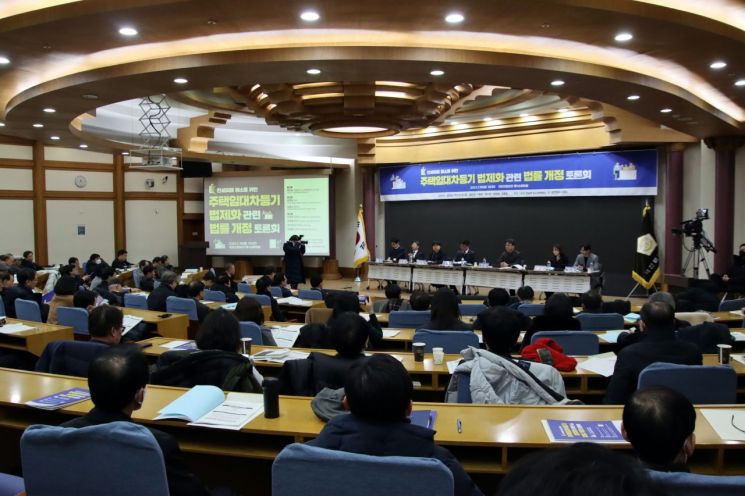 On the 10th, a "Legal Amendment Discussion on the Legislation of Housing Lease Registration (Lease Registration Legislation)" was held at the National Assembly Members' Office Building in Yeouido, Seoul. Photo by Park Yong-gap, Office of the Democratic Party of Korea
Immediate Effectiveness of Tenant Registration Upon Receipt
At the ‘Legislative Amendment Discussion on the Legalization of Housing Lease Registration’ held on the 10th at the National Assembly Members’ Office Building in Yeouido, Seoul, lawyer Lee Kang-hoon (Vice Chairman of the Participatory Solidarity Steering Committee) pointed out, “Current law publicizes housing leases through housing delivery and resident registration, but both methods are incomplete as third parties find it difficult to verify. On the day of move-in, landlords can falsely claim to banks that there is no tenant and borrow money using the house as collateral,” he said. While mortgage rights take effect immediately upon registration receipt, tenants’ opposability and priority repayment rights only arise at midnight the day after housing delivery and move-in registration, allowing frequent fraud exploiting this time gap.
Jeong Kyung-guk, a judicial scrivener (Head of the Public Interest Legal Support Group for Jeonse Victims at the Korean Judicial Scriveners Association), also explained, “Currently, details such as move-in date, date of fixed registration, deposit, and lease period are not disclosed in the official registry copy, making it difficult for tenants to predict the likelihood of recovering their deposits. Especially in multi-family houses with multiple tenants, cases frequently occur where tenants fail to verify senior tenants and thus cannot recover their jeonse deposits,” he said.
They unanimously agreed that tenant registration is the solution to these problems. Lawyer Lee said, “Registering housing leases allows multiple lease relationships and other real rights to be disclosed in a single registry, which increases transparency in housing sales and leases,” adding that it can prevent false notifications of senior lease rights. Professor Kim Cheon-il of the Department of Construction and Real Estate at Gangnam University explained, “To protect tenant rights, it must be easy to verify rights relationships, and registration is the only means to do so. Also, tenant registration grants opposability and priority repayment rights immediately upon registration receipt, preventing malicious mortgage rights,” he said.
Resolving the ‘Information Asymmetry’ Cause of Jeonse Fraud
This can also increase trust in the rental market. Judicial scrivener Jeong said, “Just as sales prices are disclosed in the registry, if lease deposits are recorded in the registry over several years, reliable and appropriate jeonse prices will be established,” adding, “This will prevent damages caused by ‘empty can jeonse’ and no-capital gap investment, and block illegal appraisals.” Professor Kim emphasized, “While legalizing housing lease registration cannot solve jeonse fraud at once, making tenant rights publicly known addresses the fundamental cause of fraud, which is ‘information asymmetry,’ making it meaningful.”
From the perspective of banks and financial institutions, this method is also useful as it allows them to understand the rights related to a house by simply checking the registry, without having to verify numerous documents such as lease contracts, move-in household confirmation, and fixed registration status when executing mortgage loans.
The need to reduce registration costs was also mentioned. Lawyer Lee said, “If the burden on citizens is too high, dissatisfaction will increase, making it difficult to properly introduce this system,” suggesting, “Consideration could be given to abolishing registration license tax and local education tax on lease registration.” He added, “Discussions on this issue are needed between the Ministry of Land, Infrastructure and Transport and the judicial scrivener profession.” Professor Kim stressed, “If local governments support lease registration costs especially for vulnerable groups and provide legal services throughout the entire lease process through agreements between local governments and judicial scriveners, the rental rights of ordinary citizens will be strongly protected.”
© The Asia Business Daily(www.asiae.co.kr). All rights reserved.
![Clutching a Stolen Dior Bag, Saying "I Hate Being Poor but Real"... The Grotesque Con of a "Human Knockoff" [Slate]](https://cwcontent.asiae.co.kr/asiaresize/183/2026021902243444107_1771435474.jpg)















