50.01 Million KRW for Companies with 300 or More Employees... 1.8 Times Higher Than Firms with Fewer Than 5 Employees
Overall Starting Salary for University Graduates in Korea is 30.5% Higher Than Japan
Gap by Company Size is Also Severe... Over Three Times Larger in Korea
An analysis revealed that the starting salary for regular full-time employees with a university degree at companies with 300 or more employees in South Korea has surpassed 50 million KRW for the first time. The overall starting salary for university graduates was also found to be about 19% higher than that of Japan.
On the 12th, the Korea Employers Federation (KEF) announced a report titled "Analysis of Starting Salaries for University Graduates in South Korea and Comparison with Japan," based on an analysis of raw data from the Ministry of Employment and Labor's Employment Status Survey by Employment Type.
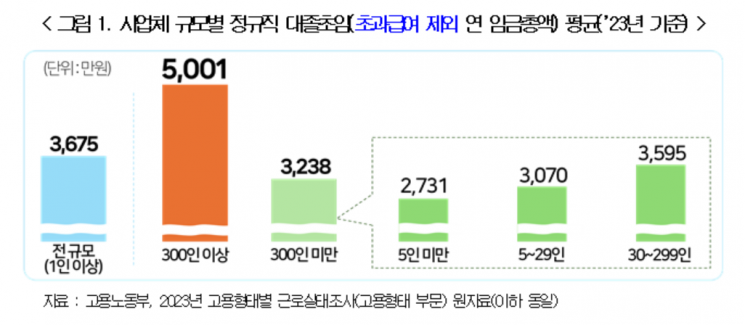
According to the report, in 2023, the average starting salary for regular full-time university graduates at South Korean companies with 300 or more employees was 50.01 million KRW. This figure is based on the total annual wage excluding overtime pay and includes fixed pay and special pay (regular bonuses + variable bonuses). This amount is 1.8 times the 27.31 million KRW starting salary for regular full-time university graduates at companies with fewer than 5 employees. It is also 36.1% higher than the overall average starting salary of 36.75 million KRW for all regular full-time university graduates. By company size, the starting salaries were identified as 30.7 million KRW for companies with 5?29 employees and 35.95 million KRW for those with 30?299 employees.
KEF also released comparative results with Japan. The starting salary for regular full-time university graduates in Korean companies was higher than Japan’s regardless of company size. Based on KEF’s analysis of the 2023 Basic Wage Structure Statistics Survey by Japan’s Ministry of Health, Labour and Welfare, the starting salary for university graduates at companies with 10 or more employees in Korea was $45,401 (PPP-adjusted), which is 30.5% higher than Japan’s $34,794.
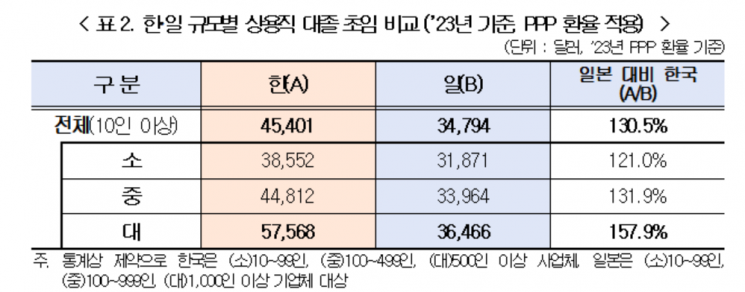
The gap widened as company size increased. The starting salary for regular full-time university graduates at large South Korean companies (500 or more employees) was $57,568, nearly 1.6 times that of large Japanese companies (1,000 or more employees) at $36,466. Even when applying the simple market exchange rate (as of 2023), the average starting salary for university graduates across all companies was $27,823 in Korea, 18.6% higher than Japan’s $23,466. When expanded to large companies, this gap increased to 43.5%. Without adjusting for exchange rates, the starting salary level relative to GDP per capita was 78.2% in South Korea, 8.8 percentage points higher than Japan’s 69.4%.
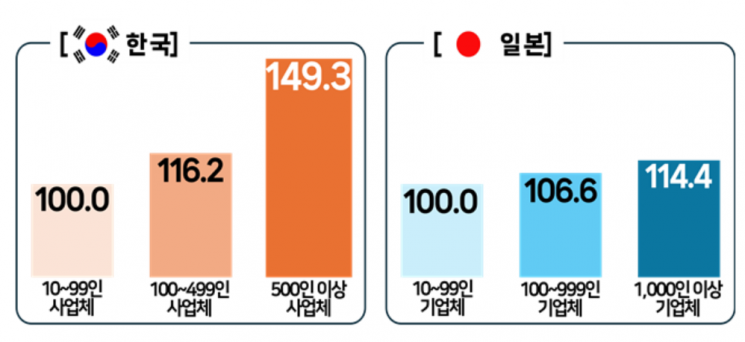
The disparity in starting salaries by company size was much greater in South Korea. Using the starting salary for companies with 10?99 employees as 100, Japanese large companies (1,000 or more employees) scored 114.4, while South Korean large companies (500 or more employees) reached 149.3.
Ha Sang-woo, head of KEF’s Economic Research Division, stated, "The excessively high starting salaries at large South Korean companies compared to Japan are causing a worsening job mismatch in the labor market and widening wage gaps between large and small-to-medium enterprises. High-paying large companies need to restrain excessive increases in starting salaries for university graduates, and it is urgent to shift to a wage system that ensures reasonable compensation based on the value and performance of work."
© The Asia Business Daily(www.asiae.co.kr). All rights reserved.
![Clutching a Stolen Dior Bag, Saying "I Hate Being Poor but Real"... The Grotesque Con of a "Human Knockoff" [Slate]](https://cwcontent.asiae.co.kr/asiaresize/183/2026021902243444107_1771435474.jpg)

















