Approximately 5 Trillion Won to Be Invested Over Six Years to Normalize Medical School Education
Special Training Exceptions for Returning Residents Who Resigned
The government has decided to invest approximately 5 trillion won by 2030 to normalize medical school education and improve training environments. If residents who resigned last year return to their original training hospitals, special training exceptions will be applied, and military medical officer candidates will be allowed to enlist as medical officers or similar roles after completing all training. The government also stated that it will flexibly negotiate the issue of medical school quotas for the 2026 academic year through dialogue with the medical community.
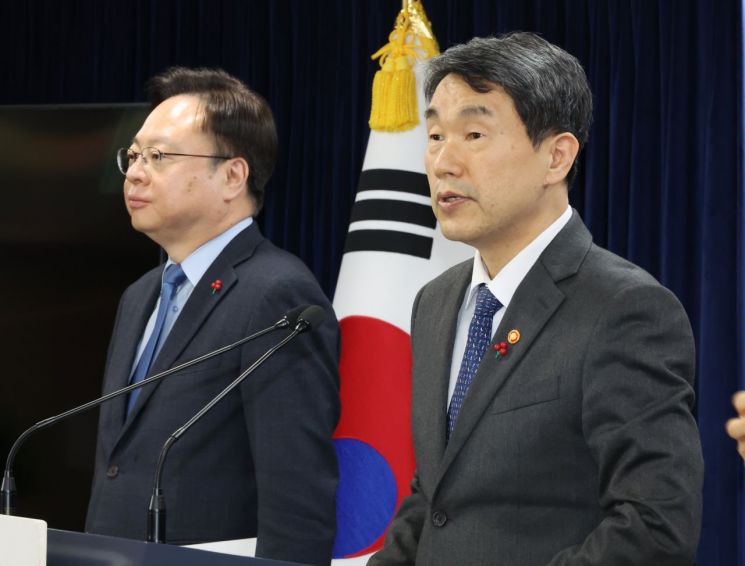
On the afternoon of the 10th, Lee Ju-ho, Deputy Prime Minister for Social Affairs and Minister of Education, and Cho Kyu-hong, Minister of Health and Welfare, held a briefing to announce these plans regarding medical reform and the normalization of medical education.
Deputy Prime Minister Lee said, "Since the announcement of the increase in medical school quotas last February, the prolonged departure of residents has caused concern and inconvenience to the public, for which I sincerely apologize. In particular, the declaration of martial law concerning the medical community, including residents, is completely different from the government's policy. I offer my heartfelt regret and consolation to the residents and medical staff who were hurt by the contents of the declaration."
He continued, "To ensure smooth medical education for the 2025 academic year, the government plans to invest about 5 trillion won by 2030. This year alone, 606.2 billion won will be invested to significantly improve educational conditions through faculty recruitment, facility expansion, and medical education innovation."
Currently, each university is in the process of recruiting faculty members and plans to complete this by February. Improvements to educational facilities, such as classroom remodeling and new building construction, are also proceeding as planned. Especially this year, about 7,500 students from the 2024 and 2025 cohorts will have to attend classes simultaneously, creating a challenging situation, but the government intends to mobilize all resources and provide administrative and financial support in cooperation with universities.
The government also plans to ensure that residents who resigned can resume their training without disruption. Current resident training regulations restrict return within one year after resignation, but if a resident returns to the hospital and specialty where they trained before resigning, these regulations will not apply through special training exceptions. Additionally, the government will take maximum measures to allow resigned military medical officer candidates to enlist as medical officers or similar roles after completing their training. Deputy Prime Minister Lee emphasized, "If students return, we will utilize all resources to ensure they can attend classes normally."
The government reiterated its position to keep all options open and engage in new discussions with the medical community regarding the medical school quota issue for the 2026 academic year. Deputy Prime Minister Lee said, "Considering the gap in classes for the 2024 cohort, the educational conditions of each university, and the outlook for medical workforce supply and demand, we will negotiate flexibly from a zero base. I believe that if the government and the medical community put their heads together, a reasonable solution can be reached."
Addressing the residents, Deputy Prime Minister Lee said, "I feel regretful and sorry for those of you who have temporarily put aside your goals in each specialty and left the training sites to contemplate over the past year. The government will not only invest financially to improve training environments but also create a forum for discussion with residents to improve training conditions. We will also consult with the medical community on strengthening the functions, roles, and independence of the Training Environment Evaluation Committee."
© The Asia Business Daily(www.asiae.co.kr). All rights reserved.
![Clutching a Stolen Dior Bag, Saying "I Hate Being Poor but Real"... The Grotesque Con of a "Human Knockoff" [Slate]](https://cwcontent.asiae.co.kr/asiaresize/183/2026021902243444107_1771435474.jpg)
















