Immediate Presentation Before Bill Deliberation Period Expires
To Be Referred to Subcommittee After Substitute Debate
Democratic Party Aims for Passage in Legislation and Judiciary Committee on the 13th
The National Assembly's Legislation and Judiciary Committee brought a revised bill to the discussion table just two days after the so-called 'Special Investigation Act on Treason' was rejected following a re-vote. The opposition parties broke the usual National Assembly practice of a 20-day deliberation period for new bills and launched a speed campaign by using an exception clause in the National Assembly Act.
On the 10th, the Legislation and Judiciary Committee held a plenary meeting at the National Assembly and presented 40 bills, including the "Act on the Appointment of a Special Prosecutor for the Investigation of Treason and Foreign Exchange Acts by the Yoon Seok-yeol Government (Special Investigation Act on Treason)." After the first Special Investigation Act on Treason, which included provisions for the opposition parties to solely recommend the special prosecutor, was finally discarded following a re-vote, six opposition parties submitted a second, softened version of the bill the day before. This version incorporated the ruling party's opinions, such as the special prosecutor being recommended by a third party (the Chief Justice of the Supreme Court) and excluding the opposition's veto power. Among the bills presented that day were many contentious issues, such as lowering the age of criminal responsibility under the Criminal Act, but the members' discussions focused on the Special Investigation Act on Treason.
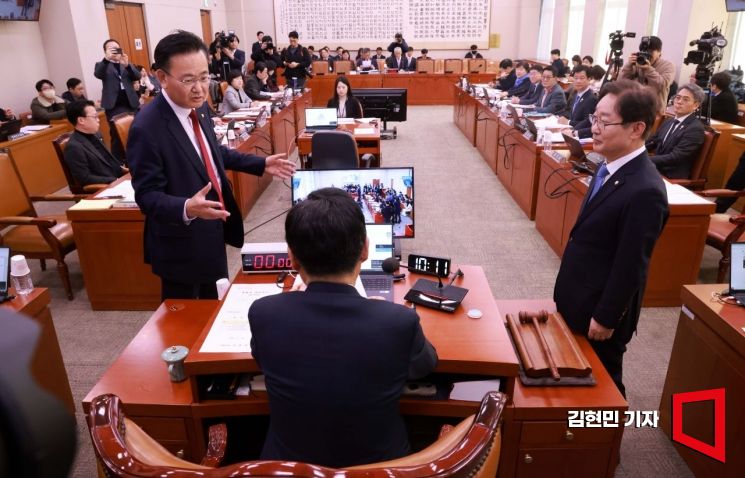 On the 10th, at the plenary meeting of the Legislation and Judiciary Committee held in the National Assembly, Chairman Jeong Cheong-rae, ruling party secretary Yoo Sang-beom, and opposition party secretary Park Beom-gye are discussing the bill concerning the appointment of a special prosecutor to investigate the internal and external acts of the Yoon Seok-yeol administration. Photo by Kim Hyun-min
At the start of the meeting, the ruling and opposition parties clashed over whether the Special Investigation Act on Treason could be presented and discussed in both the plenary and subcommittee meetings of the Legislation and Judiciary Committee on the same day. Yoo Sang-beom, the senior member of the People Power Party, argued that "I have doubts about whether bills should be swiftly presented anytime the Democratic Party wants," insisting that a deliberation period for bills is necessary. In response, Jeong Cheong-rae, the chairperson of the Legislation and Judiciary Committee, said, "We plan to pass (the Special Investigation Act on Treason) at the plenary meeting next Monday," adding, "What Mr. Yoo said is not entirely wrong, but these are extraordinary times."
After the debate and a vote, the bill was ultimately presented to the plenary meeting. This was a predictable outcome given the chairperson's will, who is from the Democratic Party, and the numerical superiority of the committee's composition. Seven members of the People Power Party opposed the presentation in the vote. During the subsequent substitute debate, ruling and opposition members continued discussions for over an hour on the necessity of the Special Investigation Act on Treason. Democratic Party members emphasized that the concerns raised by Acting Prime Minister and Minister of Economy and Finance Choi Sang-mok, who had called the bill "unconstitutional" when exercising his veto power (request for reconsideration), had been resolved and that the bill should be passed. Meanwhile, People Power Party members argued that since the police and others are currently investigating President Yoon, there is no need to appoint a special prosecutor.
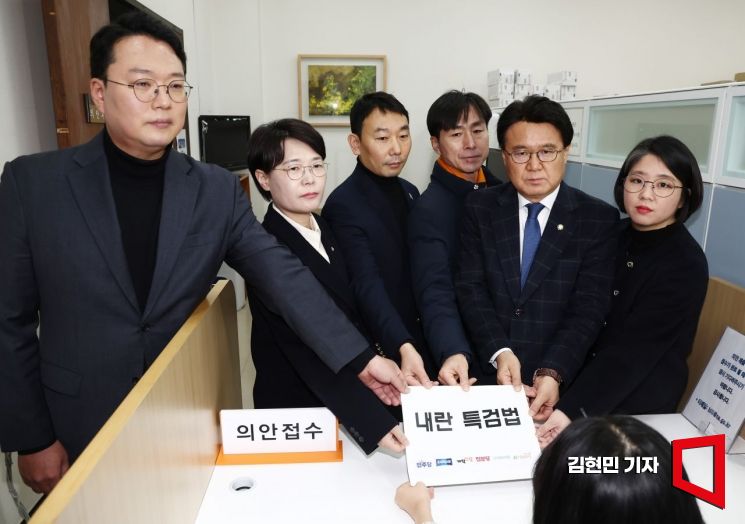 On the 9th, lawmakers from the six opposition parties submitted the Special Investigation Act on Sedition at the National Assembly's Legislative Affairs Office. From the left: Cheon Haram, Floor Leader of the Reform New Party; Jeon Jong-deok, lawmaker of the Progressive Party; Kim Yong-min, Deputy Floor Policy Leader of the Democratic Party of Korea; Han Chang-min, leader of the Social Democratic Party; Hwang Un-ha, Floor Leader of the Innovation Party for Justice; Yong Hye-in, leader of the Basic Income Party. Photo by Kim Hyun-min
However, it is highly likely that subsequent procedures will proceed as the Democratic Party intends. The Democratic Party plans to refer the bill to the Legislation and Judiciary Committee's first subcommittee for review and then hold another plenary meeting on the 13th to pass the Special Investigation Act on Treason in the committee. Once passed by the Legislation and Judiciary Committee, the bill will be put to a vote in the National Assembly plenary session. If the second Special Investigation Act on Treason is enacted, Acting President Choi is expected to face another dilemma over whether to promulgate the bill.
© The Asia Business Daily(www.asiae.co.kr). All rights reserved.


















