A Remarkable Achievement at an International Symposium Workshop
Usable Even with Limited Computational Resources
Professor Park Ki-woong's research team from the Department of Information Security at Sejong University achieved the remarkable feat of winning the Best Paper Award for their ransomware detection technology.
Sejong University announced on the 11th that Professor Park's research team received the Best Paper Award at the 8th Mobile Internet Security International Symposium Workshop (MobiSEc 2024), held over two days from the 17th of last month in Japan.
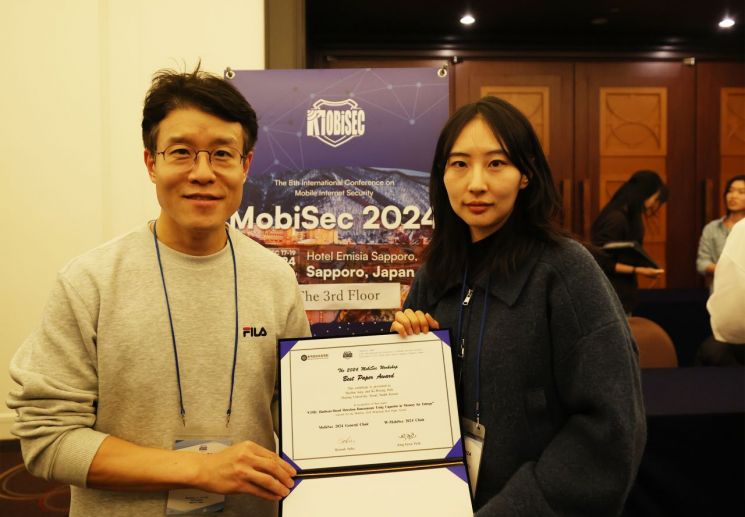 Professor Kiwoong Park (left) from the Department of Information Security at Sejong University and PhD candidate Herim Jeong (right) are taking a commemorative photo after receiving the Best Paper Award. Photo by Sejong University
This research focused on developing a new technology designed to overcome the limitations of existing ransomware detection methods. Ransomware is a malicious program that encrypts data stored on a computer without authorization and demands payment in exchange for decryption. Existing detection methods have focused on sensing software configurations and behavioral characteristics, but they have drawbacks such as high computational burden and difficulty keeping up with the rapid encryption speed of ransomware.
In response, Professor Park's research team developed a new ransomware detection technology that utilizes the physical characteristics of computer memory. They first noted that the random data write operations occurring during the data encryption process cause subtle changes in memory devices. They then devised a method to detect ransomware by sensing these changes in real time.
This technology operates based on the physical properties of semiconductor devices, allowing real-time analysis of memory data without performance degradation even in systems with limited computational resources. Therefore, it can be effectively utilized in environments with scarce computational resources, such as Internet of Things (IoT) devices.
Professor Park explained, "The ransomware detection technique developed in this research measures the entropy of data stored in memory in real time to detect ransomware," adding, "It does not burden computer performance and can also be used to monitor and process ultra-large data volumes in real time."
© The Asia Business Daily(www.asiae.co.kr). All rights reserved.
![Clutching a Stolen Dior Bag, Saying "I Hate Being Poor but Real"... The Grotesque Con of a "Human Knockoff" [Slate]](https://cwcontent.asiae.co.kr/asiaresize/183/2026021902243444107_1771435474.jpg)















