Strengthening the Safety Net for Patients and Medical Staff in Medical Accidents
Increasing Livelihood Benefits for Vulnerable Groups...
Thicker and More Detailed Welfare for the Disadvantaged
The government will begin persuading the medical community from the beginning of the year to normalize healthcare and resolve conflicts between the medical and government sectors. While focusing on maintaining emergency and urgent medical care systems to prevent disruptions in the treatment of severe and emergency patients, it will also present concrete achievements such as significantly raising the undervalued health insurance fees. To actively respond to the entry into a super-aged society, the government will build a sustainable health and welfare system and discuss raising the current elderly age of 65.
On the 10th, the Ministry of Health and Welfare reported the 2025 major work plan, including these contents, to Choi Sang-mok, Acting President and Deputy Prime Minister as well as Minister of Strategy and Finance.
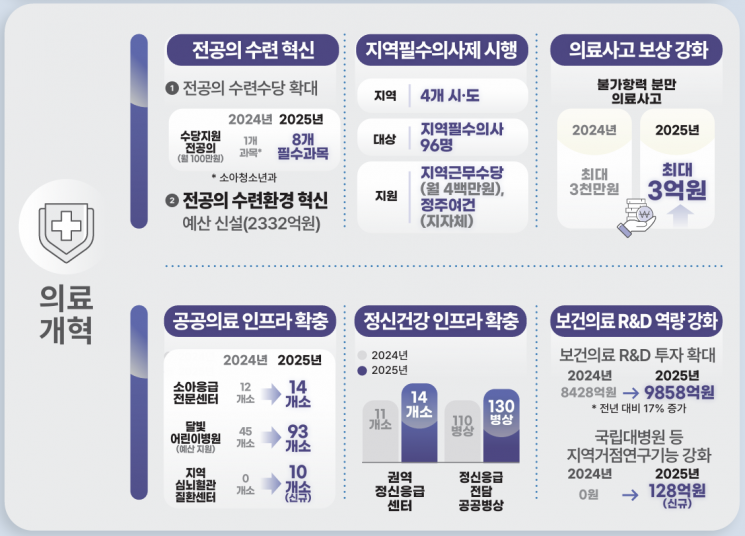
Strengthening Medical Accident Safety Nets for Patients and Medical Staff
The Ministry of Health and Welfare will first concretely implement the medical reforms that have been promoted since last year. Starting with doctors and nurses, it will establish a workforce supply and demand forecasting organization for each medical profession including dentists, Korean medicine doctors, and pharmacists to train medical personnel, and will also actively improve working conditions through a pilot project that reduces residents' working hours to 72 hours per week.
By innovating the medical accident dispute mediation system, including the establishment of a provisional 'Patient Advocate System,' the ministry will strengthen the protection of patients' rights and set up a prosecution system focused on gross negligence cases that require investigation and prosecution to resolve the avoidance of essential medical care.
The 47 advanced general hospitals nationwide will undergo structural transformation to focus on the treatment of severe, emergency, and rare diseases, while regional general hospitals with comprehensiveness and treatment capabilities will receive concentrated support. Specialized hospitals will also be reorganized focusing on essential treatment areas such as burn and cerebrovascular care. Regional responsibility medical institutions such as national university hospitals will strengthen their role as hubs for essential regional medical care, and regional public hospitals will be supported with operating costs, facilities, and equipment for essential medical care.
In particular, to eliminate the low-fee structure from the entire health insurance fee schedule by 2027, the fees for about 1,000 surgeries, procedures, and anesthesia fields will be prioritized for significant increases in the first half of this year. The ministry will establish a medical cost analysis foundation for scientific fee adjustments and build a system for continuous fee adjustment by drastically shortening the revision cycle of relative value scores (from 5-7 years to 2 years).
Furthermore, non-covered services that are essential for treatment will be converted to covered services, while non-covered services that raise concerns about overuse or abuse will be incorporated into a 'managed coverage (tentative name)' system to regulate prices and treatment standards. A pilot project will also be promoted to shorten the health insurance listing period for treatments of severe and rare diseases (from 210 to 150 days). A primary care innovation pilot project will be implemented to enable clinic-level medical institutions to provide continuous integrated health management and receive differentiated compensation based on performance.
To enhance the sustainability of health insurance and fairness in premium imposition, the ministry will also consider switching the property insurance premium for regional subscribers to a flat-rate system. Considering social perception changes due to the advent of a super-aged society and active seniors, preparations will be made for social discussions on raising the elderly age, currently set at 65.
Increasing Livelihood Benefits for Vulnerable Groups... Thicker and More Detailed Welfare for the Disadvantaged
Protection for vulnerable groups will also be strengthened. The median income standard, which serves as the selection criterion for 74 welfare projects including livelihood benefits, will be raised to the highest level ever (6.42%) to lower the welfare threshold. Livelihood benefits will be increased by 118,000 KRW per month (for a four-person household), and the dependent expense imposition rate included in income calculation for medical aid recipients will be eased for the first time in 16 years (from 30 or 15% to 10%), thereby strengthening livelihood and medical expense support for vulnerable groups.
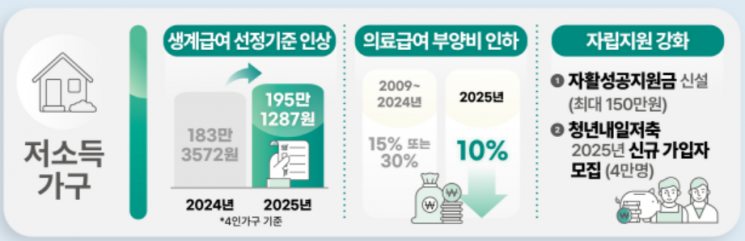
Basic pensions and disability pensions (basic benefits) will also be increased by reflecting the inflation rate (2.3%). Approximately 1.1 million jobs for the elderly will be provided, and to strengthen children's rights, the adoption process centered on private adoption agencies will be reorganized to be state-centered. An emergency protection fund (1 million KRW per month, about 3 months support) will be newly established to ensure safe care for newborns until the final protective institution is confirmed.
To support the independence of vulnerable groups, a self-support success support fund will be newly established to provide up to 1.5 million KRW annually when participants in self-support work exit livelihood benefits. The target for the Didim Seed Bank account, which supports early social entry of vulnerable children, will be expanded to include the existing near-poor class, and income criteria will be relaxed to recruit an additional 40,000 new subscribers to the Youth Tomorrow Savings Account.
Pension reform to secure the stability of pension finances will continue. The Ministry of Health and Welfare plans to implement a benchmark portfolio that can contribute 1 percentage point to long-term returns through various alternative investment assets, including private equity loans. Previously, alternative investments were limited to predetermined asset classes such as real estate, infrastructure, and private equity funds. Additionally, the ministry stated, "We will actively support prompt parliamentary discussions based on the government reform plan submitted last September."
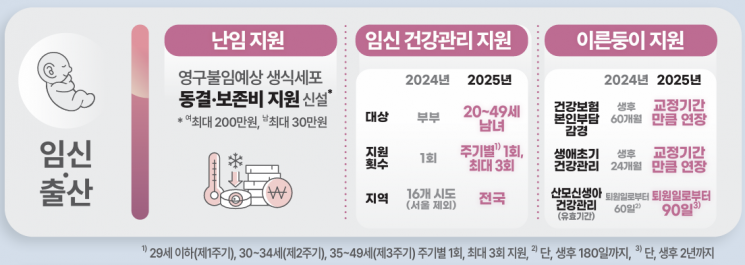
Furthermore, to rebound the birth rate, essential fertility tests will be supported for all men and women aged 20 to 49 regardless of marital status, and the cost burden for cesarean sections will be 'zeroed' just like natural births. Also, advanced criteria for selecting suspected crisis households will be prepared considering the importance and utilization differences of 47 types of crisis information, improving the accuracy of crisis household detection, and initial consultations using artificial intelligence (AI) will be actively provided.
© The Asia Business Daily(www.asiae.co.kr). All rights reserved.



















