Draft of Government Reform Plan Unveiled at Uigae Special Committee Forum
Medical Groups: "The More We Treat, the More We Lose... Need to Verify Overuse and Abuse First"
Patient Groups: "Non-Severe Non-Covered Services Should Not Be Reduced for Insurers' Profit"
The government proposed the 'Non-covered Service Management and Actual Expense Insurance Reform Plan,' which reduces coverage for non-severe and non-covered services and significantly increases the out-of-pocket rate for insurance subscribers (patients), prompting strong opposition from the medical community and patient groups. Opinions ranged from the need to first verify whether the problematic non-covered services are indeed excessive or abused treatments to concerns that the actual expense insurance reform plan only represents the interests of insurance companies and will reduce patient coverage.
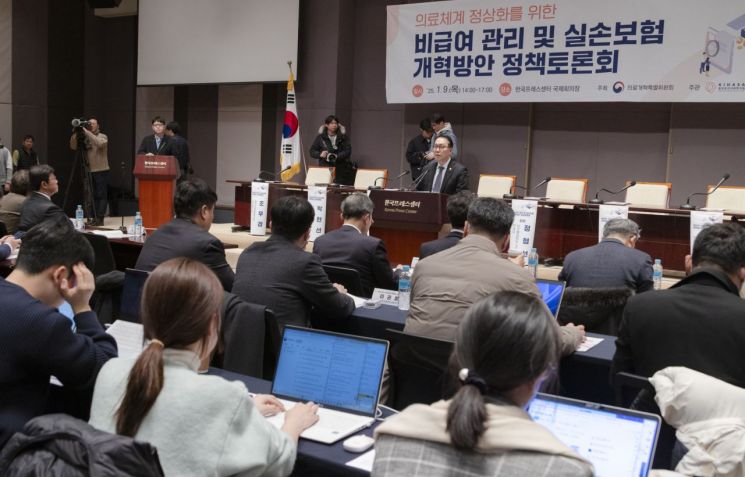
On the 9th, the Presidential Commission on Medical Reform held a 'Policy Forum on Non-covered Service Management and Actual Expense Insurance Reform Plan' at the Korea Press Center in Jung-gu, Seoul, and unveiled a draft of the reform plan. The core of the plan is to incorporate some unnecessary non-severe and non-covered medical services, such as manual therapy, into a 'managed coverage (tentative name)' category with higher out-of-pocket rates, and to introduce a 5th generation actual expense insurance plan that covers mainly severe cases.
Regarding the non-covered service reform plan, there were calls not only for reporting and managing non-covered services but also for direct price regulation. Nam Eun-kyung, Policy Director of the Citizens' Coalition for Economic Justice, said, "Managed coverage involves health insurance finances, so only a few can be included," adding, "All mixed non-covered services that overlap with covered services should be reported, and the government should set price guidelines for the identified non-covered services." Jeong Seong-hee, Research Coordination Director at the Korea Insurance Research Institute, also suggested, "The cost of non-covered services should be verified and disclosed, and once cost information accumulates, recommended prices based on that should be created and guidelines announced so consumers can be informed."
On the other hand, the medical community questioned the government's designation of regulatory items as 'excessive or abused non-covered services.' Yang Moon-sul, Director of Bupyeong Serim Hospital, explained, "As Korea enters a super-aged society, the concentration of musculoskeletal diseases in the top ranks of non-covered service items is not simply a moral hazard but reflects the emergence of new treatments that may offer alternative methods."
There were also differing views on the 5th generation actual expense insurance plan that reduces non-covered service coverage. Ham Myung-il, Professor of Health Administration and Management at Soonchunhyang University, said, "The increase in non-covered service prices and utilization seems to have lowered the income of essential medical personnel and caused future workers to avoid essential fields," adding, "Strengthening coverage focused on severe diseases in essential medical care aligns with health insurance reform." Kwon Byung-geun, Director of the General Insurance Association, agreed, saying, "I sympathize with the authorities' intention to reform to prevent the collapse of essential medical care and distortion of the medical delivery system," and "The reform plan focused on severe diseases is reasonable."
In contrast, patient groups expressed concerns that the government plan only represents insurance companies' interests and reduces coverage. Ahn Sang-ho, President of the Korea Congenital Heart Disease Patients Association, criticized, "Non-severe excessive non-covered services should not be reduced for the benefit of insurance companies," and "There is no visible expansion of coverage for severe diseases." The reform plan includes non-covered services as special contracts limited to registered patients under the special calculation system, but since the special calculation system itself is not perfect, it cannot be said to cover all severe diseases.
Seo In-seok, Director of Rochester Hospital, said, "Should the sterile meals for cancer patients and low-sodium diets for heart failure patients be regarded as mere meal costs rather than treatment purposes?" He added, "Instead of overhauling the entire actual expense insurance, let's first manage the problematic items and gradually expand the scope."
Lee Bong-geun, Insurance Director of the Korean Medical Association, rebutted, "Doctors did not create non-covered services or actual expense insurance, yet now they are being unfairly portrayed as an immoral group due to flawed systems." He said, "General physical therapy, not manual therapy, currently costs only 1,000 to 2,000 won, so hospitals lose money the more they provide medical services, and the government has induced hospitals to compensate for these losses through non-covered services," adding, "It would be better to first ensure cost compensation and then manage actual expense insurance."
The government and financial authorities emphasized that the reform plan aims to 'reduce the national medical expense burden' and 'normalize the medical system,' and responded that they will review opinions regarding concerns about reduced coverage. Jo Woo-kyung, Director of Essential Medical Care at the Ministry of Health and Welfare, said, "Currently, the health insurance system has limited mechanisms to manage prices," and added, "We will internally review the establishment of related legal grounds and consult with relevant ministries."
Park Min-soo, 2nd Vice Minister of Health and Welfare, stated, "The goal of non-covered service and actual expense insurance reform is to promote public health and reduce the national medical expense burden," adding, "By normalizing the distorted medical system, we will restore the broken balance with essential medical care and create a virtuous cycle structure that reinvests the savings from reform into regional and essential medical care to ensure that essential medical personnel receive fair compensation."
© The Asia Business Daily(www.asiae.co.kr). All rights reserved.
![Clutching a Stolen Dior Bag, Saying "I Hate Being Poor but Real"... The Grotesque Con of a "Human Knockoff" [Slate]](https://cwcontent.asiae.co.kr/asiaresize/183/2026021902243444107_1771435474.jpg)
















