Political and Academic Circles Mention Limits of the 1987 System
Pointing Out 'Imperial Presidency and Parliamentary Dominance' as Issues
"Winner-Takes-All Structure Must Be Abolished... Impeachment and Constitutional Reform Simultaneously"
It has been 38 years since the 9th revised constitution, known as the '1987 system,' was promulgated. Currently facing the third presidential impeachment phase, some quarters have begun to mention the need for constitutional revision. Kim Jong-in, former emergency committee chairman of the People Power Party and a member of the National Assembly's special committee on constitutional revision during the 9th revision, said, "When the constitution was revised in 1987, there was no discussion whatsoever about presidential powers," adding, "We are still leaving the presidential powers created by former President Park Chung-hee under the 'Yushin Constitution' intact."
The NEAR Foundation (Northeast Asia Research Foundation) held a discussion titled 'Creative Innovation of the Current 1987 Constitutional System' on the afternoon of the 9th in the medium conference room on the second basement floor of the Korea Chamber of Commerce and Industry. The discussion was attended by political figures including former Chairman Kim, former Democratic Party lawmaker Woo Yoon-geun, former Blue House policy chief Lee Gak-beom, former Minister of Foreign Affairs and Trade Song Min-soon, as well as academic experts such as Lee Sang-soo, head of the Constitutional Amendment Promotion Coalition, and professors Kang Won-taek, Jang Young-su, and Jang Yong-geun. Participants pointed out the problem of excessive concentration of power under the current presidential system. They also emphasized the need for a fundamental system change, citing the disregard for the spirit of collegiality in the National Assembly and the phenomenon of 'parliamentary dictatorship.'
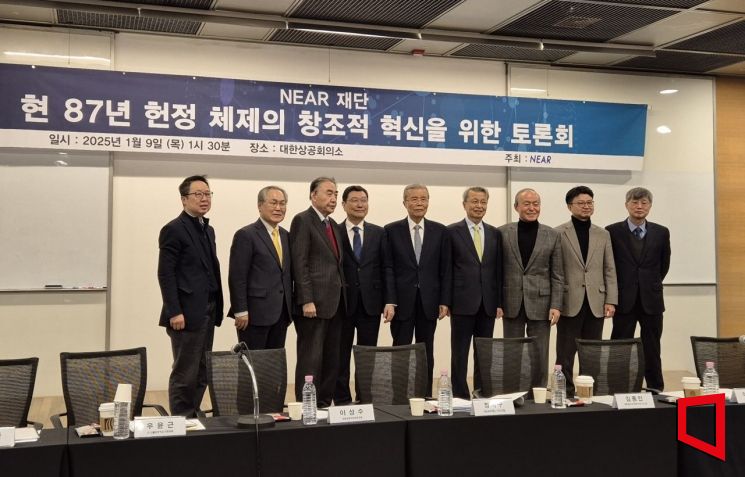 On the afternoon of the 9th, participants are taking a commemorative photo at the "Discussion for the Creative Innovation of the Current 1987 Constitutional Order" held at the Korea Chamber of Commerce and Industry. From the left: Jang Yong-geun, Professor at Hongik University Law School; Woo Yoon-geun, former member of the National Assembly from the Democratic Party of Korea; Lee Sang-soo, Representative of the Constitutional Amendment Promotion Coalition; Jung Deok-gu, Chairman of the Near Foundation; Kim Jong-in, former Emergency Committee Chairman of the People Power Party; Lee Gak-beom, former Senior Secretary for Policy at the Blue House; Song Min-soon, former Minister of Foreign Affairs and Trade; Jang Young-soo, Professor at Korea University Law School; Kang Won-taek, Professor of Political Science and International Relations at Seoul National University. Photo by Oh Ji-eun
Jeong Deok-gu, chairman of the NEAR Foundation, said in his opening remarks, "The emergency martial law incident proved that there are insufficient mechanisms to control extreme figures before they destroy the constitutional order," and added, "Under the two-party system, we have also witnessed the dysfunction of one-sided parliamentary proceedings due to the opposition party's overreach in the National Assembly." He continued, "If the next president is elected under the current constitution, the internal problems of Korean politics will become even more serious," and stated, "This is an opportunity to innovate the 1987 constitutional system."
Through a discussion lasting over three hours, participants identified problems with the five-year single-term presidential system and discussed alternatives such as ▲transition to a dual executive system or parliamentary cabinet system ▲introduction of medium and large electoral districts to enable a multiparty system ▲expansion of direct democracy. Lee Sang-soo, former Minister of Labor and head of the coalition, argued, "The winner-takes-all structure of the imperial presidency must be abolished first," and "Presidential impeachment and constitutional revision should proceed simultaneously." He believed that constitutional revision should be completed before the 2026 local elections.
Former Chairman Kim referred to his experience during the 1987 constitutional revision, explaining that since the main content was the 'direct election of the president,' presidential powers were hardly touched. He added, "If the ruling party fails in the general election during its term, the entire regime collapses," and said, "This shows that government operation is impossible when the legislature and government are in conflict." He analyzed that President Yoon Suk-yeol faced difficulties operating under a minority government throughout his term and, failing to resolve this politically, made the 'absurd choice' of emergency martial law.
Former Chief Lee Gak-beom said, "The presidential system must be fundamentally revised, and constitutional revision should be carried out in a direction that ends 'parliamentary dictatorship.'" He added, "We need new constitutional discussions by looking for our experiences and historical context rather than finding just one alternative," and said, "The constitution should be changed to strengthen the continuity of state affairs."
© The Asia Business Daily(www.asiae.co.kr). All rights reserved.
![Clutching a Stolen Dior Bag, Saying "I Hate Being Poor but Real"... The Grotesque Con of a "Human Knockoff" [Slate]](https://cwcontent.asiae.co.kr/asiaresize/183/2026021902243444107_1771435474.jpg)











