Concerns Over Prolonged Avoidance Phenomenon
LCC's Top Position May Also Be Shaken
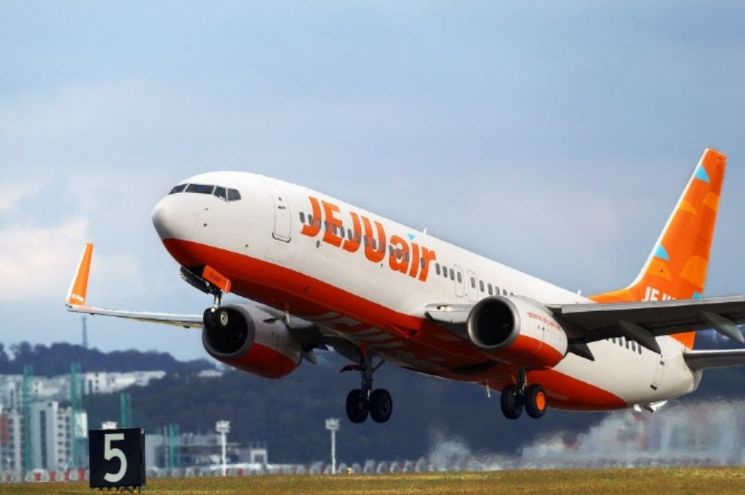
Jeju Air's daily passenger numbers have plummeted by 37% following the Muan Airport disaster. There are also forecasts that the avoidance of Jeju Air due to loss of trust could become prolonged.
According to the Ministry of Land, Infrastructure and Transport's Aviation Information Portal System on the 10th, Jeju Air's daily passenger count dropped from 50,755 on the 29th of last month to 32,091 as of the 2nd, a decrease of 36.8%. Compared to the overall domestic airlines' passenger numbers, which fell by 11.8% during the same period, Jeju Air's passenger scale shrank more than three times as steeply. The gap widens further when compared to competing low-cost carriers (LCCs) such as T'way Air (-4.9%) and Air Busan (-5.2%). Considering that major full-service carriers (FSCs) like Korean Air and Asiana Airlines only saw decreases of 6.6% to 9.6%, the avoidance phenomenon toward Jeju Air is particularly pronounced.
Considering Jeju Air's voluntary announcement to reduce flight operations by about 10-15% in the first quarter, the passenger transport performance this year is expected to decline further. Jeju Air has already decided to cut a total of 1,878 flights, including 838 domestic and 1,040 international flights, until March 29.
There are forecasts that Jeju Air's long-held position as the number one LCC could be shaken. Last year, Jeju Air recorded a total passenger count of 13,352,539, ranking third among all domestic airlines after Korean Air and Asiana Airlines, and first among LCCs. Jin Air, the second-ranked LCC, had 11,034,665 passengers, 17.4% fewer than Jeju Air. If Jeju Air continues to reduce flights in the first quarter and the avoidance trend persists due to a decline in corporate image, the rankings could be reversed. Already, Jin Air's operating profit market consensus for last year stands at 173.3 billion KRW, surpassing Jeju Air's 151.0 billion KRW.
As of the end of the third quarter last year, Jeju Air's cash equivalents amounted to 181 billion KRW. If customers cancel their bookings, the advance payments will decrease, reducing cash equivalents. If all advance payments (260.8 billion KRW as of the end of the third quarter) are fully refunded, additional funding may be required. Since Jeju Air announced that all tickets booked before December 29 last year will be refunded free of charge by the end of this month, it cannot offset some of the refunds with cancellation penalties.
An aviation industry official said, "If the avoidance phenomenon prolongs, Jeju Air will have to drastically revise all its business strategies."
© The Asia Business Daily(www.asiae.co.kr). All rights reserved.
![Clutching a Stolen Dior Bag, Saying "I Hate Being Poor but Real"... The Grotesque Con of a "Human Knockoff" [Slate]](https://cwcontent.asiae.co.kr/asiaresize/183/2026021902243444107_1771435474.jpg)











