Nationwide Flu Cases Reach 8-Year High
Gwangju Sees Weekly Increase Since Last Year
Flu Likely to Spread Through Spring... Vaccination Urged
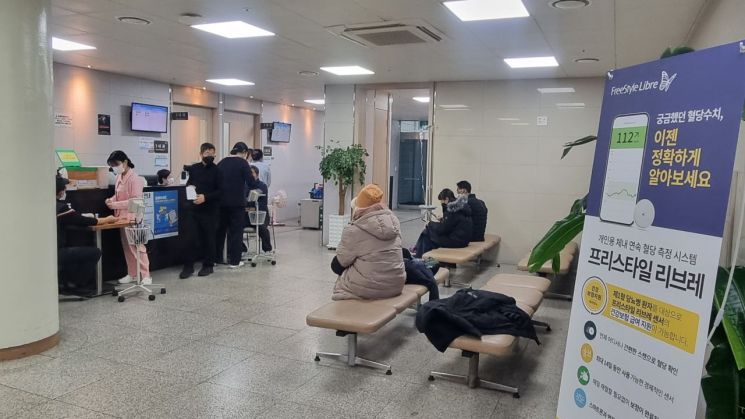 On the morning of the 9th, the internal medicine waiting room of a hospital in Seo-gu, Gwangju, is bustling with patients seeking treatment for respiratory diseases and other conditions. Photo by Min Chanki
"Suddenly, there is an influenza outbreak in my child's elementary school class. I'm worried because my child has been suffering from a cough all day."
On the morning of the 9th, at the waiting room of an internal medicine clinic in Seo-gu, Gwangju.
The place was packed with patients of all ages, from children to the elderly, who had come early in the morning to receive treatment for respiratory illnesses and other conditions.
A child waiting for treatment had a high fever of about 39 degrees Celsius and was sweating profusely, while guardians explained the child's condition to the nurse.
Another child was sniffling and coughing in the waiting room, and the accompanying parents wiped around the child's mouth with tissues, looking worried.
The monitor next to the examination room quickly filled up with the names of waiting patients. Patients wearing masks watched the display, waiting for their turn.
Kim (39), who took a half-day off work to visit the hospital due to her child's cough, said, "There is an influenza outbreak in my child's class. My child suddenly started coughing a few days ago, so I rushed to the hospital out of concern. With the flu spreading, I plan to stay by my child's side and take care of them until they get better."
According to the Gwangju Infectious Disease Control Team, the influenza-like illness rate in Gwangju for week 51 (December 15-21) was 39.8 per 1,000 people.
By week, the numbers were 6.4 in week 47, 7.7 in week 48, 12.5 in week 49, and 19.4 in week 50, showing a rapid weekly increase in flu cases.
Influenza cases have also been increasing nationwide.
According to the Korea Disease Control and Prevention Agency, the influenza-like illness rate for week 52 (December 22-28) was 73.9 per 1,000 people.
This is about 2.4 times higher than the 31.3 per 1,000 people recorded in week 51, marking the highest nationwide flu rate in eight years since 86.2 in 2016.
By year, the rates for the same period were 49.8 in 2019, 2.5 in 2020, 2.1 in 2021, 55.4 in 2022, and 49.9 in 2023, showing a steady upward trend.
By age group, the highest incidence was among those aged 13-18, followed by 7-12, and then 19-49.
As of the second week of December (week 50, December 8-14), the nationwide influenza-like illness rate had already reached 13.6 per 1,000 people, exceeding the epidemic threshold of 8.6, prompting an influenza epidemic advisory.
The Korea Disease Control and Prevention Agency predicted that this influenza outbreak would continue until spring, emphasizing that children, pregnant women, and seniors over 65 should definitely receive the influenza vaccine.
An official from the Gwangju Infectious Disease Control Team said, "With influenza and other respiratory infections spreading, extra caution is needed. Please follow infection prevention measures such as proper handwashing and indoor ventilation, and if you have a fever or respiratory symptoms, visit a medical institution immediately to receive appropriate treatment."
© The Asia Business Daily(www.asiae.co.kr). All rights reserved.
![Clutching a Stolen Dior Bag, Saying "I Hate Being Poor but Real"... The Grotesque Con of a "Human Knockoff" [Slate]](https://cwcontent.asiae.co.kr/asiaresize/183/2026021902243444107_1771435474.jpg)















