Passage of 21 Economic and Livelihood-Related Bills
Establishment of Appointment Procedure for Acting Chief Justice of the Constitutional Court
Emergency Questioning on Charges of Insurrection Within 9 Days
The National Assembly has launched a special committee to investigate the cause of the Jeju Air passenger plane disaster that occurred at Muan International Airport and to provide relief for the victims' families. A bill allowing each individual to open one livelihood expense account was also passed.
On the 8th, the National Assembly held a plenary session and approved the formation of the "Special Committee for the Investigation of the 12.29 Passenger Plane Disaster and Relief for Victims and Bereaved Families."
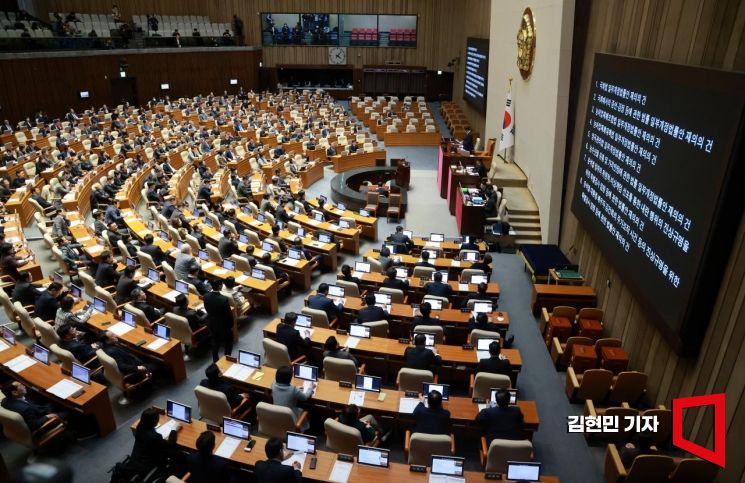
The special committee will discuss the investigation of the cause and establishment of measures to prevent recurrence related to the Jeju Air passenger plane disaster that occurred on December 29 last year at Muan International Airport in Jeollanam-do, as well as relief and support plans for victims and their families. The committee will consist of 15 members: 7 from the People Power Party, 7 from the Democratic Party of Korea, and 1 from a non-negotiating group. The chairperson will be Kwon Young-jin, a member of the People Power Party. Under the special committee, there will be a subcommittee for investigation and prevention of recurrence and another subcommittee for support and memorial projects for the bereaved families. The activity period is until June 30.
The National Assembly also decided to hold an urgent current affairs question session on the 9th from 2 p.m. regarding the investigation of the passenger plane disaster and the charges of insurrection related to President Yoon Suk-yeol's declaration of martial law. On the same day, the plenary session passed the "Urgent Current Affairs Question on President Yoon Suk-yeol's Unconstitutional Declaration of Martial Law and the Investigation of the Jeju Air Passenger Plane Disaster." Despite abstentions and opposition from ruling party members, the motion passed with 202 votes in favor, 3 against, and 25 abstentions out of 230 members present.
Passage of the 'Civil Execution Act Amendment' to Prevent Seizure of Livelihood Expense Accounts
During the plenary session, numerous economic-related bills were passed. The National Assembly approved a partial amendment to the Civil Execution Act that prohibits the seizure of one account per individual. The passed bill stipulates that each person can open one livelihood expense account, and the deposit claims corresponding to this account cannot be seized by creditors. If the amount deposited in this account exceeds the seizure-protected livelihood expenses, the excess amount will be automatically transferred to a reserve account.
The National Assembly also passed an amendment to the Act on the Promotion of Nanotechnology Development, allowing the government to designate a public nanofab center and provide government funding and special privileges. An amendment to the Special Act on the Fostering of National Strategic Technologies was also passed, requiring prior consultation with the head of the central administrative agency before providing national strategic technology-related information to foreign governments or institutions. Additionally, a partial amendment to the Act on the Establishment, Operation, and Fostering of Government-Funded Research Institutions in the Science and Technology Field was passed, mandating that the appointment process for a successor director of a government-funded research institute must begin at least three months before the current director's term expires. The Basic Act on the Treatment of Foreigners Residing in Korea was also amended to remove the legal term "illegal stay foreigners" from surveys of "foreigners residing in Korea" and "illegal stay foreigners," instead encompassing both groups under the term "foreigners residing domestically."
Meanwhile, the National Assembly passed an amendment to the Constitutional Court Act, which stipulates the procedure for appointing an acting head when the Chief Justice of the Constitutional Court is temporarily unable to perform duties due to an accident. This bill defines the appointment procedure for the acting Chief Justice by law rather than by enforcement decree, and specifies that when the Chief Justice is temporarily unable to perform duties, a justice will act as the head in order of appointment date. If the appointment dates are the same, the senior justice will act as the head. The bill passed with 250 votes in favor, 2 against, and 15 abstentions out of 267 members present.
© The Asia Business Daily(www.asiae.co.kr). All rights reserved.
![Clutching a Stolen Dior Bag, Saying "I Hate Being Poor but Real"... The Grotesque Con of a "Human Knockoff" [Slate]](https://cwcontent.asiae.co.kr/asiaresize/183/2026021902243444107_1771435474.jpg)















