Inquiries Continue Regarding Whether Various Allowances Are Included in Ordinary Wages
Following the Supreme Court plenary session ruling that conditional regular bonuses paid based on conditions such as company employment status or number of working days must be included in ordinary wages, law firms are rushing to hold related seminars. Given the high likelihood of increased financial burdens on companies due to potential rises in various allowances, more than 2,000 corporate representatives and others have flocked to these seminars. At the seminars, corporate representatives focused their inquiries on whether performance bonuses or welfare-related allowances are included in ordinary wages.
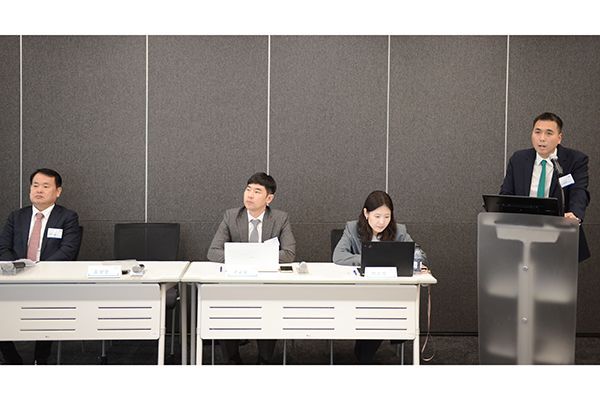 Attorney Kim Sang-min of the law firm Taepyungyang (far right) is presenting at the 'Ordinary Wage Judgment' webinar held on the 6th. Photo by Legal Newspaper
◇ Inquiries from companies flood in immediately after ruling... 2,400 attendees at webinars
The Supreme Court plenary session (Presiding Justice Oh Kyung-mi) on the 19th of last month changed precedent by abolishing the fixedness criterion in a wage lawsuit filed by current and former employees of Hanwha Life Insurance and Hyundai Motor Company against their companies. The plenary session stated, "Ordinary wages are a legal and mandatory concept, so they must be interpreted faithfully according to the legal definition and not be arbitrarily changed by the parties. 'Fixedness' has no basis in any law, including Article 6, Paragraph 1 of the Enforcement Decree of the Labor Standards Act, which defines ordinary wages."
The reason law firms are consecutively holding seminars on this ruling is due to the flood of inquiries from corporate officials immediately after the decision. The legal principle, revised comprehensively for the first time in 11 years, inevitably brings many changes to wage-related practices in companies, and some companies now need to consider changing their wage systems or the possibility of litigation following this ruling.
Kim & Chang Law Office (Representative Attorney Jung Kye-sung) held a webinar on the 27th of last month titled "The Meaning and Future Prospects of the Change in Ordinary Wage Precedents." At the webinar, Attorney Joo Sun-ah presented on "Analysis of the Plenary Session Ruling and Future Prospects," and Attorney Cho Beom-gon explained whether each wage item qualifies as ordinary wages. On the same day, Law Firm Sejong (Representative Attorney Oh Jong-han) held a webinar together with the Korea Chamber of Commerce and Industry. Attorneys Yoon Hye-young and Kim Jong-soo served as presenters at the Sejong webinar.
Law Firm Yulchon (Representative Attorney Kang Seok-hoon) held a webinar analyzing the same ruling on the 3rd. Attorney Lee Myung-chul, a former Supreme Court judicial research officer, provided commentary on the ruling, Attorney Choi Jin-soo presented on the impact of existing ordinary wage disputes, and Attorney Lee Kwang-sun explained "Future Dispute Trends and Wage System Reform Measures."
Law Firm Bae, Kim & Lee (Representative Attorney Lee Jun-gi) held a webinar on the 6th titled "How to Respond to the Expansion of Ordinary Wages Following the Exclusion of Fixedness?" Attorney Park Eun-jung explained the significance of this ruling, and Attorneys Koo Kyo-woong and Kim Sang-min introduced "Corporate Response Measures After the Ruling."
Law Firm Kwangjang (Representative Attorney Kim Sang-gon) held a webinar on the 8th titled "Explanation and Response Measures for the Recently Delivered Supreme Court Ruling on Ordinary Wages." Attorneys Kim Young-jin and Oh Yong-soo served as presenters at the Kwangjang webinar. Law Firm Barun (Representative Attorneys Lee Dong-hoon, Lee Young-hee, Kim Do-hyung) plans to hold a related seminar on the 9th.
◇ "Review needed according to the nature of each performance bonus"
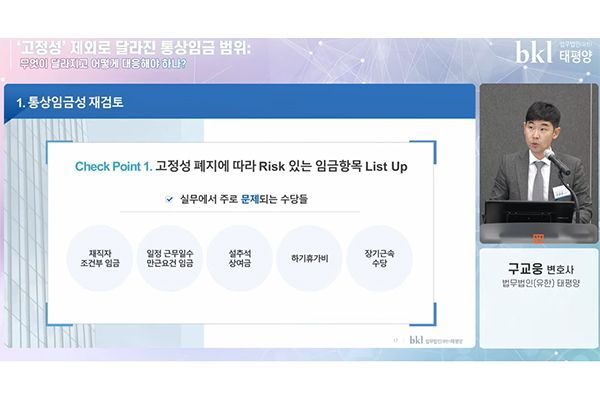 Attorney Koo Kyo-woong of the law firm Taepyungyang is presenting at the 'Ordinary Wages Judgment' webinar held on the 6th. Photo by Legal Newspaper
At the seminars, corporate representatives inquired about whether △ each company’s performance bonuses, conditional bonuses based on employment, and welfare-related allowances qualify as ordinary wages △ how to calculate and reflect new ordinary wages in wages when reflecting the precedent changes △ how unpaid annual leave allowances for 2024 will be handled in relation to the prospective effect of this ruling △ and the validity of conditional allowances.
Attorney Song Hyun-seok (51, Judicial Research and Training Institute Class 34) of Kwangjang explained, "Basically, as the scope of ordinary wages expands, it is necessary to manage overtime, night, and holiday working hours meticulously," adding, "A detailed review is needed regarding which existing wage items qualify as ordinary wages under the changed precedent and which do not."
Regarding unpaid annual leave allowances for 2024, Attorney Kim Sang-min (46, Class 37) of Bae, Kim & Lee said, "Since this is a claim arising in 2025, this ruling applies, and it should be included in ordinary wages." On the validity of conditional allowances, Attorney Kim explained, "This ruling does not deny the validity of conditional allowances," adding, "Separate from inclusion in ordinary wages, allowances with attached conditions must be paid, and if the conditions are not met, there is no obligation to pay."
Regarding whether performance bonuses qualify as ordinary wages, Attorney Kim Dong-wook (54, Class 36) of Sejong said, "It is necessary to review whether the nature of the performance bonus qualifies as wages under the Labor Standards Act," adding, "According to this ruling, the key point is whether there is remuneration for prescribed work, which is a requirement for ordinary wages."
Additionally, inquiries continued about whether △ holiday bonuses also qualify as ordinary wages △ and whether the application timing of new wage standards can be adjusted by labor-management agreement.
Attorney Lee Myung-chul (55, Class 30) of Yulchon said, "Holiday bonuses included in regular bonuses are highly likely to be considered ordinary wages," but added, "However, for bonuses paid solely because employees are employed during holidays regardless of prescribed work, separate judgments may be needed, so we need to watch the trend." He further stated, "Whether something qualifies as ordinary wages is a mandatory provision (enforced regardless of the parties' intentions), so even if labor and management agree on the application timing, it cannot be forced on each employee."
Attorney Jung Sang-tae (49, Class 35) of Barun said, "This ruling is expected to cause confusion and labor-management conflicts in wage negotiations from the beginning of the year, and companies will need to reorganize their wage systems."
Reporter Han Su-hyun, Legal Times
※This article is based on content supplied by Law Times.
© The Asia Business Daily(www.asiae.co.kr). All rights reserved.
![Clutching a Stolen Dior Bag, Saying "I Hate Being Poor but Real"... The Grotesque Con of a "Human Knockoff" [Slate]](https://cwcontent.asiae.co.kr/asiaresize/183/2026021902243444107_1771435474.jpg)

















