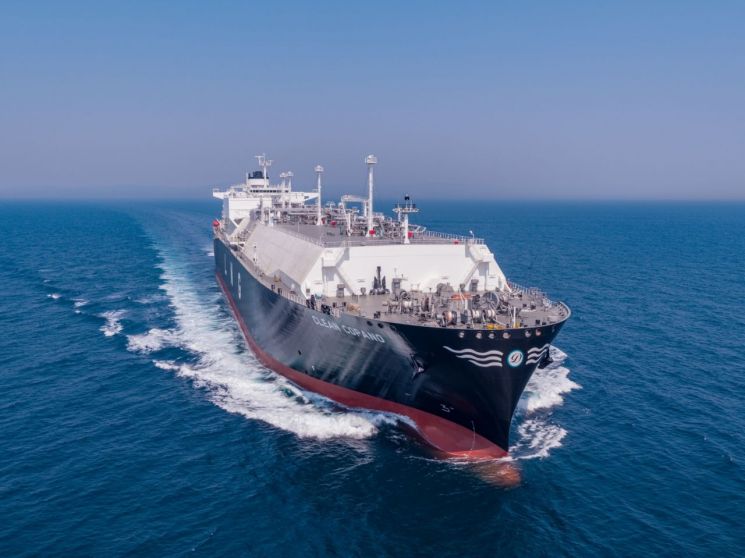
Last year, South Korea's order share in the global shipbuilding market recorded its lowest level in eight years. It is analyzed that the decline in market share is due to the Korean shipbuilding industry's strategy of selective orders focusing on high value-added ships, despite having already secured 3 to 4 years' worth of work orders.
According to Clarkson Research, a UK-based maritime market analysis firm, South Korea secured 10.98 million CGT (Compensated Gross Tonnage, equivalent to 250 ships), accounting for 17% of the global orders last year. Although the order volume increased by 9% compared to 2023, the global market share dropped by 3 percentage points from 20%. This is largely attributed to the three major Korean shipbuilders' shipyards having secured 3 to 4 years of workload and thus adopting a selective ordering approach.
According to data from the Export-Import Bank of Korea, South Korea's order share fell to the 10% range for the first time since 2016 (15.6%). Meanwhile, China secured 46.45 million CGT (1,711 ships) last year, accounting for 71% of the global orders. China's order volume increased by 58% year-on-year, and its market share rose by 11 percentage points.
As a result, the market share gap between South Korea and China widened from 40 percentage points in 2023 to 54 percentage points last year. The total global order volume last year was 65.81 million CGT (2,412 ships), a 34% increase compared to the previous year.
In December last year, the global order volume was 1.94 million CGT (86 ships), down 56% compared to the same period the previous year. Of this, China accounted for 1.66 million CGT (67 ships, 86%), and South Korea accounted for 70,000 CGT (3 ships, 4%).
As of the end of last year, the global order backlog increased by 1.67 million CGT from the previous month to 157.17 million CGT. China held 90.78 million CGT (58%), and South Korea held 37.87 million CGT (24%). The Clarkson Newbuilding Price Index stood at 189.16 at the end of last year, down 0.02 from November (189.18), but 6% higher than the same period the previous year.
By ship type, the prices were $260 million for liquefied natural gas (LNG) carriers, $129 million for ultra-large crude oil tankers, and $275 million for ultra-large container ships.
© The Asia Business Daily(www.asiae.co.kr). All rights reserved.
![Clutching a Stolen Dior Bag, Saying "I Hate Being Poor but Real"... The Grotesque Con of a "Human Knockoff" [Slate]](https://cwcontent.asiae.co.kr/asiaresize/183/2026021902243444107_1771435474.jpg)















