Lee "Crisis Situation... Special Efforts Are Essential"
Ministry of Economy and Finance Mentions 'Incentives and Foreign Currency Supply'
Choi Ji-young "Will Strive to Enhance Competitiveness"
Lee Jae-myung, leader of the Democratic Party of Korea, recently targeted the rising trend of the won-dollar exchange rate, stating, "This is a crisis situation, so the efforts of financial and foreign exchange authorities are urgently needed."
On the morning of the 8th, Lee attended the 'Meeting of Related Agencies to Review the Foreign Exchange Market' held at the National Assembly, saying, "Fortunately, today's foreign exchange graph has turned downward, which is a relief," but added, "The public is very worried about the economic situation." The won-dollar exchange rate, which had surged after the December 3 emergency martial law incident last year, closed down amid a falling market the previous day. The won-dollar exchange rate, which started the day slightly higher, is maintaining a steady trend.
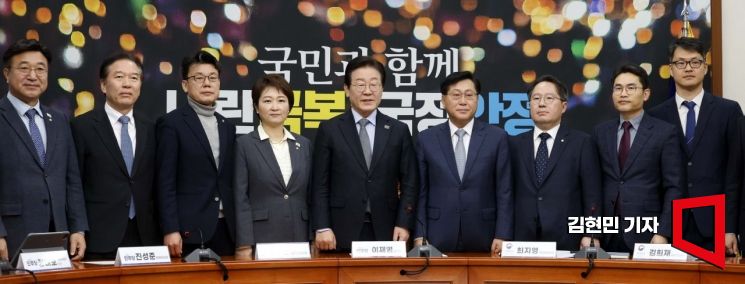 Lee Jae-myung, leader of the Democratic Party of Korea, is attending a meeting of related agencies to review the foreign exchange market held at the National Assembly on the 8th and posing for a commemorative photo. From the left, Yoon Ho-jung, member of the Planning and Finance Committee, Jeong Tae-ho, secretary, Jin Seong-jun, chairman of the Policy Committee, Lee Eon-ju, Supreme Council member, Lee Jae-myung, Choi Ji-young, Director of International Economic Management at the Ministry of Strategy and Finance, Kwon Min-soo, Deputy Governor of the Bank of Korea, Yoon Kyung-soo, Director of the International Department of the Bank of Korea, Kim Hee-jae, Head of Foreign Currency Funds at the Ministry of Strategy and Finance. Photo by Kim Hyun-min
At the meeting, officials invited by the Democratic Party, including Choi Ji-young, Director of International Economic Management at the Ministry of Economy and Finance, Kim Hee-jae, Head of Foreign Currency Funds at the Ministry of Economy and Finance, Kwon Min-soo, Deputy Governor of the Bank of Korea, and Yoon Kyung-soo, Director of the International Department at the Bank of Korea, also attended. They reported on foreign exchange market trends and discussed necessary measures to stabilize the market. After reviewing domestic exchange rate policies, Lee plans to seek countermeasures against the prolonged high exchange rate.
Director Choi analyzed the reasons for the won's weakness, stating, "Along with the strong dollar effect, we believe that political uncertainty in our country has increased since December last year." He added, "We are responding through foreign direct investment incentives and expanding foreign currency supply and demand with the National Pension Service," and stated, "We will strive to enhance the attractiveness of the domestic market and strengthen industrial competitiveness in cooperation with related ministries on a more fundamental level."
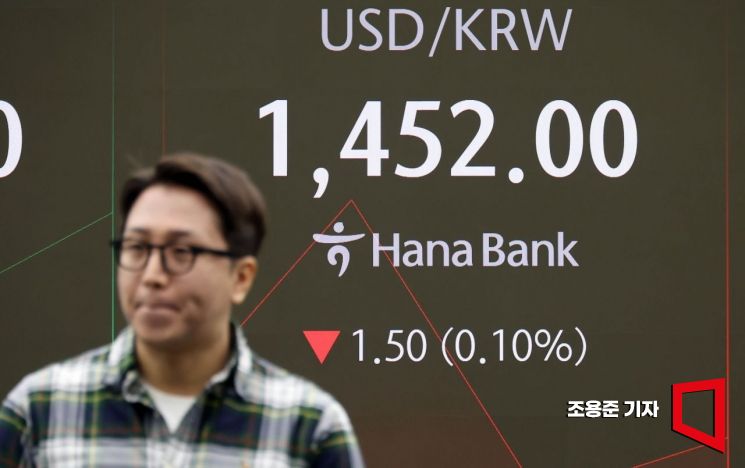 On the 8th, as the three major indices on the New York Stock Exchange all closed lower, reigniting concerns about inflation (persistent price increases), employees at the Hana Bank dealing room in Jung-gu, Seoul, were conducting their work. On that day, the KOSPI index opened at 2,481.25, down 10.85 points (0.44%) from the previous session, and the won/dollar exchange rate started at 1,455.0 won, up 1.5 won, continuing its downward trend. Photo by Jo Yongjun
Lee had previously expressed concerns several times about the prolonged high exchange rate situation. On the 9th of last month, before the impeachment motion against President Yoon Seok-youl was passed in the National Assembly, he said, "If President Yoon does not resign immediately and continues to resist, it will cause irreversible damage in areas such as the exchange rate," and mentioned, "The foreign exchange and stock markets have been continuously shocked since the declaration of martial law." His direct mention of the need to manage the foreign exchange market by meeting with officials on this day could be a strategic move to seek solutions to the unstable exchange rate while emphasizing responsibility for the emergency martial law incident.
Meanwhile, the won-dollar exchange rate's rise last year recorded the largest increase in 16 years since the 2008 global financial crisis. Domestic and international research institutions expect this trend to continue this year, with the exchange rate likely to keep rising.
© The Asia Business Daily(www.asiae.co.kr). All rights reserved.


















