First Implementation This Year... Reduction Area Notification to Farms Within This Month
Priority Allocation of Public Stock Rice to Farms Complying with Reduction
Additional Basic Direct Payment Support Considered for Excess Reduction
The government will implement the 'Rice Cultivation Area Adjustment System' starting this year to resolve the recurring problem of rice overproduction. Farms that participate in the reduction, aiming to cut 80,000 hectares of rice cultivation area, will be given priority allocation of public stockpiled rice at purchase prices higher than the market rate.
An official from the Ministry of Agriculture, Food and Rural Affairs stated on the 8th, "There is a structural oversupply situation where the decrease rate of rice cultivation area is smaller than the decrease rate of consumption," adding, "Despite efforts to reduce cultivation area through expanded strategic direct payments, the number of farmers returning to rice farming is increasing. Therefore, to resolve the structural oversupply in the rice industry and stabilize supply and demand, we have decided to promote the pre-area reduction system called the Rice Cultivation Area Adjustment System."
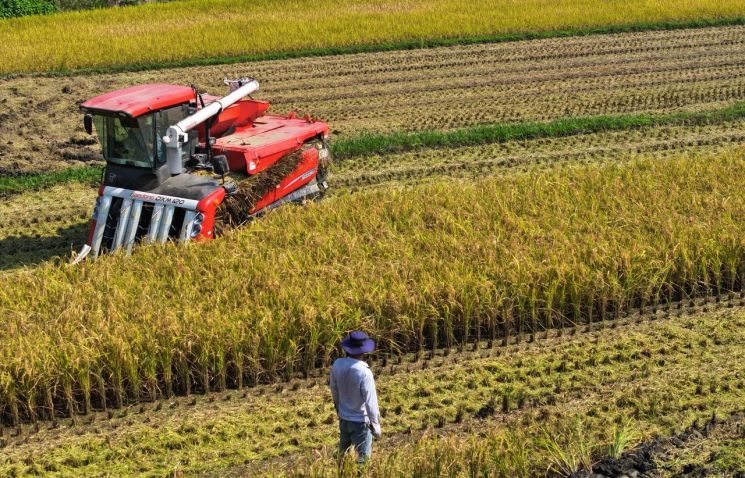
According to the Ministry of Agriculture, Food and Rural Affairs, per capita rice consumption decreased by 7.5% from 61 kg in 2018 to 56.4 kg in 2023, while the rice cultivation area only decreased by 4.1%, from 738,000 hectares to 708,000 hectares during the same period.
Since 2005, the government has intervened in the market 12 times by isolating rice from the market to reduce supply, but these efforts have been insufficient. The decline in rice prices during harvest due to oversupply leads to reduced farm income. As a result, the income rate of rice farmers has stagnated at around 60% since 2005. The Ministry of Agriculture, Food and Rural Affairs views the implementation of a pre-area reduction system as inevitable to stabilize supply and demand.
The reduction of rice cultivation area will be carried out by the government setting a total reduction target and distributing it to cities and provinces. Considering expected rice demand and market isolation volumes, the ministry is pushing the Rice Cultivation Area Adjustment System with a target of reducing 80,000 hectares this year. The area adjustment will be applied to all rice farmers, taking into account fairness and feasibility. Eco-friendly rice and powdered rice are excluded from the adjustment system, and the reduction will target the cultivation area of general rice.
Earlier, at the end of last year, the government allocated reduction areas to local governments based on their 2024 rice production and notified them. Jeonnam, which accounts for 19.8% of rice production, must reduce cultivation area by 15,831 hectares. Following that, Chungbuk is allocated 15,763 hectares, Jeonbuk 12,163 hectares, Gyeongbuk 10,710 hectares, and Gyeonggi 8,108 hectares for reduction.
Considering the purpose of reduction and ease of implementation, the government has developed various implementation methods such as 'trading of reduction areas between farms.' For example, if 0.1 hectares of reduction is imposed on each of 10 farms, one farm reducing 1 hectare will be considered as all 10 farms having fulfilled the reduction. Also, when general rice farms switch to eco-friendly or powdered rice, it is recognized as fulfilling the reduction. The ministry will notify examples of deemed implementation when issuing adjustment notices and will continue to identify farmers' difficulties to improve implementation methods before the inspection period.
Verification of implementation will be conducted through satellite images and on-site inspections based on supporting documents. Farms that have reduced rice cultivation area must submit proof documents to the local township or neighborhood office by September 1. A monitoring system will then be activated to verify implementation through satellite images, and suspicious farms will be subject to on-site inspections.
The government plans to encourage participation in the adjustment system by providing incentives to participating farms. Farms that fulfill the reduction will be given priority allocation of public stockpiled rice at purchase prices 7-10% higher than the market price, and additional basic direct payments will be considered for over-reduction. Considering last year's public stockpiled rice purchase scale (90,000 hectares), farms that do not reduce rice cultivation area will mostly be excluded from the public stockpiled rice program.
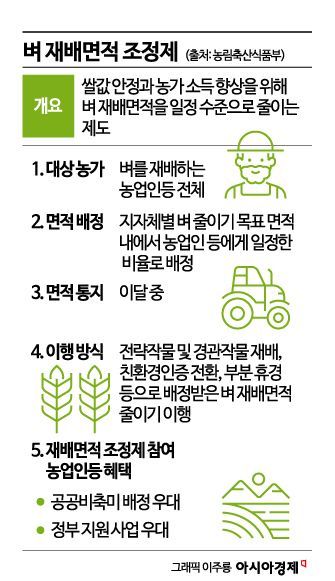
Provinces and cities that exceed reduction targets will be given preferential treatment in various rural development projects such as general agricultural and fishing village development (national budget of 570 billion KRW), rural spatial maintenance (68 billion KRW), and agricultural machinery rental (31 billion KRW), as well as in the selection of food-related policy projects, and will receive additional public stockpiled rice allocations.
An official from the Ministry of Agriculture, Food and Rural Affairs said, "If rice prices stabilize through the adjustment of rice cultivation area, farmers will be able to secure appropriate profits, and the government will reduce financial burdens by cutting management costs such as rice stockpiling caused by overproduction. Balancing supply and demand through area adjustment will alleviate the imbalance between production and consumption and respond to the decrease in rice consumption."
© The Asia Business Daily(www.asiae.co.kr). All rights reserved.


















