Prosecutors Refile Warrant Request at Western District Court
Withdraw Attempt to Shift 'Yoon Arrest' to Police
Security Chief and Prosecutors Differ on On-Site Arrest Position
The joint investigation headquarters (Joint HQ) investigating the '12·3 Emergency Martial Law Incident' is facing instability. This is because the High-ranking Officials' Crime Investigation Office (HOCI) and the police have differing opinions on executing the arrest warrant for President Yoon Seok-yeol. Although both sides have agreed again to maintain the Joint HQ system, concerns are emerging that the failure experienced during the first arrest warrant execution may be repeated.
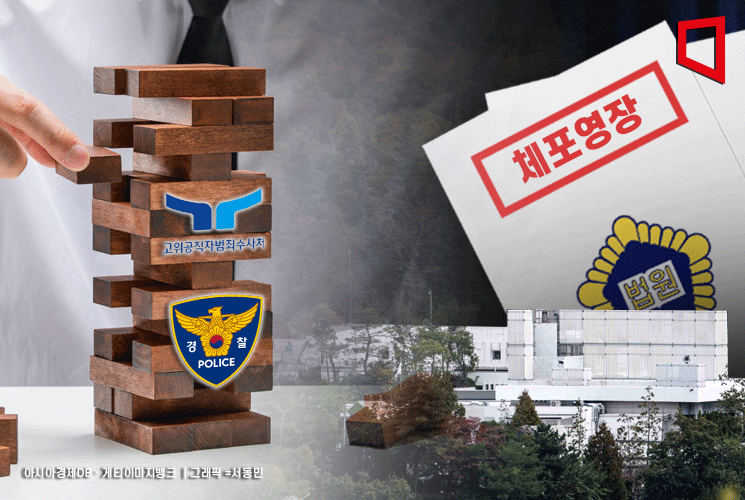
According to the legal community on the 7th, HOCI re-requested an arrest warrant from the Seoul Western District Court the day before to extend the validity period of the warrant against President Yoon. The Joint HQ is expected to proceed with the second execution of the arrest warrant once the court issues the re-requested warrant. The Joint HQ is an investigative consultative body composed of the National Investigation Headquarters (NIH) of the National Police Agency, HOCI, and the Ministry of National Defense Investigation Headquarters.
HOCI and the police claim that the Joint HQ system remains intact, but the underlying situation is different. On the 5th, around 9 a.m., HOCI sent an official letter to the Special Investigation Unit of the NIH at the National Police Agency titled 'Command for Execution of Arrest and Search Warrants.' The letter cited Article 47 of the HOCI Act, Articles 81, 291, 200-6, and 115(1) of the Criminal Procedure Act as grounds to entrust the police with executing the arrest warrant.
The police rejected HOCI's letter, citing legal defects. Baek Dong-heum, deputy head of the Special Investigation Unit, said, "After internal legal review, we judged that HOCI's letter has legal controversies," and added, "We will continue to consult with HOCI regarding the execution of the arrest warrant." Within the police, complaints surfaced such as "There has never been a case where the police executed a warrant issued to the prosecution on their behalf," and "This is absurd since it is not a case transfer but merely an order to arrest." The police explained indirectly that although there was some consultation with HOCI, they did not expect such a letter. In effect, criticism is mounting that HOCI shifted the risky task of executing the arrest warrant onto the police while retaining investigative authority over President Yoon, thereby only fostering distrust and confusion.
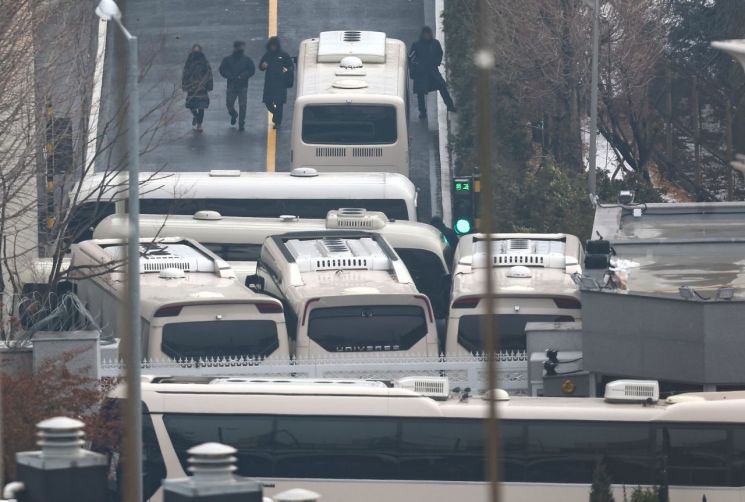 The entrance to the Presidential Residence in Yongsan-gu, Seoul, is blocked by buses. Photo by Yonhap News
HOCI and the police also had disagreements over the arrest of Park Jong-jun, head of the Presidential Security Service, during the first execution of the arrest warrant. At that time, the police attempted to arrest the head of the Presidential Security Service who blocked the arrest of President Yoon, but HOCI reportedly did not approve. Yoon Geon-young, a member of the Democratic Party of Korea, told reporters at the NIH on the previous day, "On the 3rd, a senior HOCI official implied that there were no plans to execute the warrant that day. We judge that HOCI had no real intention," and added, "The NIH said the first execution of the arrest warrant was possible. Initially, the security personnel were few and could have been subdued, but HOCI delayed."
If HOCI lacks the will to execute the arrest warrant, it is obvious that the failure of the first execution will be repeated. On the morning of the 3rd, around 8 a.m., HOCI began executing the arrest warrant with police support but was blocked by the Presidential Security Service and stopped the execution around 1:30 p.m. without securing President Yoon's custody. HOCI stated that they approached within 200 meters of the presidential residence but could not proceed due to a 'wall' formed by about 200 soldiers and Presidential Security Service personnel. The Security Service mobilized soldiers from the 55th Guard Unit of the Army Capital Defense Command and the 33rd Military Police Security Unit. A Special Investigation Unit official said, "We confirmed partial mobilization and congestion," and added, "Two units stationed near the presidential residence were involved."
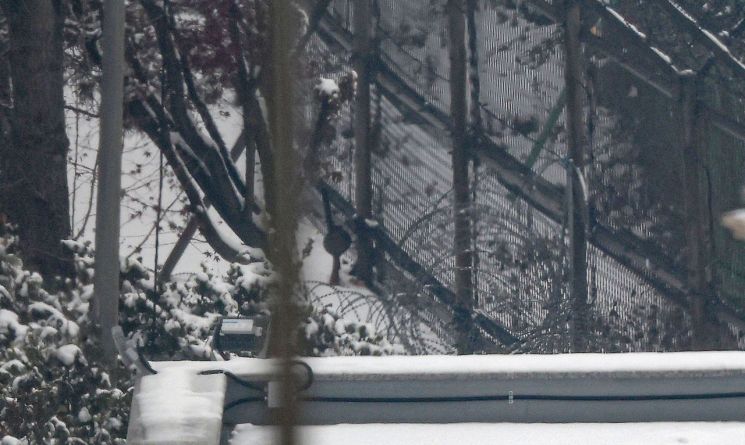 Barbed wire is installed at the entrance of the Presidential Residence in Yongsan-gu, Seoul. Photo by Yonhap News
Currently, the Presidential Security Service has set up multiple layers of barricades and installed barbed wire around the presidential residence. This is analyzed as a measure to compensate for the breach of the second line of defense by taking a detour along a mountain path beside the road during the previous Joint HQ arrest warrant execution. As the Security Service prepares for the second execution of the arrest warrant, physical confrontation appears inevitable. The Special Investigation Unit explained that they are "continuously reviewing" the Security Service's installation of circular barbed wire in the bushes outside the presidential residence.
The police stated that they have completed locating President Yoon and that conditions are sufficient for executing the arrest warrant. When asked whether they would make a citizen's arrest during the warrant execution, a Special Investigation Unit official said, "We are thinking along the lines of the question." Regarding the possible deployment of a special forces unit, they gave a general response, "We are reviewing possible measures."
© The Asia Business Daily(www.asiae.co.kr). All rights reserved.
![Clutching a Stolen Dior Bag, Saying "I Hate Being Poor but Real"... The Grotesque Con of a "Human Knockoff" [Slate]](https://cwcontent.asiae.co.kr/asiaresize/183/2026021902243444107_1771435474.jpg)













