Ahead of Trump Inauguration, Missile Launch... Closely Monitoring Additional Launches
On the 6th, North Korea launched a ballistic missile presumed to be a hypersonic missile into the East Sea. It is estimated to be a missile within range of the U.S. territory of Guam, where U.S. reinforcements would be deployed in case of emergency.
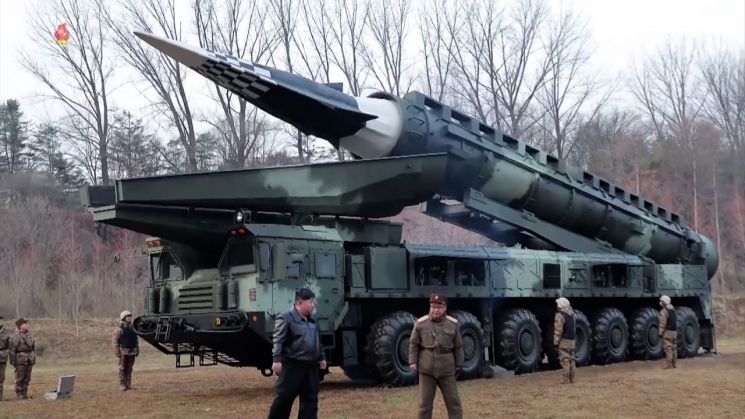
On the same day, the Joint Chiefs of Staff stated, "Around noon, one ballistic missile launched from the Pyongyang area into the East Sea was detected, and the missile flew about 1,100 km before landing in the East Sea."
Initially, this missile was assessed to be equipped with a medium-range engine (range 3,000?5,500 km), but the actual flight distance was shorter. There is a possibility that North Korea reduced the distance by adjusting the fuel amount, or that the hypersonic missile’s low-altitude flight characteristics prevented accurate detection. The missile is analyzed to be similar in form to the solid-fuel hypersonic missiles launched by North Korea in January and April last year, raising the possibility that North Korea has upgraded its performance. If it is indeed a hypersonic missile, the flight distance of about 1,100 km is the farthest among North Korea’s hypersonic missiles detected so far.
If the medium-range engine’s performance is fully utilized, the missile would be within range of Guam, a U.S. territory where reinforcements would be deployed in an emergency. North Korea may have adjusted the missile’s range by reducing it while demonstrating its capability to strike Guam, sending a warning to the Trump administration.
This is the first ballistic missile launch by North Korea in two months since the short-range ballistic missile (SRBM) launch on November 5 last year. After Donald Trump’s victory in the U.S. presidential election on November 6 last year, North Korea had not launched ballistic missiles but carried out this provocation two weeks before Trump’s inauguration scheduled for the 20th.
The Joint Chiefs of Staff said, "South Korean and U.S. intelligence agencies had detected and monitored preparations for the launch in advance," and that surveillance and vigilance have been strengthened in preparation for additional launches.
It is also reported that South Korean military authorities detected signs that North Korea is operating a transporter erector launcher (TEL) near the launch site, presumed to be used for intercontinental ballistic missile (ICBM) launches.
North Korea’s missile launch on this day occurred while the South Korea-U.S. foreign ministers’ talks were underway in Seoul, leading to analysis that it indirectly expressed dissatisfaction with the Biden administration’s North Korea policy. It was also a ballistic missile launch amid South Korea’s chaotic impeachment situation. There is speculation that North Korea may have wanted to check South Korea’s response posture amid the confusing situation where military command authority is shifting from President Yoon Suk-yeol to Acting President and Prime Minister Han Duck-soo, and then to Acting President and Deputy Prime Minister/Minister of Strategy and Finance Choi Sang-mok.
The Joint Chiefs of Staff stated, "Under the current security situation, the military maintains a robust ROK-U.S. combined defense posture to prevent any miscalculation by North Korea, closely monitoring various North Korean activities and maintaining the capability and readiness to overwhelmingly respond to any provocation."
© The Asia Business Daily(www.asiae.co.kr). All rights reserved.
![Clutching a Stolen Dior Bag, Saying "I Hate Being Poor but Real"... The Grotesque Con of a "Human Knockoff" [Slate]](https://cwcontent.asiae.co.kr/asiaresize/183/2026021902243444107_1771435474.jpg)
















