Uncertainty in Trump Administration's Second Term
Complex Effects of US Monetary Policy Variables
Net Treasury Purchases Down 31.9%
Net Corporate Bond Purchases Down 15.5%
Supplementary Budget Expected to Dilute 'Early-Year Effect'
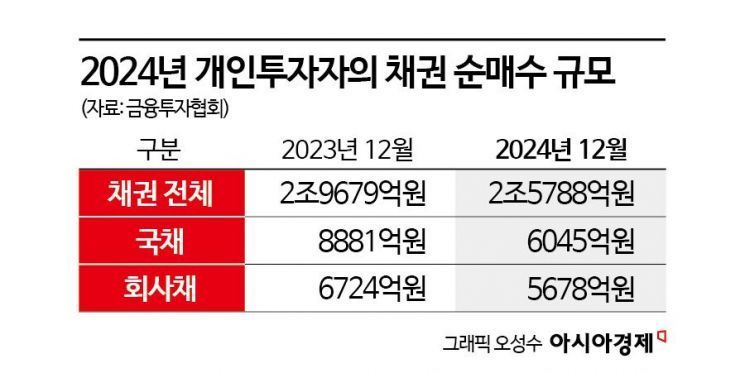
Due to the re-launch of the Donald Trump administration and the Federal Reserve's (Fed) adjustment in the pace of monetary policy, the net bond purchases by individuals in the bond market decreased by more than 10% in December last year. As this trend continues, it is analyzed that the 'beginning-of-year effect,' where net purchases temporarily increase in January, will be weak this year, and volatility is expected to expand.
According to the Korea Financial Investment Association on the 7th, the net bond purchases by individual investors in December 2024 amounted to 2.5788 trillion KRW. This is a 13.1% decrease compared to December 2023 (2.9679 trillion KRW). Among these, net purchases of government bonds in December 2024 were 604.5 billion KRW, which also dropped significantly by 31.9% compared to December 2023 (888.1 billion KRW). Net purchases of corporate bonds were 567.8 billion KRW in 2024, down 15.5% from the same period last year (672.4 billion KRW).
The decline in net government bond purchases in December last year is attributed to concerns over the re-launch of the Donald Trump administration and the variables in U.S. monetary policy. This sentiment is expected to be reflected in the bond market at the beginning of the year as well.

Domestically, the current situation shows sluggish domestic demand alongside weakening export momentum. In particular, amid ongoing concerns about the semiconductor industry's downturn, the strong protectionist trade policies of the second Trump administration are expected to negatively impact the recovery of domestic export momentum. Major industries such as steel, petrochemicals, and batteries are experiencing significant declines in profitability due to the industry downturn, leading to downgrades in corporate bond credit ratings. At the end of last year, rating outlook downgrades were mainly seen in the secondary battery sector and related companies.
Researcher Lee Kyung-rok from Shin Young Securities explained, "SK IE Technology, which operates in the lithium-ion battery separator business, saw a sharp decline in sales and recorded a large operating loss of 199.1 billion KRW due to reduced supply volume to SK On, resulting in a negative rating outlook downgrade." He added, "EcoPro BM and EcoPro also recorded operating losses amid a continued slowdown in the electric vehicle upstream industry, and their rating outlooks were downgraded based on working capital burdens from inventory accumulation and increased borrowings."
The outlook on monetary policy is also continuously shifting. Earlier, the Federal Open Market Committee (FOMC) slightly raised the estimated neutral interest rate from 2.9% to 3.0% in this year's dot plot. Based on this, the market analyzed that the Fed's rate-cutting stance would be slower than expected.
However, with the re-launch of the Trump administration, policy uncertainty is increasing, and inflation concerns are rising again, leading to a strong debate over the possibility of a rate cut at the January FOMC meeting.
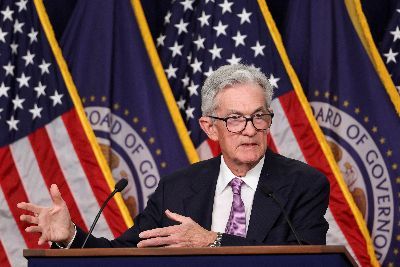
Researcher Baek Yoon-min from Kyobo Securities said, "Although the Fed is expected to keep the base interest rate unchanged at the January FOMC, considering the recent adjustments in monetary policy guidance, there is a high possibility that expectations for future monetary policy will be revised again." He added, "Despite the solid fundamentals of the U.S. and adjustments in expectations for Fed monetary policy, I still maintain the forecast of about one rate cut per quarter this year."
Researcher Baek also noted, "As mentioned in last year's annual outlook, this rate-cut cycle is not a response to a recession or economic contraction but a process of preparing for economic slowdown, so the expectation of gradual monetary easing remains valid."
Additionally, with the issue of supplementary budget execution overlapping, the bond market in January this year is expected to experience significantly increased volatility. In the corporate bond market, there is also an analysis that the 'beginning-of-year effect' will be weaker than usual due to the expansion of government bond issuance. The 'beginning-of-year effect' refers to the phenomenon where institutional investors increase their purchasing activity in the bond market in January as they deploy funds.
Researcher Baek stated, "From an investment strategy perspective, it is necessary to remain cautious about excessive concentration amid continued high volatility. However, since expectations for a downward stabilization of market interest rates remain valid, I maintain a recommendation to increase bond holdings."
© The Asia Business Daily(www.asiae.co.kr). All rights reserved.
![Clutching a Stolen Dior Bag, Saying "I Hate Being Poor but Real"... The Grotesque Con of a "Human Knockoff" [Slate]](https://cwcontent.asiae.co.kr/asiaresize/183/2026021902243444107_1771435474.jpg)


















