Semiconductor 'Super Eul' ASML and Others Recruit Aircraft Maintenance Technicians
Commonality in Handling Fine Processes... 'Cost-effective' Talent
Declining Popularity of Technicians... Concerns Over Scale and Quality of Aircraft Maintenance
"Need for Improved Treatment and Industry Development"
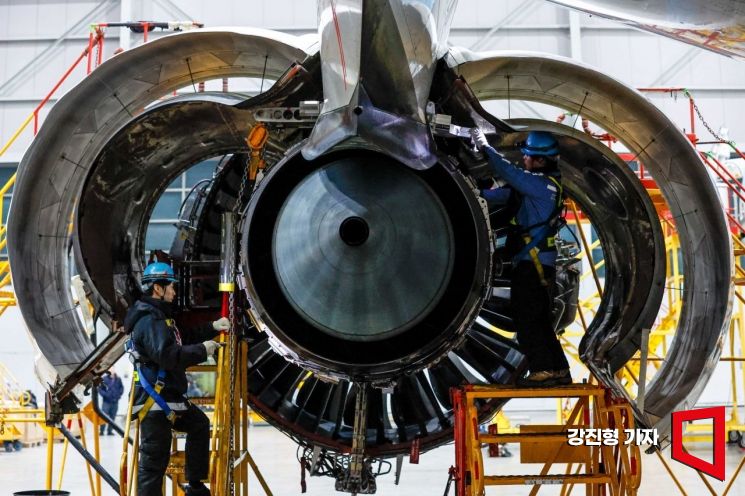
Aircraft maintenance technicians are reportedly leaving for the semiconductor equipment industry in search of better working conditions. Some aviation-related technologies are being applied in semiconductor processes, bringing attention to maintenance personnel. One of the causes of the Muan Jeju Airplane Disaster was identified as a shortage of maintenance personnel, and this issue is worsening as the AI-driven semiconductor boom continues to draw them away.
According to industry sources on the 6th, some maintenance technicians from domestic low-cost carriers (LCCs) have recently moved to the Dutch semiconductor equipment manufacturer ASML. An airline official revealed, "Three to four maintenance technicians with 3 to 5 years of experience have consecutively transferred," adding, "They doubled their salaries and improved working conditions, so there was no way to prevent their departure."
ASML is recognized as the world’s only manufacturer of extreme ultraviolet (EUV) lithography equipment and is considered a ‘super supplier’ in the semiconductor industry. ASML attracts aviation maintenance personnel because the maintenance logic is similar to semiconductor processes. A semiconductor equipment industry insider explained, "The gas and fluid piping inside the equipment is similar to that of aircraft, and since aviation maintenance technicians are accustomed to handling micro-processes, they are classified as ‘immediately deployable’."
The main target is line maintenance technicians with 3 to 5 years of experience. Their experience and skills are well balanced, and there is ample room for improved treatment, making mutual understanding easier.
The gap in treatment between aviation maintenance and the semiconductor equipment industry is already significant. According to the Ministry of Employment and Labor’s Worknet, the top 25% salary for aircraft maintenance technicians was 51.9 million KRW in 2021. ASML Korea’s starting salary for university graduates in 2023 was around 65 million KRW. It is known that from the second year, when shift work begins, salaries exceed 100 million KRW. A maintenance technician from an LCC who requested anonymity said, "The physical working environment, salary, and work-life balance are all better in the semiconductor industry," adding, "If given the opportunity, I would prefer to move to a semiconductor equipment company rather than a major airline."
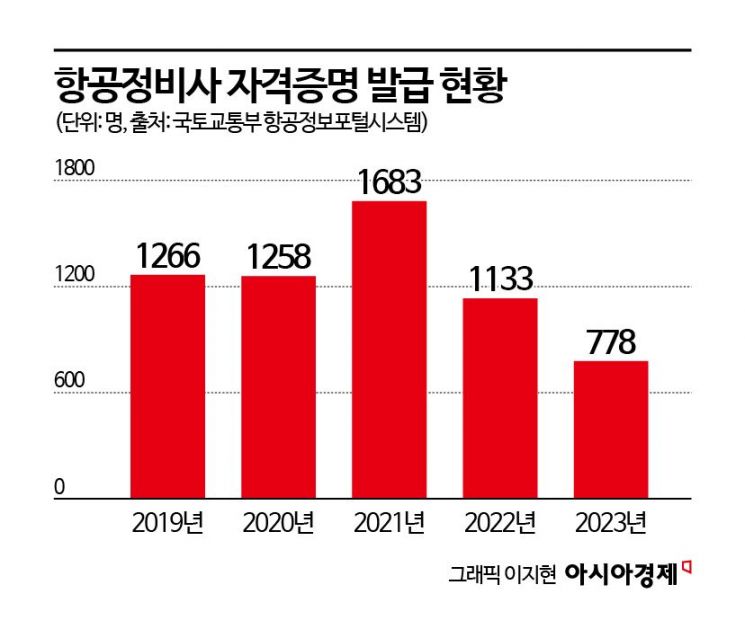
The number of aircraft maintenance personnel is gradually decreasing. While the outflow to semiconductor equipment companies is accelerating, the influx of new personnel is actually declining. According to the Ministry of Land, Infrastructure and Transport, the number of domestic aircraft maintenance technician certifications issued dropped from 1,683 in 2021 to 778 in 2023, less than half. Compared to 1,266 certifications in 2019 before COVID-19, this is a 38.6% decrease.
This also affects maintenance at LCCs such as Jeju Air. Most LCCs have not properly met the Ministry of Land, Infrastructure and Transport’s recommended standard of 12 maintenance personnel per aircraft. According to the Ministry’s Aviation Information Portal System, as of 2023, the average number of maintenance technicians per aircraft at five LCCs?Jeju Air, Jin Air, Air Busan, Eastar Jet, and T’way Air?was 10.94. Between 2016 and 2023, only Jeju Air and Eastar Jet met the Ministry’s recommended standard even once. However, since this is a recommendation rather than a mandate, the Ministry does not impose penalties.
Within the industry, there are calls for the government to foster the aircraft maintenance, repair, and overhaul (MRO) industry if individual airlines find it difficult to expand maintenance personnel. Currently, LCCs outsource 71.1% of medium maintenance tasks such as engine repairs overseas (as of 2023).
An aviation industry official stated, "Because competition in the industry is fierce and everyone is focused on cost reduction, the government must specify and rigorously supervise regulations on aircraft maintenance personnel," adding, "The government should nurture the MRO industry and provide quality jobs to encourage ‘competition for better treatment.’"
© The Asia Business Daily(www.asiae.co.kr). All rights reserved.
![Clutching a Stolen Dior Bag, Saying "I Hate Being Poor but Real"... The Grotesque Con of a "Human Knockoff" [Slate]](https://cwcontent.asiae.co.kr/asiaresize/183/2026021902243444107_1771435474.jpg)

















