Yoon: "Authority Dispute and Injunction Trials Must Proceed Swiftly"
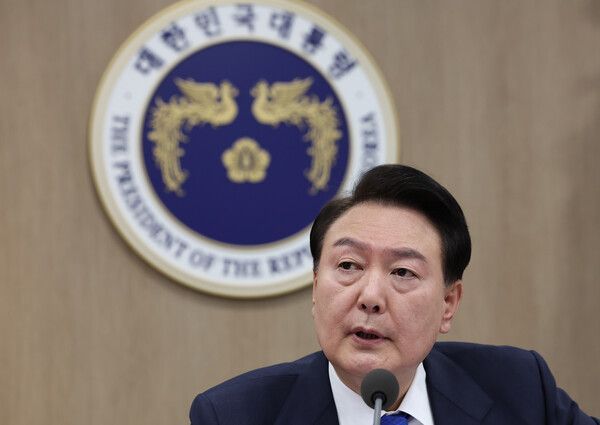
The office of President Yoon Seok-yeol stated, "The Constitutional Court has not even set a date for an important decision regarding the president's custody."
On the 6th, Yoon Gap-geun, a lawyer from President Yoon's legal team, said in a statement to reporters, "Despite filing a constitutional dispute trial and a provisional injunction application with the Constitutional Court, it is regrettable that the court, which emphasizes promptness in presidential impeachment trials, is showing an indifferent attitude."
Earlier, on December 31 of last year, President Yoon's legal team filed a constitutional dispute trial and provisional injunction application against the judge in charge of warrants at the Seoul Western District Court regarding the issuance of an arrest warrant.
The legal team's argument is that the court's issuance of the warrant infringed upon the president's exercise of the 'constitutional duty to protect the constitution' and the authority to exercise 'emergency powers' as the head of state. This is based on the premise that the December 3 emergency martial law is an act of governance by President Yoon and therefore cannot be subject to judicial review. Nevertheless, the judiciary's issuance of the arrest warrant is considered an infringement on the president's authority, making it subject to constitutional dispute trial and provisional injunction.
President Yoon's side argued, "In a situation where the arrest warrant has not been executed, disputing the unconstitutionality and invalidity of the arrest and search warrants at the Constitutional Court is the essential and fundamental solution to the problem." They added, "We strongly urge the Constitutional Court to promptly proceed with the constitutional dispute trial and the provisional injunction trial to suspend the warrant's effect."
However, a constitutional dispute trial is a system where the Constitutional Court is asked to make a judgment when there is a dispute over authority between state institutions. Usually, the president, as a state institution, has the right to file such a claim, but since this case involves the president as an individual subject to arrest, there are opinions that the Constitutional Court is unlikely to rule it as an 'infringement of authority.'
© The Asia Business Daily(www.asiae.co.kr). All rights reserved.

















