Netizens Criticize Rather Than Sympathize with Author's Complaint
A dog owner who left the apartment elevator without cleaning up their pet’s urine has shown an arrogant attitude, drawing criticism from netizens. On the 4th, an online community post titled "Isn't it possible for the security guard to clean up the dog’s pee in the elevator?" was uploaded. The author, Mr. A, said, "When I take my dog for a walk, I carry a 1.5ℓ plastic bottle filled with water and spray it outside when my dog pees. But if the dog pees in the elevator, I can’t spray water there. It would just make a bigger mess. Also, there’s no sunlight, so it doesn’t dry."
 A dog owner who left the apartment elevator without cleaning up their pet's urine has been criticized by netizens for showing an arrogant attitude. On the 4th, a post titled "Can't the security guard clean up the dog's urine in the elevator?" was uploaded to an online community. Photo is not related to the specific content of the article. Pixabay
Afterward, a notice saying "If your dog relieves itself, please clean up after them" was posted in the elevator of Mr. A’s apartment along with CCTV footage of the incident. Mr. A went to the management office and confronted them, saying, "Who gave permission to post my image? I’m the only one in the complex who owns a retriever. Doesn’t this identify me?" He reportedly had a heated argument with the management office staff. He lamented, "Common sense says I can’t clean up what my dog did in the elevator, and it’s the security guard’s job to do so. Every household pays 150,000 won in maintenance fees."
Netizens criticized Mr. A’s complaint instead. Comments included, "Why should the security guard clean up after your dog’s mess?", "Can’t you just bring tissue or wet wipes and clean it?", "Do you think security guards are hired to clean up after residents’ dogs?", and "If the owner doesn’t clean up, why should the security guard?"
Previously, in April 2020, following an incident in an apartment in Gangbuk-gu, Seoul, where a security guard was assaulted and harassed by residents and subsequently took their own life, the Apartment Management Act (also known as the Security Guard Abuse Prevention Act) was enacted. This law prohibits residents and management entities from giving security guards unfair orders beyond their duties in apartment complexes with over 300 households. However, more than four years after the law’s implementation, fundamental working conditions have not improved, leading to concerns about its effectiveness.
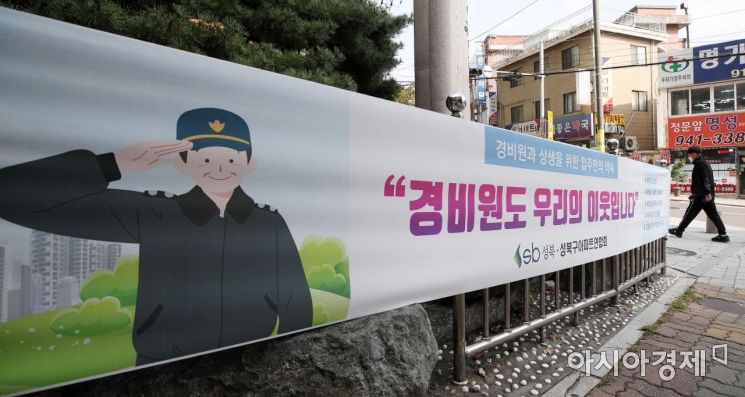 A banner containing a promise from residents to coexist with security guards is hung at an apartment in Seoul. The Ministry of Land, Infrastructure and Transport implemented an amendment to the Enforcement Decree of the Apartment Management Act, which clarifies the scope of duties for security guards in apartment complexes, starting around October 2022. Accordingly, residents of apartment complexes are not allowed to request security guards to provide services such as valet parking or delivery of packages to individual units. Photo by Hyunmin Kim kimhyun81@
According to a 2022 survey conducted by the Korea Association of Housing Managers targeting 413 housing managers nationwide (multiple responses allowed), 88% (363 respondents) reported experiencing unfair treatment. More than half, 256 (62%), had faced verbal abuse or violence from residents, and 70 (17%) had been unfairly dismissed. Consultations for apartment security workers’ rights filed with the Labor Rights Center increased from 428 cases in 2021 to 1,004 cases in 2022, a 134.5% rise compared to before the law was enacted.
The main cause of the ongoing poor working conditions is the unstable employment structure, where most security guards are indirectly employed on short-term contracts of around three months. Due to their advanced age, lack of alternative job opportunities, and limited understanding of related laws, they find it difficult to raise issues about harsh working conditions and unfair treatment. Additionally, apartment security guards are placed by subcontracted management companies or security service firms, making it difficult to assign responsibility for residents’ unfair treatment during work.
Furthermore, since the management office chief and security guards belong to different employers, workplace harassment under the Labor Standards Act does not apply. Small-scale apartments with fewer than 300 households are also exempt from the law, leaving security guards in a blind spot where they often do not even have written employment contracts and are burdened with various miscellaneous tasks such as repairs, parking management, and parcel delivery.
© The Asia Business Daily(www.asiae.co.kr). All rights reserved.
![Clutching a Stolen Dior Bag, Saying "I Hate Being Poor but Real"... The Grotesque Con of a "Human Knockoff" [Slate]](https://cwcontent.asiae.co.kr/asiaresize/183/2026021902243444107_1771435474.jpg)
















