Hankyung Association Analyzes Female Employment Indicators in 38 OECD Countries
Korean Women (Ages 15-64) Employment Rate at 61.4%
Female Labor Force Participation Rate Also 63.1%
Ranked 31st Among OECD
"Flexible Work Environment and Expanded Family Care Support Must Be Established"
Over the past 20 years, South Korea's female employment indicators (employment rate and economic activity participation rate) have remained in the lower ranks among OECD countries. It is argued that to expand women's participation in the labor market and increase employment levels, policies supporting the creation of flexible working environments and alleviation of family care burdens must be in place.

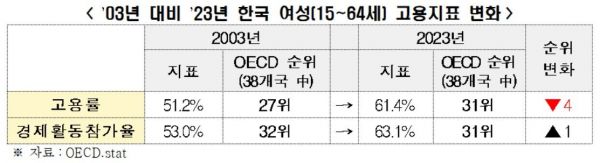
The Korea Economic Association (KEA) analyzed female (ages 15-64) employment indicators across 38 OECD countries and found that in 2023, South Korea's female employment rate and economic activity participation rate were 61.4% and 63.1%, respectively, ranking 31st out of 38 countries, placing it in the lower tier of the OECD.
Looking at the OECD rankings over the past 20 years (2003?2023), South Korea's female employment rate dropped four places from 27th in 2003 (51.2%) to 31st in 2023 (61.4%), remaining in the lower ranks (26th to 31st) throughout the period. During the same period, South Korea's female economic activity participation rate rose one place from 32nd in 2003 (53.0%) to 31st in 2023 (63.1%), but still remained in the lower tier, fluctuating between 31st and 35th place over the 20 years.
The employment rate of women with young children in South Korea was lower than that of major advanced countries with similar economic size and population. As of 2021, the employment rate of women with children under 15 in South Korea was 56.2%, the lowest among the seven countries in the 30-50 Club. This was 12.0 percentage points lower than the 30-50 Club average of 68.2%, revealing a significant gap compared to other advanced countries.
KEA stated, "In South Korea, the burden of childcare and household chores acts as a major factor hindering women's participation in economic activities," and advised, "To expand female employment to the level of advanced countries, policy efforts should focus on reducing the dual burden of work and family for women so they can actively participate in economic activities."
To identify characteristics of countries advanced in female employment, KEA compared the employment environments of South Korea and three countries in the 30-50 Club?Germany, Japan, and the United Kingdom?where female employment rates exceed 70%. The results showed that South Korea was lacking in two key areas compared to these three countries: the creation of flexible working environments and support for family care.
Germany, Japan, and the United Kingdom provide broader options for working hours, enabling a flexible working environment that allows balancing work and childcare. Regarding working hour options, South Korea regulates working hours on a weekly basis, limiting extended work hours to a maximum of 12 hours per week, whereas Germany, Japan, and the UK operate working hours flexibly on a monthly or longer basis. For flexible working hours systems, South Korea allows operation for up to six months, while Germany, Japan, and the UK permit up to one year, thus guaranteeing a wider range of working hour choices.
South Korea also showed lower policy support for child-rearing and family care compared to Germany, Japan, and the UK. As of 2020, South Korea's family policy expenditure as a percentage of GDP was 1.5%, lower than the average of 2.2% for Germany (2.4%), the UK (2.3%), and Japan (2.0%). Particularly, the proportion of cash benefits within family policy expenditure was only 0.5% in South Korea, about half of the 1.0% average of the three countries (Germany 1.0%, UK 1.3%, Japan 0.8%).
Looking at major care policy examples, Japan implemented the "Accelerated Plan to Resolve Waiting Children" in 2013 to expand childcare facilities and services for women who gave up employment due to difficulty finding childcare. As a result, the total number of childcare facilities and daycare centers increased from about 29,000 in 2015 to about 40,000 in 2023, and the number of children on waiting lists dropped significantly from about 23,000 in 2015 to about 3,000 in 2023.
The United Kingdom provides up to ?2,000 per year per eligible worker working more than 16 hours per week to help cover childcare costs for children under 11, aiming to prevent women from quitting jobs due to high childcare expenses. Additionally, children aged 3 to 4 from workers below certain income thresholds are entitled to 570 hours of free education annually.
In Germany, under the "Federal Financial Support Act for Expanding Childcare Facilities" enacted in 2007, children aged one and older have had a legal right to use daycare centers since 2013. If childcare services are unavailable due to facility shortages or other reasons, local governments must compensate the parents accordingly.
KEA explained, "Since the burden of child-rearing and family care in South Korea mainly falls on women, it is necessary to strengthen policies that reduce family care burdens, such as expanding childcare facilities and services and increasing support for care costs, to create an environment where women can actively participate in the labor market."
Lee Sang-ho, head of KEA's Economic and Industrial Headquarters, emphasized, "To raise female employment rates in South Korea to the level of advanced countries, maintaining and expanding jobs for women with children is especially important," adding, "Along with creating a working environment that allows balancing work and family through flexible working hours and expanding quality part-time jobs, strengthening family care support is essential to actively promote women's participation in economic activities."
© The Asia Business Daily(www.asiae.co.kr). All rights reserved.
![Clutching a Stolen Dior Bag, Saying "I Hate Being Poor but Real"... The Grotesque Con of a "Human Knockoff" [Slate]](https://cwcontent.asiae.co.kr/asiaresize/183/2026021902243444107_1771435474.jpg)
















