"YouTube Algorithm Pushes Believers Out to the Streets"
Foreign media attributed South Korea's political turmoil to "chronic political polarization" and "online agitation."
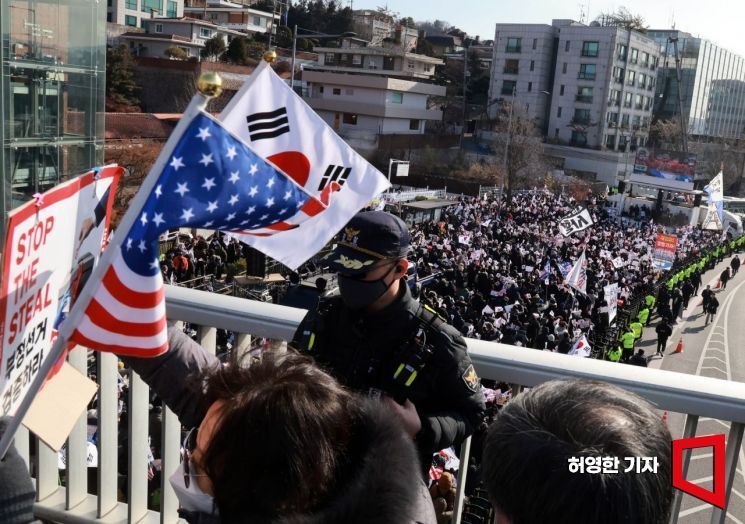 On the morning of the 3rd, as officials from the Corruption Investigation Office entered the presidential residence in Hannam-dong, Seoul, to execute an arrest warrant for President Yoon Seok-yeol, supporters of President Yoon gathered on the road near the residence in Hannam-dong to hold an anti-impeachment rally. Photo by Heo Young-han
On the 4th (local time), The New York Times (NYT) published an analysis article titled "How Fear and Conspiracy Theories Fuel South Korea's Political Crisis," pointing out, "If former U.S. President Donald Trump has 'MAGA' (Make America Great Again) behind him, President Yoon Suk-yeol has the 'Taegukgi Unit'." The foreign media explained, "For them, protecting President Yoon is synonymous with defending South Korea from 'pro-North Korea sympathizers' deeply rooted throughout society."
The NYT criticized President Yoon and right-wing YouTubers for claiming that South Korea's election results can no longer be trusted, noting that Yoon deployed soldiers to the National Election Commission to investigate allegations of election fraud during the declaration of martial law. It added, "Generally, South Koreans regard such conspiracy theories as mere online agitation spread by right-wing YouTubers, but amid deep political polarization, these YouTubers have fueled confusion surrounding President Yoon's situation, driving fervent supporters into the streets."
Foreign media highlighted the significant similarity between the claims made by President Yoon and his supporters and the conspiracy theories of far-right YouTubers. YouTube has been criticized for adopting algorithms that show users more of the information they prefer, leading to 'confirmation bias,' where users believe only what they want to believe. This is interpreted as South Korean politics falling into such a trap, escalating to polarization at both extremes. Furthermore, the NYT cited a 2022 survey conducted by the Korea Press Foundation, stating that in South Korea, over 53% of the population consumes news via YouTube, nearly double the global average of 30% across 46 countries.
AFP also pointed out that supporters of President Yoon, camped out in front of the presidential residence in Hannam-dong, are echoing "vague conspiracy theories," and despite the National Assembly impeaching President Yoon, a small group, stimulated by YouTubers' remarks, has stepped forward to protect him. The Sunday Times, the Sunday edition of the UK’s The Times, explained in an analysis article titled "Why Real Life in South Korea Has Become Stranger Than Fiction" that South Korean society has been torn by long-standing divisions, and all national wounds have now been publicly exposed.
Raphael Rashid, a British freelance journalist who has lived in Seoul for 13 years, wrote in this article, "This country has skillfully presented itself to the world through K-pop, award-winning films, and popular Netflix series like 'Squid Game' and 'All of Us Are Dead,' but beneath the glittering surface, old wounds and new crises are tearing society apart." He evaluated, "Outside the presidential residence in Seoul, such intense divisions occur daily. The six-hour standoff last Friday, which ended without President Yoon's arrest, reminded us how uncertain South Korea's future still is."
© The Asia Business Daily(www.asiae.co.kr). All rights reserved.
![Clutching a Stolen Dior Bag, Saying "I Hate Being Poor but Real"... The Grotesque Con of a "Human Knockoff" [Slate]](https://cwcontent.asiae.co.kr/asiaresize/183/2026021902243444107_1771435474.jpg)















