Ordinary Soldiers May Face Charges for Obstruction of Official Duties
Ministry of National Defense: "Under Security Office Jurisdiction... Cannot Confirm Precisely"
Soldiers enlisted to fulfill their military service obligations were mobilized not only during the '12·3 Emergency Martial Law' charged with insurrection but also to block the arrest warrant against President Yoon Suk-yeol. As a result, concerns have been raised that these soldiers may face punishment for charges such as obstruction of official duties.
The 55th Guard Unit of the Army Capital Defense Command blocked prosecutors and investigators from the High-ranking Officials' Crime Investigation Office (HOCI) who visited the Hannam-dong presidential residence on the morning of the 3rd to execute President Yoon's arrest warrant. The 55th Guard Unit is a security unit responsible for the outer perimeter protection of the presidential residence, and it is known that many regular soldiers belonging to the 55th Guard Unit were mobilized to prevent HOCI's entry. Although these soldiers are dispatched from the Presidential Security Service, their command and supervision require cooperation from the Ministry of National Defense, the Joint Chiefs of Staff, and the Capital Defense Command.
HOCI investigators confronted the 55th Guard Unit for some time, then broke through the blockade and entered, only to face the Presidential Security Service inside the residence, leading to another standoff. Ultimately, they judged that executing the arrest warrant was impossible and withdrew. Previously, HOCI had repeatedly warned that if the execution of the arrest warrant was blocked by barricades or other means, those involved could be arrested or punished under laws such as special obstruction of official duties. Because of this, there are predictions that regular soldiers, acting under their commanders' orders, might face criminal liability. Families of soldiers belonging to the Capital Defense Command have expressed concerns, saying, “We worry whether they might face legal punishment for obstructing official duties while following orders from superiors,” and “It is uncertain whether the characteristic that ordinary soldiers cannot disobey orders will be taken into consideration.”
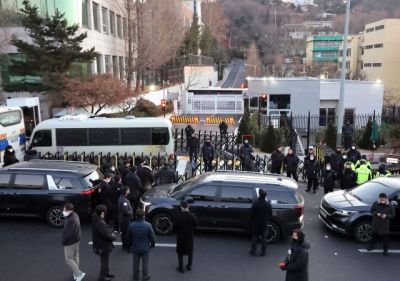 Vehicles carrying investigators from the High-ranking Officials' Crime Investigation Division, who have been dispatched to execute an arrest warrant for President Yoon Suk-yeol, arrived and are waiting at the entrance of the presidential residence in Hannam-dong, Yongsan-gu, Seoul on the 3rd. Photo by Yonhap News
However, the Ministry of National Defense stated that the deployment of military personnel to block the execution of President Yoon's arrest warrant was not a mission carried out under the military command chain but falls under the jurisdiction of the Presidential Security Service. The 55th Guard Unit is assigned to the Security Service according to the Presidential Security Act, and the command and control authority lies with the Security Service. A Ministry of National Defense official told reporters, “The military personnel (55th Guard Unit) supporting the outer perimeter security of the residence are controlled by the Security Service,” and added, “The Ministry of National Defense cannot confirm the exact situation.”
Despite the clash between military personnel and HOCI being anticipated since the issuance of President Yoon's arrest warrant on the 31st of last month, criticism has arisen that the Ministry of National Defense took no action. In fact, the police, who engaged in physical confrontations with some military personnel, have stated that they will decide on filing charges later based on evidence collected. Regarding the criticism that soldiers on mandatory service were deployed in acts that could lead to criminal punishment, a Ministry of National Defense official said, “We need to verify the evidence to determine whether they were deployed in illegal situations,” and “The Ministry of National Defense is not clearly aware of what happened on the ground today.”
During the '12·3 Emergency Martial Law,' many regular soldiers on mandatory service were also deployed as martial law troops. The Capital Defense Command deployed a total of 61 soldiers as martial law troops, including 42 from the Military Police Battalion and 19 from the 1st Guard Unit, to block the National Assembly. The Special Forces also deployed personnel to the National Assembly and the National Election Commission, mobilizing soldiers as support personnel such as drivers. When the faces and identities of the martial law troops deployed at that time were exposed, voices calling for their punishment emerged, and the martial law troops themselves and their families expressed grievances, emphasizing the need to consider the characteristics of the military organization.
However, there is also a view that the likelihood of soldiers or junior military officers mobilized during the emergency martial law being punished for charges such as insurrection is low. On the 15th of last month, Lee Jae-myung, leader of the Democratic Party of Korea, said at a press conference, “Except for high-ranking commanders who bear actual responsibility, I believe that most lower-ranking commanders and soldiers who did not actively participate should not be held accountable but rather be rewarded according to their degree of contribution.”
© The Asia Business Daily(www.asiae.co.kr). All rights reserved.
![Clutching a Stolen Dior Bag, Saying "I Hate Being Poor but Real"... The Grotesque Con of a "Human Knockoff" [Slate]](https://cwcontent.asiae.co.kr/asiaresize/183/2026021902243444107_1771435474.jpg)
















