Korea Railroad Corporation (hereinafter KORAIL) has successfully completed a pilot project for international multimodal transport. As a result of confirming the business feasibility of international multimodal transport, KORAIL plans to continuously expand related businesses. International multimodal transport is a logistics method that connects multiple modes of transportation such as rail, ship, and truck to transport cargo to other countries.
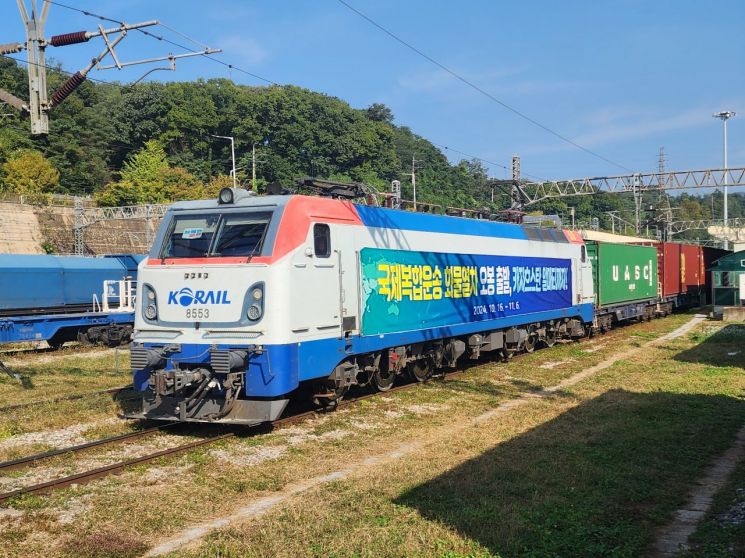 A freight train involved in the international multimodal transport business is departing from Obong Station carrying containers. Provided by Korea Railroad Corporation
According to KORAIL on the 3rd, the pilot project was conducted from June to December last year, operating export cargo trains a total of four times along the main route of Obong Station~Busan Port~Lianyungang, China~Kazakhstan~Uzbekistan.
The trains transported cargo on the following schedules: ▲June 13 to July 14 (1st round) Obong Station~Busan Port~Lianyungang~Almaty~Tashkent~Fuzhan (7,123 km) ▲October 16 to November 3 (2nd round) Obong Station~Busan Port~Lianyungang~Almaty (6,044 km) ▲November 12 to December 4 (3rd round) Obong Station~Busan Port~Lianyungang~Tashkent (7,010 km) ▲December 10 to December 29 (4th round) Obong Station~Busan Port~Lianyungang~Almaty (6,044 km).
Through the pilot project, KORAIL optimized the process of transferring cargo from ship to rail and from rail to rail while crossing Chinese ports and inland borders, minimizing costs such as cargo storage fees that occurred in the existing transportation process. This enhanced efficiency by leveraging the advantages of multimodal transport.
Based on the benefits (business feasibility) confirmed in the pilot project, KORAIL plans to expand the international multimodal transport business in the future.
First, the international multimodal transport product will be named ‘KORAIL International Cargo Express,’ and promotion will be strengthened focusing on export companies by emphasizing time value and price competitiveness.
Additionally, through cooperation with China State Railway Group Co., Ltd. (CR), KORAIL plans to continuously increase the number of dedicated train operations. CR is a state-owned enterprise responsible for the operation and maintenance of Chinese railways and operates the China route (TCR) of the Eurasian Transcontinental Railway.
CR’s railway operating distance reaches 159,000 km, including 45,000 km of high-speed rail, with daily operations of over 9,000 passenger trains and more than 20,000 freight trains. Its transport capacity exceeds 10 million passengers and 10 million tons of cargo per day.
In particular, as Korea’s representative railway operator, KORAIL envisions securing regular train quotas stably and resolving congestion at Chinese ports once the ratification of the ‘International Rail Transport Organization (OSJD) Multimodal Transport Agreement’ is completed.
The main routes envisioned by KORAIL for the international multimodal transport business are the 6,044 km section from Obong Station via Busan Port and Lianyungang, China, to Almaty, Kazakhstan, and the 7,010 km section from Obong Station via Busan Port and Lianyungang to Tashkent, Uzbekistan.
Earlier, on June 25 last year, KORAIL signed a memorandum of understanding with CR to establish a strategic partnership to strengthen Eurasian freight transport cooperation. Based on this, KORAIL began its first operation and has transported a total of 215 containers (40 feet) carrying semi-assembled parts for local automobile factories in Central Asia and electronic products.
A local official from the Uzbekistan railway company expressed confidence that "the successful completion of the pilot project with KORAIL will further strengthen trade and cooperation between the two countries," showing a willingness for continued collaboration.
Also, a representative from a domestic logistics company that used the transport service during the pilot project stated, "The pilot project resolved congestion at Chinese ports and significantly increased reliability for transporting export cargo volumes to Central Asia based on fast transport and price competitiveness."
Han Moon-hee, President of KORAIL, said, “By significantly reducing transport time and logistics costs through international multimodal transport, we will strive to establish an efficient logistics network connecting Central Asia and Europe,” adding, “Through this, we will strengthen the competitiveness of domestic logistics companies and spare no effort to support increasing opportunities for companies to secure overseas markets.”
© The Asia Business Daily(www.asiae.co.kr). All rights reserved.
![Clutching a Stolen Dior Bag, Saying "I Hate Being Poor but Real"... The Grotesque Con of a "Human Knockoff" [Slate]](https://cwcontent.asiae.co.kr/asiaresize/183/2026021902243444107_1771435474.jpg)















