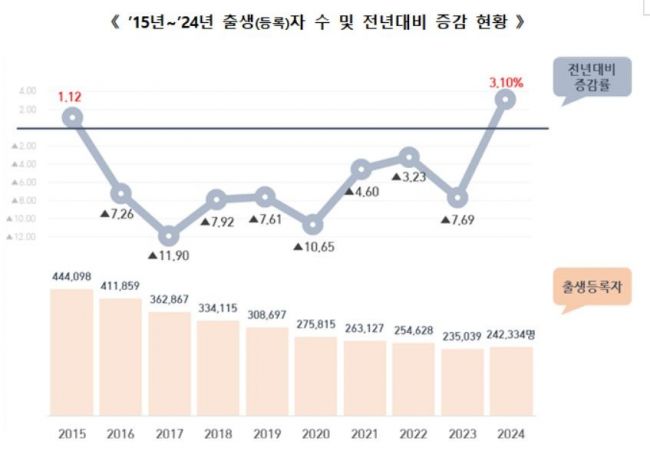
Birth Registrations Total 242,334...3.10% Increase
The number of registered births last year increased for the first time in nine years. While the population of children and working-age individuals declined, the trend of an increasing elderly population aged 65 and over was maintained.
The Ministry of the Interior and Safety announced on the 3rd that, according to the 2024 resident registration population statistics analysis, the number of registered births in South Korea was 242,334, an increase of 7,295 from the previous year. The number of registered births had decreased for eight consecutive years since 2016 but rose by 3.10% last year. The number of registered male births was 123,923, exceeding female births at 118,411.
The resident registration population has been declining for five consecutive years since 2020. It was recorded as 51,325,329 in 2023 and 51,217,221 last year. By gender, females numbered 25,718,897, about 220,000 more than males (25,498,324), widening the gender population gap since females surpassed males in 2015.
The average age of the resident registration population was 45.3 years, with males at 44.2 years and females at 46.5 years.
While the number of births increased, the aging trend continued. The population in their 60s surpassed those in their 40s, and those aged 70 and above exceeded the population in their 30s. By age group, the resident registration population proportions were highest in their 50s at 8,706,370 (17.00%), followed by those in their 60s (15.27%), 40s (15.08%), 70 and above (12.94%), 30s (12.93%), 20s (11.63%), teens (9.02%), and under 10 (6.13%).
While the child and working-age populations decreased, the elderly population aged 65 and over increased. The population aged 0-14 was 5,464,421, a 3.52% decrease compared to 2023. The working-age population aged 15-64 was 35,496,018, down 1.21%. The elderly population aged 65 and over was 10,256,782, up 5.41% during the same period. The proportion of those aged 65 and over in the total resident registration population exceeded 20%, reaching 20.03%.

The population gap between the Seoul metropolitan area and non-metropolitan areas widened. The population residing in the metropolitan area was 26,047,523 last year, accounting for 50.86% of the total population. The non-metropolitan population was 25,169,898 (49.14%). Compared to the previous year, the metropolitan population increased by 0.13%, while the non-metropolitan population decreased by 0.56%, widening the population gap to 877,825.
Compared to 2023, the number of local governments with population increases was four metropolitan and 54 basic local governments. Population increased in the order of Gyeonggi, Incheon, Chungnam, and Sejong, while 13 other areas saw population declines. Among cities, counties, and districts, Hwaseong City in Gyeonggi showed the largest increase with 24,479 people, and population increased in 54 areas including Yangju City in Gyeonggi, Gangdong-gu in Seoul, Paju City in Gyeonggi, and Gangnam-gu in Seoul.
Notably, among 89 population decline areas, population increased in Yesan-gun in Chungnam, Ganghwa-gun in Incheon, Yeonggwang-gun in Jeonnam, Gapyeong-gun in Gyeonggi, Andong-si in Gyeongbuk, Sinan-gun in Jeonnam, Sunchang-gun in Jeonbuk, and Ulleung-gun in Gyeongbuk.
Kim Min-jae, Deputy Minister of the Ministry of the Interior and Safety, said, "Although South Korea's population has declined for five consecutive years, the number of registered births increased for the first time in nine years, showing signs of positive change. To continue this trend of reversing the number of births, it is necessary for related ministries to collaborate to improve the child-rearing environment and continuously prepare multifaceted support measures."
© The Asia Business Daily(www.asiae.co.kr). All rights reserved.
![Clutching a Stolen Dior Bag, Saying "I Hate Being Poor but Real"... The Grotesque Con of a "Human Knockoff" [Slate]](https://cwcontent.asiae.co.kr/asiaresize/183/2026021902243444107_1771435474.jpg)
















