Price Increases on Chocolate Snacks, Nuts, and Carbonated Drinks
The prices of chocolate snacks, nuts, and other products sold at convenience stores in South Korea have increased starting from the new year. This is interpreted as joining the wave of price hikes due to the sharp rise in the prices of raw materials such as cocoa.
According to the distribution industry on the 3rd, the prices of some products sold at domestic convenience stores were raised from the 1st of this month. The main products include snacks containing chocolate, nuts, carbonated drinks, and hangover relief products.
 The prices of chocolate snacks and nut products sold at convenience stores in Korea have increased starting from the new year. Among the major products with decided price hikes, the increase in prices of chocolate-containing products appears to be due to the sharp rise in raw material costs such as cocoa and palm oil. Photo by Getty Images
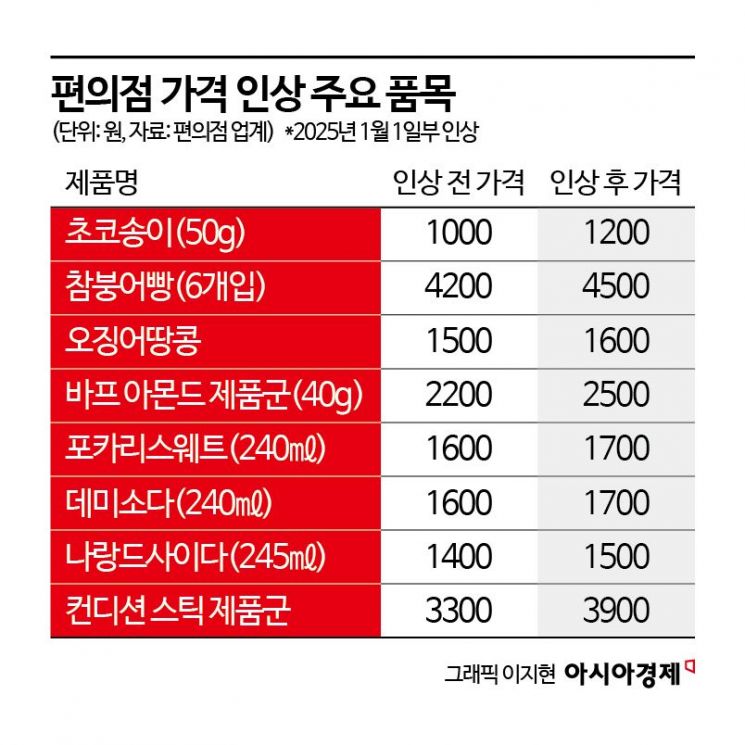
Looking specifically at the items with price increases, the price hike of Orion’s snacks using chocolate as a raw material stands out. Choco Song-i (50g) rose from 1,000 won to 1,200 won, an increase of 200 won, and Cham Bungeoppang (6 pieces) went up from 4,200 won to 4,500 won, a 300 won increase. Tokping (Almond & Granola, Hazelnut & Granola) increased from 1,500 won to 1,600 won, and Protein Bar Pro (70g) rose from 2,500 won to 2,700 won.
The prices of products using nuts also rose uniformly. Orion’s Squid Peanut (98g) increased from 1,500 won to 1,600 won, and Muggabon’s Honey Peanut (70g) was raised from 1,900 won to 2,000 won. BAP’s almond products also increased by 300 won, from 2,200 won to 2,500 won for the 40g product.
Carbonated drinks and ion beverages also joined the price hike trend. The prices of Pocari Sweat (240ml) and Demi Soda (250ml) canned products rose from 1,600 won to 1,700 won, and Narang Cider (245ml) also increased from 1,400 won to 1,500 won. Vitamin drink Confidence (230ml) was adjusted from 1,800 won to 2,000 won, and Cheonjigaebyeok Hallabong Sparkling (355ml) rose from 1,500 won to 1,600 won.
In addition, HK Innoen’s hangover relief product Condition stick series increased from 3,300 won to 3,900 won, and the prices of 17 types of Energizer batteries were raised by 100 to 500 won depending on the product.
The price increase of chocolate-containing products among the major products decided this time appears to be due to the sharp rise in raw material prices such as cocoa and palm oil. According to the Food Industry Statistics Information, the average price of cocoa futures (delivery in March 2025) last month was $10,906 (about 16 million won). This is a 153.8% surge compared to the average price of $4,298 (about 6.3 million won) in December of the previous year. Cocoa is a major ingredient used in chocolate products.
The sharp rise in cocoa prices is due to a decrease in production volume at the producing regions. Cocoa-producing areas, mainly located in West Africa such as Ghana, have seen reduced output since early this year due to pests and abnormal weather conditions. As raw material prices continued to rise, food manufacturers announced product price increases citing the price hikes of chocolate and palm oil, and major large supermarkets have already applied the increased prices since last month.
Furthermore, the depreciation of the Korean won and the rapid rise in exchange rates are expected to act as additional pressure for further price increases. The higher the exchange rate, the greater the cost of importing raw materials. The won-dollar exchange rate briefly reached the 1,480 won level last month amid ongoing domestic political instability. This is the first time the exchange rate has hit the 1,480 won level since the global financial crisis in March 2009.
© The Asia Business Daily(www.asiae.co.kr). All rights reserved.


















