Incheon City has finalized its basic urban plan prioritizing balanced development between the old downtown and new towns. The city announced on the 3rd that it confirmed and publicized the '2040 Incheon Basic Urban Plan Amendment' on December 31 of last year.
The amended plan reflects related laws such as the higher-level '2040 Metropolitan Area Urban Plan,' the recently enacted 'Old Planned City Maintenance Act,' and the 'Railroad Undergrounding Special Act.' The planned population for Incheon remains unchanged at 3.3 million, and the city's future vision is set as "Incheon, a global city good to live anywhere."
To achieve balanced development between the old downtown and new towns, the city will introduce a Timing Zoning system that determines land use zones after specific building plans are prepared for reclaimed land on the urban outskirts. Applying this, the commercial land at Bukseong Port will be converted into preservation land to create a waterfront space where citizens can visit and enjoy anytime.
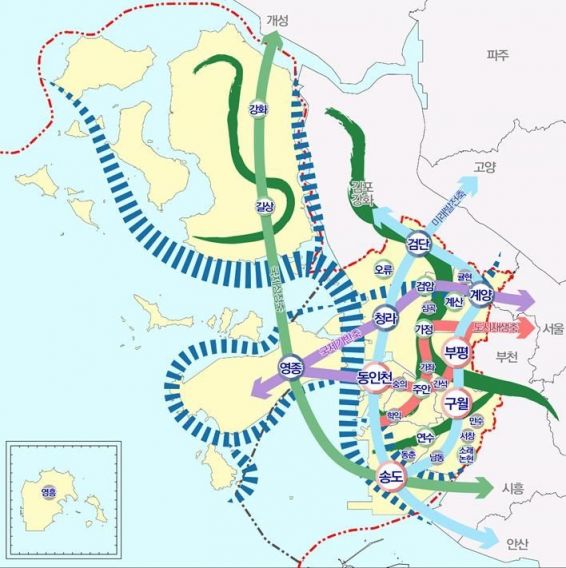 Incheon Urban Basic Plan: Spatial Structure of 4 Downtowns, 4 Sub-Downtowns, and 9 Regional Centers. Provided by Incheon City
Concrete efforts to realize carbon neutrality have also been incorporated. Considering that 57.1% of Incheon’s carbon emissions come from the power generation sector, the city plans to adjust the site of the Yeongheung Thermal Power Plant and systematically promote development to specify the 2045 Incheon Carbon Neutrality Strategy.
Additionally, in preparation for the administrative district reorganization scheduled for July next year, new administrative organizations will be established in Yeongjongdo, Jung-gu, and Geomdan area, Seo-gu, and a Floating Zoning system will be introduced to flexibly apply infrastructure construction and development projects.
The amended 2040 Incheon Basic Urban Plan was drafted using artificial intelligence-based large language models (LLM) and deep learning technology for the first time in Korea. The language model technology contributed to enhancing consistency among various plans such as environment, transportation, land use, parks and green spaces, and disaster prevention, and is recognized as an innovative approach combining human creativity and data.
Moreover, this plan incorporates the United Nations (UN) Habitat sustainability indicators to enable Incheon to establish itself as a sustainable city with international competitiveness. Through this, Incheon aims to lead sustainability, a global trend in urban growth, and leap forward as a city meeting global standards.
Lee Cheol, Director of Incheon City Urban Planning Bureau, said, "While the existing basic urban plan focused on land use and population plans, the 2040 Incheon Basic Urban Plan emphasizes improving citizens’ quality of life across Incheon and strengthening international competitiveness."
© The Asia Business Daily(www.asiae.co.kr). All rights reserved.
![Clutching a Stolen Dior Bag, Saying "I Hate Being Poor but Real"... The Grotesque Con of a "Human Knockoff" [Slate]](https://cwcontent.asiae.co.kr/asiaresize/183/2026021902243444107_1771435474.jpg)















